Showing posts with label Texas. Show all posts

Wednesday, July 2, 2025

The New State of Chilaquiles in Austin, Texas
(or, what a long, strange trip it's been).

150+ plates of chilaquiles in Austin, Texas. © Ryan Schierling
As a lot of you know, we've been on a epic, epicurean quest – a grand gustatory gamble with breaking the fast deep in the heart of Texas.

We've been scouring Austin for the very best chilaquiles it has to offer. We've torn apart the town, top to bottom, for almost fifteen years sampling both highbrow and humble versions of this traditional Mexican dish. 

There are no shortage of restaurants offering up their take on what shouldn't really be more than crisp fresh-fried tortilla chips (totopos) simmered with a red or green sauce until just slightly softened, crowned with a pair of properly-cooked eggs. With such a simple preparation, you'd think it would be difficult to screw up this classic.

We weren't looking for haute cuisine a la Mexicana, we just wanted an honest, reliable, simple Sunday morning comfort-food breakfast at a joint where everyone might eventually know us (and our broken Spanish).

There were standouts, certainly, but just as often there were store-bought chips, soggy and swimming in sub-par sauces, eggs that were under-cooked, over-cooked or not even offered as an option. There were some surprises, and there were some disappointments. 

There were also some stunningly brilliant breakfasts. 

If a restaurant presented only one salsa option for chilaquiles, Julie and I would typically order the same dish. If a restaurant had both verdes (green) and rojos (red), we'd order one of each. The majority of the time, we'd order eggs over-easy. If we knew the eggs were hopefully going to be happy eggs (see $14-plus chilaquiles), I'd go for sunny-side-up. Beans, potatoes and accoutrements (if available) were taken into consideration, as was the coffee or aguas frescas. The overall experience was key, but really, it all came down to the chilaquiles. 

After eating 150-plus different restaurant and food truck plates of chilaquiles, I can say we've done our due diligence, and now, we humbly present to you establishments that Julie and I both agreed have the finest chilaquiles in Austin. These are our favorites, the places we return to time and time again. 

These chilaquiles are Austin's best of the best. 

Wednesday, March 2, 2016

The 'New' State of Chilaquiles in Austin, Texas.

100 plates of chilaquiles. © Ryan Schierling
(FGHD editor's note: Originally updated March 2016 for the AFBA City Guide with 100 plates of chilaquiles.)

As a lot of you know, we've been on a epic, epicurean quest – a grand gustatory gamble with breaking the fast deep in the heart of Texas.

We've been scouring Austin for the very best chilaquiles it has to offer. We've torn apart the town, top to bottom, for more than two years sampling both highbrow and humble versions of this traditional Mexican dish. 

There are no shortage of restaurants offering up their take on what shouldn't really be more than crisp fresh-fried tortilla chips (totopos) simmered with a red or green sauce until just slightly softened, crowned with a pair of properly-cooked eggs. With such a simple preparation, you'd think it would be difficult to screw up this classic.

We weren't looking for haute cuisine a la Mexicana, we just wanted an honest, reliable, simple Sunday morning comfort-food breakfast at a joint where everyone might eventually know us (and our broken Spanish).

There were standouts, certainly, but just as often there were store-bought chips, soggy and swimming in sub-par sauces, eggs that were under-cooked, over-cooked or not even offered as an option. There were some surprises, and there were some disappointments. 

There were also some stunningly brilliant breakfasts. 

If a restaurant presented only one sauce option for chilaquiles, Julie and I would typically order the same dish. If a restaurant had both verdes (green) and rojos (red), we'd order one of each. The majority of the time, we'd order eggs over-easy. If we knew the eggs were going to be happy eggs (see $9 chilaquiles), I'd go for sunny-side-up. Beans, potatoes and accoutrements (if available) were taken into consideration, as was the coffee or aguas frescas. The overall experience was key, but really, it all came down to the chilaquiles. 

After eating 100 different plates of chilaquiles, we've done our due diligence, and now, we humbly present to you ten establishments that Julie and I both agreed have the finest chilaquiles in Austin. These are our favorites, the places we return to time and time again. 

These chilaquiles are the best of the best. 

Sunday, January 3, 2016

All hail klobasniky!

Pan sausage, American cheese and jalapeño klobasnek. © Ryan Schierling

There are a few hearty breakfast handfuls that I've come to rely on that just don't exist outside of Texas. Living in Seattle, I never saw a breakfast taco. There were such curiosities as breakfast burritos, but they occupied a space that was an afterthought to most carriers of A.M. comestibles. The closest you could come to a klobasnek is a piroshky, and while delicious any time of day, none were dedicated to breaking the fast. The latter – klobasnek, klobasnik, kolache if you don't know any better – are a Czech savory morsel with the same slightly-sweet dough used for kolaches. Klobasnek filling is usually a little oblong sausage like a pig in a blanket, but Texans have taken to putting all sorts of things inside that luxurious, pillowy dough. My favorite is a piece of pan sausage (breakfast sausage), pickled jalapeño and a nice melty American cheese, which is a klobasnek that's not too hard to find at kolache shops in Austin.

But a beef summer sausage, Swiss cheese and sauerkraut klobasnek? I had to make this combination myself, and recipe testing was not a problem. I think I ate three dozen over the course of a week before I was satisfied with the end result. Hell, I was satisfied with the first round, I just had to keep making them because they're irresistible.

Sunday, December 13, 2015

TGICFS.

Chicken-fried steak and eggs at Cypress Grill. © Ryan Schierling
I'm still lamenting the closure of Arkie's Grill, because dollars to dunkers, that was the best chicken-fried steak and eggs in Austin. I've kind of given up on the breakfast CFS here, since no one really does it. Chicken-fried steak is always on proper Southern lunch and dinner menus, with fries or mashed potatoes and 40 other side dish options.

I want it in the A.M., damnit, with fried eggs, crispy hash browns, Texas toast, some badass cream gravy and a stiff cup of black coffee. That's it. This breakfast is Texas birthright.

Cypress Grill does it absolutely right. A pounded-out, tender cube steak, properly hand-battered and fried, topped with andouille sausage gravy, with a pair of perfectly-cooked eggs and a little wedge of buttered toast to sop up leftover gravy and egg yolk. If they had hash browns instead of home fries, we could have had a brunch love affair, and I would have ordered plate after plate until they kicked me out.

Bonus points for their infused Bloody Mary, which is the second best I've had in the city, just behind Cafe Malta's Bloody Hell.

Now, here's your obligatory TGICFS haiku:

A New Orleans brunch
Adept, tender kitchen hands
Soothe my quondam wounds.

Wednesday, November 4, 2015

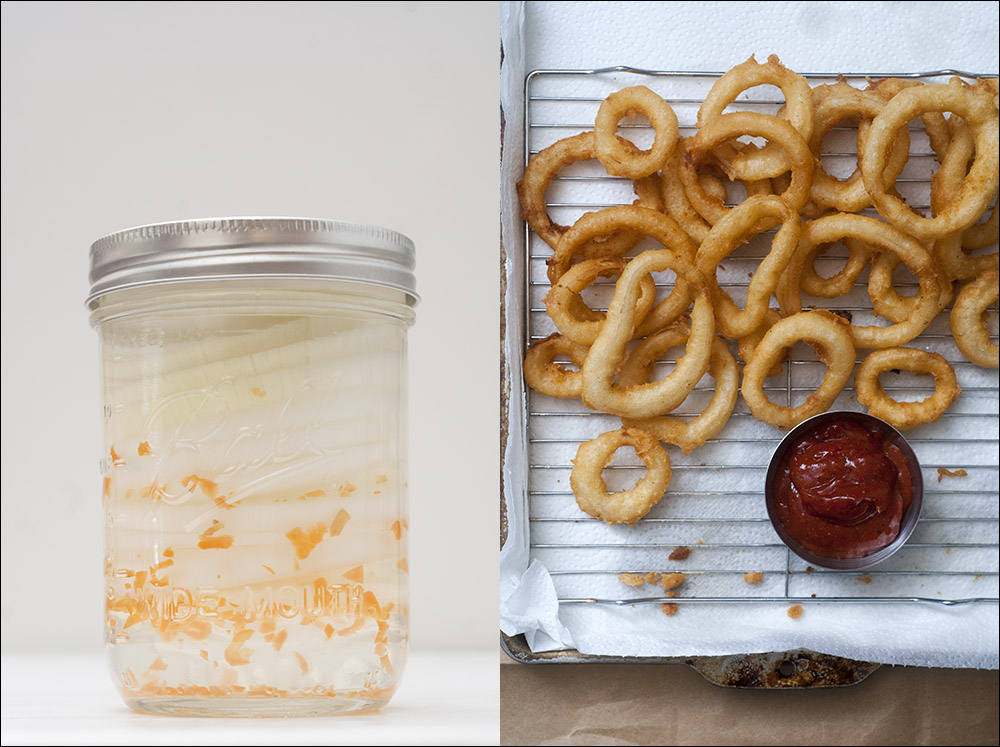
Sweet, hot, pickled, beer-battered bliss.

(L) Sweet, habanero pickled onions. (R) Fried, sweet, habanero pickled onions. © Ryan Schierling
Ultimately, this all started on a clearance table at our local grocer with a Texas brand of hot, sweet, pickled onions being blown out at 50-cents a jar. Regularly $5.99 each, we bought four, and were surprised at the simplicity of the sweet, spicy, clean and crisp flavors. They worked on all kinds of sandwiches, were divine in deviled eggs, great grilled, fabulous on top of steak, and they shined in salads. We were a bit distressed that this product wasn't popular enough for the store to keep around and we were afraid we'd never see it again. It's not the first time this has happened with something we really liked (but found out about a little late), so we figured we'd better reverse-imagineer it. 

There were six ingredients – onions, vinegar, sugar, habanero peppers, salt and citric acid. Based on percentages of sodium, carbohydrates, sugar and vitamin C on the label, we were able to approximate salt, sugar and citric acid components per serving, and per jar. Taste-testing got us pretty spot on with the pickling liquid, though we weren't sure if the onions were originally white, yellow or sweet, so we went with white based on what we had on hand. Of course we didn't hold back on the habanero, because we roll caliente, and they were goooood. 

We tried them quick-pickled, then left those in the fridge for a two-week pickle to see how to texture and flavors would change. Later, we did them properly canned in a hot water bath for longer-term storage. The longer the jars sit, the more the flavors and the heat intensify.

But I couldn't leave well enough alone. I kept thinking about deep-fried pickled things, and how these onions might taste if we beer-battered them using a spicy pilsner and took them to the hot oil-filled cast iron. The result was surprising, but not terribly unexpected – they were ridiculously good. 

Sauceless, these are amazing onion rings. They are crispy, tangy, spicy, sweet and salty without ever seeing a swipe of Ranch or buttermilk dressing, or ketchup/catsup, honey mustard or whatever other crazy things you dip your onion rings in. We made a two-pepper ketchup just in case, and it paired perfectly with the hot little ringlets.

Sunday, February 15, 2015

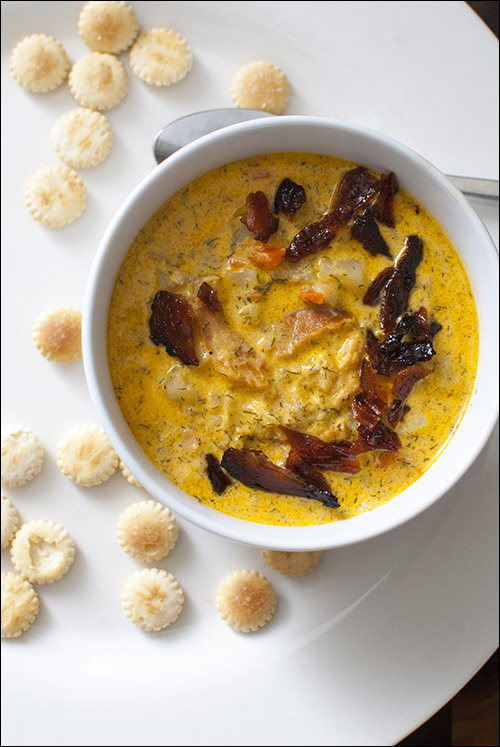
Smoked salmon chowder with salmon bacon.

Smoked salmon chowder with salmon bacon. © Ryan Schierling
There are so many brilliant smoked meats in Texas it's a shame that no one really pays much attention to the fishes.


Granted, this is bovine country and the nearest salmon, be it Pacific or (heaven forbid) Atlantic, is an ocean away. Wherever you hail from, there’s always something sacred about cooking with smoke. Brisket is the gold standard by which barbecue joints are judged in the Great Republic, and if you've got a line out the door for beef, then pork ribs and chicken are pretty much a gimme.


Geographically, barbecue in this part of the country has never had a reason to be about the fish. Southern barbecue is beef and pig and yard bird. About the only ocean-sourced thing you’re likely to see on the grates of a Texas smoker are gulf oysters.


Salmon has a little less real estate to work with than most things that end up in the smoke. If someone could engineer and farm a salmon the size of a cow, you'd have cheap sides of salmon cluttering up everyone's offset, and apple trees would be shaking in their boots, err... at their roots. But salmon are not the size of cows and they're a little harder to catch than cows, pigs and chickens, so their most delicious parts are at a premium. 

Sunday, November 2, 2014

King Ranch Salmon.

King Ranch Smoked Salmon Casserole. © Ryan Schierling
I've been threatening to do this casserole recipe for a while now, and I'm kind of surprised there's nothing like it out there on the whole wide world of internets. Searches for King Ranch Salmon turned up lots of hits for "King Salmon," "Used F-150 King Ranch edition in Salmon, Idaho," and "Carole King's ranch on the Salmon River for sale." The internet – insultingly enough – even asked me "Did you mean King Ranch Chicken?"

King Ranch Chicken is the only casserole that matters in Texas and there are rules. There may be as many subtle individual adaptations and family variations as there are Junior League cookbooks, but most will concur this is a dish best kept simple – with shredded chicken, cans of cream of this-or-that soups and Ro*Tel®, corn tortillas and a ton of cheese. 

This, however, is not King Ranch Chicken.

There is no condensed soup, no Cheese Whiz, no crushed-up nacho-flavored tortilla chips or tins of tomato and green chile. There is no chicken. This is the king of Texas casseroles meets the king of all cold-water fish. It is SXNW. It is smoky, creamy, rich, and as satisfying as comfort food gets. Great Republic purists will inevitably call this just another sensationalist bastardization of a classic Texas dish, but they can go put a sockeye in it. 

This is my King Ranch Salmon.


Friday, May 2, 2014

Enchiladas Dan Jenkins.

Eat these with an over-easy egg and say your prayers. © Ryan Schierling
When I was a kid, the whole seatbelt thing was something folks were just warming up to. I don't know the reason the moment stands out in my memory so, but one day as we piled in to the back of our family station wagon, I was a little slow to put my seatbelt on. My younger brother took it upon himself to harass me about my lack of safety precautions. Finally, in exasperation, he exclaimed, "Do you want to die?!" 

The feeling I had when he said that is kinda the same one I have when I eat these enchiladas. They are stupid to eat, but there's a liberation in the ridiculousness of it all. Between the gooey, salty, Velveeta, the bright tang of onions on the tooth, and that river of enchilada sauce – it seems like the food equivalent of what the free-lovin' 60's must have been like. Drape an over easy egg over the top and you just did it on acid, man....

Our first introduction to this hard-core Tex-Mex standard was at Dart Bowl in Austin. This recipe is from Texas culinary historian-curator-troublemaker Robb Walsh's Texas Eats: The New Lone Star Heritage Cookbook. There are two sauce options in the book – chili con carne sauce or original chili gravy – one with meat and one without. I rather prefer the smoother, meatless style (looking at you vegetarians who care not a hoot about your arteries this week), but there's a fairly narrow margin of difference between the two.

You'll be all set for a stiff drink and a nap when you're done. And, you know, we kinda had to make up for all those light enchilada recipes we've posted this week some way or another... but you'll only get lame apologies for that until you've tried these.

Recipe not included below because it's not our recipe to offer, and we make it exactly as it was written with no adaptations. Go buy a copy of Texas Eats, turn to pages 112-113 and fold the pages back until the book's spine breaks. It will now always open to this dish. It's worth it. 

Well, at least once a year, or until your cardiologist finds out.

Wednesday, January 22, 2014

Hot meat dip.

Hot meat dip - queso with smoked beef brisket. © Ryan Schierling
You've all certainly heard of the Great Velveeta Shortage of 2014 by now. "Increased seasonal demand" and a shifting of production lines from one plant to another led to a shortage of the famous pasteurized prepared cheese product, especially the more moderately-sized eight- and sixteen-ounce loaves. Moderately-sized... how cute. Your Super Bowl party is screwed. 

Thankfully, here in Texas, every grocer worth their inflated sodium content has a year-round endcap with nothing but #10 cans of Ro*Tel and five-pound chubs of Velveeta. No man, woman or child will ever go without queso here because, in The Great Republic of Texas, queso is a birthright. 

Back in the Ghetto Melrose days of Seattle, hot meat dip mysteriously became a party staple. I'm not sure how it all started, but browned ground beef, Velveeta, a tin of tomatoes with green chiles and a secret mix of spices would bubble away in an ancient, volcanic crock pot next to a gigantic bowl of tortilla chips. It was easy, and it was always a hit. 

Monday, April 15, 2013

East Austin salsa shootout.

Margo's salsa. © Ryan Schierling
In Texas, the most important food contests and cook-offs involve barbecue, chili, and salsa or hot sauce.

There are as many opinions on salsa as there are types of salsa, and the stuff is so cheap and plentiful in the Lone Star state you'll never go wanting. Like breakfast tacos, it's just something Julie and I take for granted.

For years, we never entertained the idea or explored the possibilities of making our own. Our "house" salsa was a store-bought, fiery little number made in Telephone, Texas. It just worked for us, and that was that. When a tortilleria down the street opened up last year, we started buying freshly-made tubs of a delicious roasted rojo and a fresh, piquant verde. The flavors were so much more crisp and unadulterated, and a 16-ounce container was under two bucks. Say hello to the new "house" salsa...

A few months ago, Julie's friend Margo brought totopos and fresh salsa for a party. It was a roasty, spicy, smoky kick in the face and everyone loved it. Growing up, Margo's grandmother would make a special pico de gallo every Saturday. "It had loads of lime and tomatillos and an entire bunch of cilantro. A part of me keeps that flavor in the back of my mind every time I hear the word salsa." Her salsa recipe is a heritage-driven nod to her grandmother, with her own twists based on the ways her palate has changed since she was little – and it is some of the best table salsa we've ever eaten.

Last week, we got an email from RL Reeves, Jr. asking if we'd like to participate in a salsa shootout at his next pop-up restaurant event at Tamale House East. We were flattered, and a little baffled. Though we make pico de gallo and salsa verde often, there's not a single salsa recipe on Foie Gras Hot Dog. It was either develop our own version quickly, or make a batch of what was inevitably bound to be our new "house" salsa – salsa de Margo.

Sunday, November 18, 2012

Trade routes.

A fraction of the Trader Joe's cheese aisle. San Antonio, Texas. © Ryan Schierling

When we used to live in Seattle, I'd see commercials on television for Sonic, and yet, there wasn't a Sonic within 500 miles of us. It was infuriating when that 30-second spot would set a wicked craving for a cherry limeade and a SuperSonic double cheeseburger with jalapeños, and I knew I'd be left sadly unfulfilled. Now, after we've moved away, there are three Sonic drive-ins a quick jaunt from the old zip code.

When we relocated to Austin, we had a bit of grocery nostalgia for our local Trader Joe's store at the top of Queen Anne hill, which was a short walk from our place in the LQA. We certainly didn't do the bulk of our shopping there, but the inexpensive prices on normally-spendy items like Italian and Spanish olive oil, cheese, wine and artisan breads made it destination shopping on a regular basis.

Thankfully, the cost of living here in Austin was a pleasant surprise. Housing, food and fuel were all considerably cheaper than the Pacific Northwest. We didn't necessarily need "expensive" grocery items to be less expensive, because they were already a steal compared to what we were paying prior. Here, our neighborhood grocer had a handful of similar items at similar prices, but we still missed the ol' TJ's aesthetic.

And, there are a few things that just weren't available. We recently visited Seattle for a wedding, and the last place we stopped before heading back to the airport to fly home to Austin was… Trader Joe's. A half-dozen Essential Baking Company rosemary diamante boules were procured and smuggled onto the flight. We had to. We've found there is no equal in Austin and Julie's egg salad sandwiches cannot be reproduced properly without this bread.

There are also certain things we've done without since we're no longer living walking distance from a TJ's. Those insanely-delicious house-brand dark chocolate-covered caramels, that $1.69 salsa autentica that works so brilliantly with patacones, the pesto-filled tortellini used in J's chicken-noodle soup, the reasonably-priced rustic crackers, the crazy-cheap cheeeeeeeses, and the surreptitiously-splendid blue-collar two-buck Chuck. Today, at the brand-new TJ's in San Antonio, we stocked up.

There is a Trader Joe's planned for Austin in 2014, and I can't wait to add it to the grocery store rounds we make on a regular basis, probably right between Fiesta in south Austin and MT Market up north. But if Julie asks me to check for that disgusting, foul Australian black "liquorice" she used to get at TJ's in Seattle, I'm just going to have to tell her that, sadly, it's unavailable in this market. 

350 East Basse Road. Be warned, parking is... difficult. © Ryan Schierling

Monday, October 15, 2012

Barbecued beef bierocks.

Barbecued beef bierocks. © Ryan Schierling

I saw a lot of strange things growing up in Kansas. I saw the skies turn a deathly still, hot ochre moments before a funnel cloud dropped down and started sucking the roofs off of houses. I saw an elderly woman speaking in tongues beneath an ominous, menacing mural of abolitionist John Brown. I once saw a six-legged cow. But I ain't never seen a beer rock.

Now, I understand there are many cultural variations and spelling disparities of the bierock – a meat-filled wonder of German and Russian origin, brought to the United States by German Russian Mennonites. They call it "beer rock" in Kansas, but I'm pretty sure – even as an expat – that's got to be a successor to the horrible 90s-dance-music compilation album Jock Jams (Vols. 1-5). If beer rock is what you want, there must be a cheerleading competition on ESPN2 because of the NHL lockout. If you'd rather have a bierock, I've got your number.

Pasty or pastry, pirogi or piroshky, pirok, börek, runza, empanada, calzone… all are a regional version of stuff, stuffed into dough and baked. 

I was introduced to bierocks as a kid, probably at a Mennonite church function in Harper, Kansas. My ancestry is German/Russian, and the version I remember was filled with ground beef, onion and cabbage. If one of the church ladies got a little crazy, there might have been some caraway seed and unseemly gossip in there. 

In my early 20s, I lived in Fort Collins, Colorado and found runzas at a fast-food chain called, oddly enough, Runza. They served a delicious, fresh, beef-filled bierock facsimile that fueled my nostalgia and kept me from having to craft my own. 

If only I'd known how simple it was. 

Friday, July 27, 2012

Chicken-fried Chicken à la King Ranch Chicken.

Yeah, it's a mouthful. © Ryan Schierling
As with any recipe that's been around for more than 75 years, there will always be nebulous narratives about the origins. Vague references to obscure cookbooks – long out of print, written by chefs long-since dead – are all we have to rely on. Well... that, fond and faded memories, and Wikipedia.

Fried chicken has been around since chickens evolved from dinosaurs. Delicious, delicious dinosaurs.

Chicken à la King dates back to the late 1800s – a hotel cook in Philadelphia, perhaps. In the simplest forms, it is diced chicken in a cream sauce with sherry and mushrooms, usually served over toast points.

King Ranch Chicken can be traced to a 20-year stretch between 1945 and 1965 and despite the moniker, has no ties to the sprawling Kingsville, Texas ranch of the same name. It is, roughly, a chicken enchilada casserole with a spicy cream sauce and a boatload of Colby and Jack cheese.

Junior League cookbooks and soup can labels will provide a wealth of knowledge when it comes to the standards like fried chicken, chicken à la King or King Ranch Chicken. Follow recipes to the letter and you will be blessed with crowd-pleasing, pleasantly bland, rib-sticking, middle-of-the-road, middle-of-America fare. However, venture off the path into the hinterlands, and you will find the bastard chicken, I mean children, of these tried-and-true classics.

Boned, butterflied, and buttermilked chicken thighs are dredged in well-seasoned flour and fried until crispy. Texas toast is slathered in butter and griddled. Tiny brown mushrooms are quartered and sautéed with a hit of sherry. The pale green sauce is born of roasted tomatillos, poblano and serrano peppers, onion, garlic and a lot of heavy cream.

It is fried chicken. It is Chicken à la King. It is King Ranch Chicken. It is all of these, and still none of these.

Sunday, July 15, 2012

BBQ pop-up.

(L) Hot BBQ. (R) RL Reeves, Jr. © Ryan Schierling
By the time this has posted Sunday afternoon, you'll have already missed it. Like a finger-lickin'-good flash-in-the-pan – this one-shot meat-and-two melee, noon-time, barbecue pop-up at Three Little Pigs is history.

Chef Raymond Tatum's pork-centric trailer is closed Sundays and Mondays, so Tatum's friend RL Reeves, Jr. (scrumptiouschef.com) got the green light to throw a little brisket party. Word was passed around in the days prior through various channels, and if you were in the know, you got proper Texas plate lunch. There was brisket (smoked on the old mobile pit that followed Willie Nelson and ZZ Top around on tour in the 70s), beans, slaw, peach cobbler and sweet tea.

What felt like a summertime backyard picnic – old country on the radio, Lone Star tall-boys being passed around, folks hunkered over pecan-smoked meat and pinto beans so sweetly porcine you'd swear they were a part of the animal – could become a regular, if somewhat impromptu, gig with a rotating menu.

Friday, June 29, 2012

Pigs and eggs.

Three little pigs, potatoes and eggs. © Ryan Schierling


Austin may call itself the live music capital of the world, but it's actually the breakfast taco capital of the world. I'm also pretty sure there are more solid Mexican restaurants and taco trucks than there are music venues and bands in the ATX. Some of my favorite breakfast tacos, ever, have been doled out of a soft-sided cooler from the back of a mini-van driven by a little Hispanic lady with some bad-ass homemade hot sauce to drizzle over the foil-wrapped deliciousness. They're everywhere – ubiquitous and cheap enough that you would never even have to think about making them at home.

And I never did, until our "taco lady" that got me hooked on her amazing picadillo, her tangy nopales and creamy homemade refritos, her handmade tortillas that would leave a kiss of flour on your lips, her rippin' hot homemade salsa, stopped showing up in her mini-van at the shop every morning. I'd been cut off, cold turkey, and it hurt.

Six months is enough of a morning mourning process, and I simply can't abide the new "taco man" that pulls up in his green Chevy Blazer, honking his horn and passing off hard-scrambled eggs with Jimmy Dean sausage in a gummy, sweaty, store-bought flour tortilla. Today, I made two dozen breakfast tacos with pork, potatoes and chorizo in red chile, bacon and soft-scrambled eggs and took them to work.

When the "taco man" pulled up, no one bought… and I got a hearty "Hombre vato!" from the guys, which I take as "not too bad for the white guy of Russian/German heritage."

Sunday, November 6, 2011

An evolution of chili.

(Vegetarian) Red #43. © Ryan Schierling
I never really thought about chili much before we moved to Texas. I certainly enjoyed it in every sort of variety, be it homemade or canned, but never considered it or regarded it as I do now – which is to say with the same reverence the French have for their mother sauces, the Italians have for cheese and wine, the Spaniards have for paella and tortilla española. 

I have come to realize my history with chili con carne has three and one-half distinct phases. 

The first phase: Childhood. 

My mother's winter-time chili was a thick tomato-sauce-based vehicle for ground beef and onions. Mildly spiced with dried McCormick chili powder and cumin, it was the chili con carne of my formative years and off only a few herbs and spices (and, sans beans) from her similarly-prepared spaghetti sauce. It is what I sought to recreate when I started learning to cook in my early 20s. 

The second phase: Learning to Cook (or, A Stock Pot and a Wooden Spoon). 

When you move away from home, you are free to eat what you want, when you want, and you will. But there are times when you want the comfort of home, you will make a phone call and you will work to recreate the dishes of your youth. 

For a number of years after I left home, I didn't eat meat. Being a vegetarian wasn't a health-related or a conscience-appeasing meat-is-murder kind of decision, it was a financial one. I made so very little money, and meat was usually the most expensive item on my grocery lists, so I just stopped buying it for a few years. I made a lot of soups and stews, and vegetarian chili was one of the first stock-pot-meals that evolved from my mother's recipe into my own. 

I used cheap dried beans soaked overnight, vegetable broth and fresh jalapeños, lots of onion and diced tomatoes instead of tomato sauce, and the freshest chile powder and cumin I could find. It took some trial and error to get where I wanted with it, but learning how to correct seasonings and temper the heat of the fresh chiles was invaluable. Knowing to let a young chili simmer longer or sit in the fridge overnight, or adjusting a dirty chili that tasted too heavily of chile powder and cumin with additional acid or a sweet component, took longer to figure out, but I got there. 

Learning how my tastes had changed as I'd gotten older and how to satisfy them was even more important. 

The third phase: Texas is the Reason (or, Where Chili Came From). 

Related Posts Plugin for WordPress, Blogger...