Showing posts with label vegetables. Show all posts

Tuesday, February 23, 2016

Lemon-lentil soup with mustard greens

Lemon-lentil soup with mustard greens. © Ryan Schierling
Ryan asked me an interesting question this week, "What are your three favorite soups that we make?" That's a tough question because Ryan has a knack for making soup out of virtually anything, and there are plenty of delicious one-offs that never make it to the blog or get repeated. To him, just about every soup created on the first go-round is a "throw-together" recipe. Knowing this, I have learned that if I really like something and want to see it in regular rotation, I cannot rely on him to write it down or remember what he did – I must take it upon myself to transcribe it immediately.

This was the case for me last Fall when I kinda totally went nuts for this lentil soupI like lentils in spite of the terrible "lentil loaf" I was fed as a kid (sorry Mom!) but generally don't get effusive for them in this way. I was putting this recipe to paper before the dishes were cleared, and then made it again myself a week later. After that I went a bit off the rails and started sending the recipe in unsolicited emails to friends and family members because... "OMG these plain old cheap brown lentils are amazing and this soup is so fiber-rich and good for you...!"

Alright, on some level Ryan was right about this being a "throw-together" recipe. It begins with a classic mirepoix and builds simply from there with lentils, mustard greens and fresh lemon juice. It is filling and bright, and leafy greens bathing in a warm broth is one of my favorite ways to eat them. So, while in no way shocking or revolutionary, this has already been made repeatedly in our home and deserves its moment on this blog. Plus, it gives me great joy when food this satisfying is also excellently nutritious and ridiculously economical.

Wednesday, November 4, 2015

Sweet, hot, pickled, beer-battered bliss.

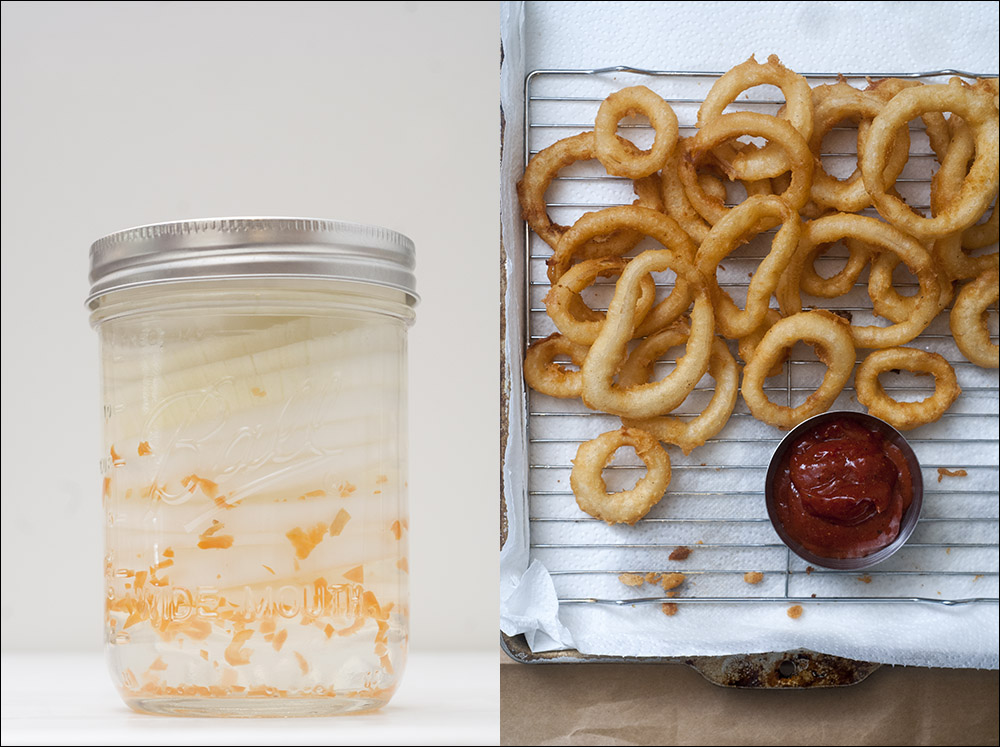
(L) Sweet, habanero pickled onions. (R) Fried, sweet, habanero pickled onions. © Ryan Schierling
Ultimately, this all started on a clearance table at our local grocer with a Texas brand of hot, sweet, pickled onions being blown out at 50-cents a jar. Regularly $5.99 each, we bought four, and were surprised at the simplicity of the sweet, spicy, clean and crisp flavors. They worked on all kinds of sandwiches, were divine in deviled eggs, great grilled, fabulous on top of steak, and they shined in salads. We were a bit distressed that this product wasn't popular enough for the store to keep around and we were afraid we'd never see it again. It's not the first time this has happened with something we really liked (but found out about a little late), so we figured we'd better reverse-imagineer it. 

There were six ingredients – onions, vinegar, sugar, habanero peppers, salt and citric acid. Based on percentages of sodium, carbohydrates, sugar and vitamin C on the label, we were able to approximate salt, sugar and citric acid components per serving, and per jar. Taste-testing got us pretty spot on with the pickling liquid, though we weren't sure if the onions were originally white, yellow or sweet, so we went with white based on what we had on hand. Of course we didn't hold back on the habanero, because we roll caliente, and they were goooood

We tried them quick-pickled, then left those in the fridge for a two-week pickle to see how to texture and flavors would change. Later, we did them properly canned in a hot water bath for longer-term storage. The longer the jars sit, the more the flavors and the heat intensify.

But I couldn't leave well enough alone. I kept thinking about deep-fried pickled things, and how these onions might taste if we beer-battered them using a spicy pilsner and took them to the hot oil-filled cast iron. The result was surprising, but not terribly unexpected – they were ridiculously good. 

Sauceless, these are amazing onion rings. They are crispy, tangy, spicy, sweet and salty without ever seeing a swipe of Ranch or buttermilk dressing, or ketchup/catsup, honey mustard or whatever other crazy things you dip your onion rings in. We made a two-pepper ketchup just in case, and it paired perfectly with the hot little ringlets.

Friday, September 25, 2015

Root veg kaleidoscope.

Steamed carrot slaw with roasted beets. © Ryan Schierling
The challenge: Create an unforgettable side dish from random items in your refrigerator before time runs out. Who will rise to the occasion, and who will be… CHOPPED.

(WE INTERRUPT THIS POST FOR COPYRIGHT LIABILITY REASONS. IN THIS CONTEXT, THE TERM “CHOPPED” MIGHT BE A REGISTERED TRADEMARK OF TELEVISION FOOD NETWORK G.P. AND ITS AFFILIATES. CONTINUED IMPLIED USAGE AND/OR VIOLATION WILL RESULT IN TED ALLEN’S HANDLERS ASCERTAINING YOUR LOCATION IN FETCHING BLACK HELICOPTERS, DESCENDING ON YOUR KITCHEN, WHERE YOU WOULD BE… BOPPED. IF THERE ARE ANY BISCUITS AROUND, YOU MAY BE… SOPPED. REGARDLESS OF THE CONTEXT, YOU WILL BE… STOPPED. UNLESS YOU ARE ABLE TO DEFEAT MASAHARU MORIMOTO AT THE IRON CHEF AMERICA NINTENDO Wii GAME. ALLEZ-CUISINE!!*)


I'm fairly certain I would be a terrible contestant on one of those competition-based cooking shows. You know the ones where contestants have to execute something spectacular in under 20 minutes with a limited number of disparate ingredients? Not a minute to spare rethinking or redoing anything? I’d probably knock it out of the park about one in three rounds, and full-on crash and burn the rest. Pressure cooker situations are just not for a planner like me. However, that’s not to say I don't enjoy rising to a challenge when the opportunity presents itself.


Sunday, August 30, 2015

Texas wildfire salad.

Texas wildfire salad. Arugula and seared zucchini with habanero herb dressing. © Ryan Schierling
We've been running a bit of a hot spell here in Central Texas, and the pepper plants are about the only thing in our garden that are tolerating the heat. Our patch consists mainly of jalapeños and habaneros this year. The jalapeños we use with frequency, but the habaneros are a little tricky because we either need a fresh harvest large enough to make hot sauce, or we have to find ways to use what ripens in a steady trickle. If you're familiar with habaneros, you know that this little orange pepper packs a wallop of heat. While it may not rank at the top of the Scoville scale, it is up there high enough to warrant wearing gloves when cutting them and taking measures to avoid any juices that may aerosolize in the chopping process.

So, I decided to make a habanero salad dressing out of a couple of them. Of course, right? For continuity of color, I chose to include orange bell pepper – well, in addition to the fact that there is nothing meaty about habanero peppers and I wanted to add some substance and body. There is a reason for the popularity of habaneros and it's not all about its spicy reputation. Habs have a wonderfully distinct, almost fruity, flavor that transcends the heat. With the addition of garlic and some fresh Texas tarragon (Mexican mint marigold) leaves from our garden, the resulting dressing is creamy in texture without being heavy and has a boldness that is both tangy and mildly herbacious.

Monday, May 11, 2015

Pesto. Do it with collards.

Collard green pesto flatbreads with boudin, peppers and tomato. © Ryan Schierling
Before I become a victim to my own verbosity, let me to cut to the chase – please try this pesto. It’s delicious. It’s nutritious. It’s economical. And, if not more versatile than traditional basil pesto, it certainly is more accessible

We’re comfortable with greens, but those most used in our repertoire have traditionally been spinach, kale, mustard and beet. Collards are more regional to our home here in Texas and until now we have been unremarkably straightforward in our use of them. You know… chopped, cooked greens with some onion, a splash of lemon or vinegar and seasoning.

Compared to other greens, collards have a thick and sturdy, almost leathery leaf on a hearty stalk. They take longer to cook than other greens and have a robust flavor to match. Quite frankly, they have been a bit of trick to incorporate into our menu plans. We’ve struggled awkwardly with new regional produce in the past. Last Fall we finally realized the delicious miracle that is roasted okra, and a vegetable I have had a disastrous relationship with previously is now one I’m looking forward to coming back into season. Breakthroughs such as these are defining moments in our personal food story, and this Spring we had that surprising moment with collard greens.

It started with a Saturday morning perusal of my Instagram feed. An artful image of large collard leaves and some thick-sliced ham scrolled onto my screen. Not exactly my thing, so far, but the maker of that image was Maggie Perkins and I always enjoy the “in-progress” photos of her impromptu creations as a farmer’s market demonstration chef each weekend. The caption that day is what caught my eye, “Good morning from the market! I’m whipping up a collard green pesto to top flatbread pizzas…”

Sunday, September 14, 2014

Seriously, we can only eat so much fried okra.

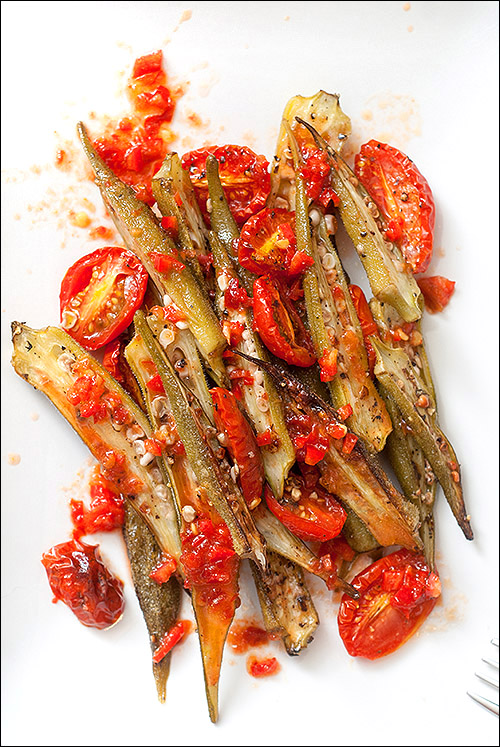
Roasted okra and tomatoes with chili garlic vinaigrette. © Ryan Schierling
My first experience with okra was decidedly unpleasant – an unfortunate "high-brow" circumstance wherein a vegetable galette included its overly-mucilaginous presence.

Then we moved to Texas. If you know anyone with a big garden in these parts, you're certain to find okra offered to you by the cubic bushel in late summer. Okra thrives in the heat and seems to defy the sun-baked earth, and it's been showing up on our doorstep for the last few weeks.

So, how do you say "no" – in good conscience – to the pound of okra that arrives with every late summer CSA delivery? We joined for the local and seasonal offerings, and it just wouldn't be right to turn it away or not make good use of it. 

What exactly are you supposed to do with this stuff? Common wisdom points immediately in the direction of pickling, making gumbo, or battering and frying. But there's only so much pickled okra that's going to get eaten at our house this year, and if I'm going to make a mess of my cooktop with a pot of boiling fat... well, I can't honestly say that okra is the first thing I'd choose to fry up.

In a flash of merciful recollection, Ryan remembered seeing a recipe for roasted okra and cauliflower salad in a cookbook we got last year – Smoke and Pickles by Chef Edward Lee. It has been our salvation over the past few weeks of CSA deliveries. (You can also find it featured in this post by CBS The Talk, where he was a guest last Fall.)

Wednesday, August 6, 2014

Tomatoes rock.

Tomato carpet at the now defunct Emo's on Red River - Austin, Texas. © Ryan Schierling
My mother always describes eating fresh tomatoes out of a childhood, long-ago family garden – plucked ripe from the vine, warm from the sun, juices dripping down her chin on the first bite. I imagine it is what tomatoes were always supposed to taste like... killer.

Grocery store tomatoes are a sad affair, no matter how organic or fresh. Compared to home-grown, they are typically a little mealy, a little dry, lackluster and lacking in fresh-picked, sun-ripened flavor. When we buy tomatoes outside of our Central Texas growing season – which is to say, November through March – they're usually used for making salsa or tomato jam. The little actual tomato flavor they've got is augmented by other, bolder ingredients. But when it's summertime in Austin – which is to say, April through October – we have two garden plots that are a cage-match tomato free-for-all.

The larger varieties don't usually fare so well. They split before they're ripe, they are susceptible to leaf-footed bugs, and we've found that crafty mockingbirds abscond with bits and pieces of them as soon as they're soft enough to poke a beak in. Sweet little cherry and grape tomatoes are prolific and quick to grow, the medium-sized orange ones do well, and small heirloom varietals have been very successful. We stick with the tried-and-trues, and use them to their tomato-ey fullest while we've got them.

Wednesday, May 21, 2014

Sweet flan? Don't carrot all.

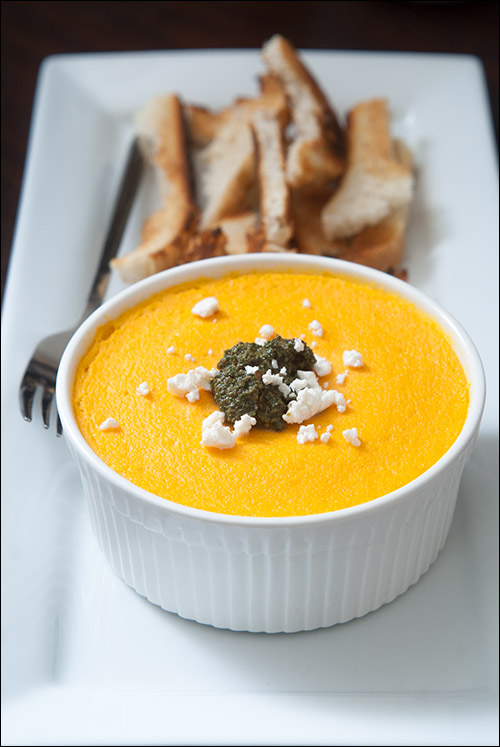
Savory carrot flan with carrot-top walnut pesto and feta. © Ryan Schierling
My forays into flan have been few and far between. I don't care for the caramel-sweet Spanish dessert custard and the crusty English open-pie version isn't my cup of tea. I'd rather have a small, savory custard as an appetizer course, and if blue cheese flan happens to grace a menu, I'll take it as dessert with one last glass of red wine, thank you very much

We've finally gotten with the CSA program, and our bi-weekly delivery of the Austin-area's finest farm veg is a welcome challenge to eat more locally-grown produce, and who doesn't like getting a super-secret-surprise box delivered to their doorstep every once in while? 

Grocery stores offer every fruit and vegetable you can think of – even if it's not in season – when you think you want it... which is always right now. With our CSA box, we're delighted (forced) to use what's currently ready to be harvested, and sometimes it's very nice to be filled with wonder (dread) at how we're going to use our very-perishable bounty. Kidding, kidding. The quantities are small enough that we haven't had too many issues with things getting lost in the crisper (rotter). 

There were some beautiful little carrots in our last delivery, with the most delicate, lacy, bright-green tops I've seen in a while. The easy way out is salad. Boring, big ol' salad. A better option (fate) would be Julie's crowd-pleasing carrots on the side, and this would have been entirely appropriate but I wanted something a little different and a little fancier than the last recipe I offered up, which was Krab enchiladas. Oh, I may occasionally put Slim Jims and gas-station cheese inside a jalapeño and deep fry it, but I know what the hell a bain Marie is. This is penance, perhaps redemption, and I'm using the carrots nose-to-tail. Errr, root to leaf

It's a simple, savory custard, full of right-out-of-the-earth carrots, topped with a pleasantly-grassy (and very complimentary) carrot-top and walnut pesto and some sheep's-milk feta. First course, last course, it doesn't matter. 

Sunday, May 11, 2014

Bonus Enchiladas – Green Chicka Green Green

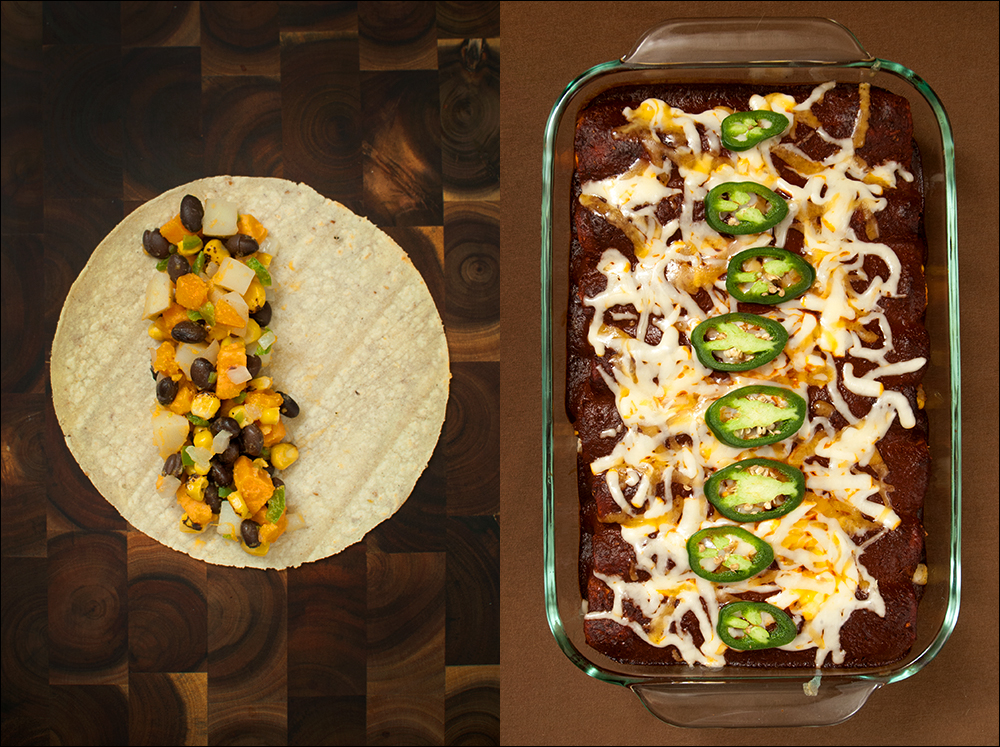
Green chile enchiladas redux. © Ryan Schierling
This one is inspired by that perennial layered "green chile enchilada" casserole recipe that many of us grew up with. Tasty as it may be, it's probably more heart-attack inducing than the Velveeta in enchiladas Dan Jenkins – what with all the cheese and that obligatory can of Cream of Something soup involved.

Our family recipe (included below in all its quantity unspecific glory, and strictly for educational purposes, of course), was made with Cream of Mushroom soup. But I understand that the non-vegetarians among us would quite often add chicken to this dish and even use Cream of Chicken soup on occasion. So, perhaps a little more protein there, but still not a dish that's going to get any healthy-living bonus points. You see, while there was something of an attempt to eat a "nutritious" meatless diet, our family was also a product of its time – a time when we all fell victim in some form or other to the put-a-can of Campbell's-in-it school of cooking that was all the suburban cultural rage.

These days we like to think we're a little more sophisticated in our preparation of food and sourcing of ingredients. What I remember loving best about this layered casserole was the saltiness of the olives (I've always loved olives) with the flavor of the green chiles. Plus, there was something distinctive about the copious addition of cheddar cheese that also went into that baking dish. Contemplating this childhood favorite in light of our recent "5 days, 5 ways" foray into enchiladas started me thinking about how I might be able to enjoy that flavorful goodness in a lighter, more traditional enchilada form.

Thursday, May 1, 2014

Enchiladas de la tierra.

Sweet potato, potato, back bean and roasted corn enchiladas. © Ryan Schierling
Once upon a time, I came across a taco joint in a northwestern town that served a veggie burrito which included sweet potato. It's a rare item to see featured as a vegetable in most Mexican restaurants, and I thought it was downright delightful. The filling for this enchilada recipe was born from that inspiration and my love for simple black bean and corn enchiladas. Nothing fried here, just a hearty mix of colorful goodness with a tasty homemade red chile enchilada sauce.

Can we just have a word here about red enchilada sauces? Somehow I got hung up on this topic at an early age. My mother was raised in Southern California and somewhere along the line developed some very strong opinions about a certain few ingredients. She always insisted that "Las Palmas" brand red enchilada sauce was the real deal – the gold standard in a can. A little label reading in later years proved her point. Most commercial red enchilada sauces are made with a pureed tomato base. Apparently, as far as Mom is concerned, authentic enchilada sauce is made with only red chiles, not tomatoes. As it can still be a little tricky to find the chile-only variety in the average supermarket, I completely understand her brand loyalty. There is definitely an important difference in both flavor and texture, and if you choose to go the canned-sauce route for these enchiladas, I implore you to do a little label reading of your own before making that purchase.

Homemade enchilada sauce is an easy thing to make if you have a good blender and can source the dried chiles. I like the flavor of the New Mexico or California chiles with the Pasilla chiles, as the combination has more of the "enchilada sauce" flavor profile I grew up with. The Arbol chiles give it a friendly touch of heat. However, you can substitute some of the dried chiles to suit your taste. Many traditional recipes recommend using a combination of  guajillo and ancho chiles – which happen to be two of my favorites in other contexts for their particular richness and depth of flavor.

Forgive me, but the proportion of filling to sauce between these recipes are not very well aligned. The enchilada sauce recipe will be just about right (maybe a tad bit extra) for a 7x11 pan of 8 enchiladas. The filling you will definitely find yourself with plenty extra. I suggest either making a double batch of enchilada sauce, or plan on using the extra filling for tacos or burritos in the next couple of days.


Tuesday, April 29, 2014

Mole mushroom melee.

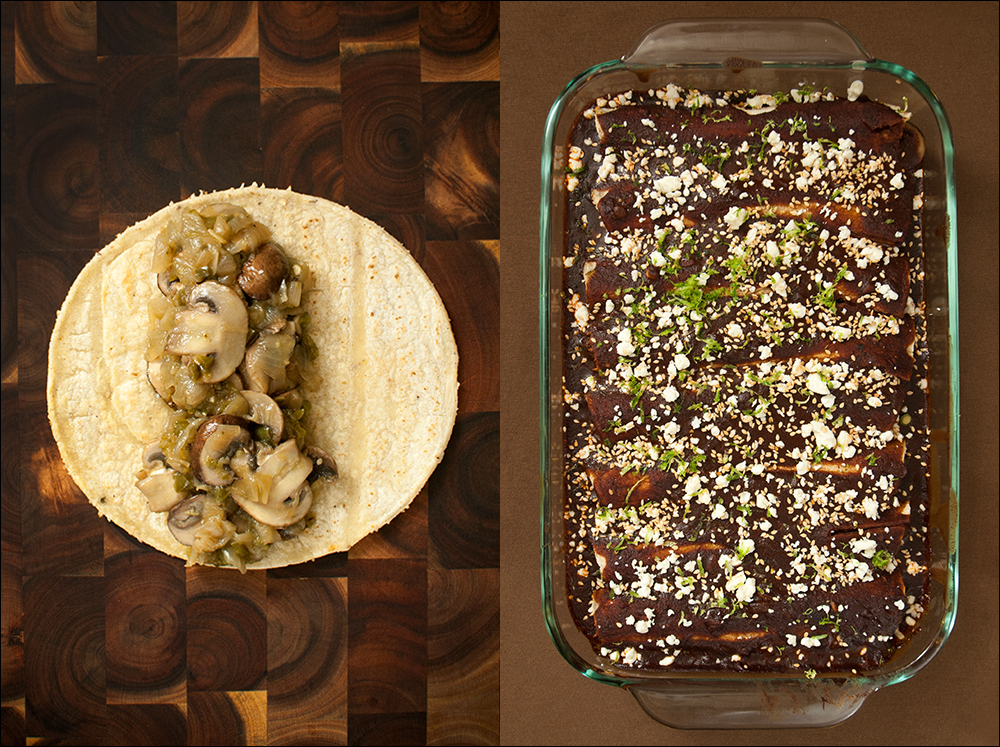
Enchiladas with mushroom and caramelized onion. © Ryan Schierling
When most of us consider sautéed mushrooms and caramelized onions, we don't immediately think "Oh, Mexican food!" First inclinations might turn to a pizza topping, a side for steak and potatoes, or a stroganoff staple. 

Not around here.

One of our longtime-favorite enchiladas is this simple en mole recipe. The mushrooms lend a meaty texture and the sweetness of the gently-caramelized onions – with an added kick of heat from some chopped jalapeños – make for a very satisfying and well-balanced filling. A good mole sauce with all its chile pepper bravado, nutty complexity and hint of sweetness, is the perfect compliment. Mole sauce is usually served with chicken, and all too often that chicken is boiled, beaten and barren – dry as the desert. It is rare to find a meatless alternative that is savory enough to stand up to the richness of mole sauce, and this one works rather splendidly.

All this talk of mole – I don't want anyone thinking they have to either reach for a grocery store jar or make one of those 47-ingredient recipes that take three days to prepare. There is a happy medium, and it isn't the least bit difficult. Some version of this recipe has been floating about the inter-webs for years, and for enchiladas, it is perfect. Do be careful with the addition of nut butters, though. While peanut butter is likely in your pantry, and is perfectly acceptable to use, be cautious with the quantity, or it may taste a little too much like peanut sauce. Alternate nut butters such as almond or hazelnut impart a nice nutty flavor without being quite so distinctive. You can also play around with the use of seed butters such as sesame (tahini) or pepitas for a twist on the complexity the nut butters provide. If you're really, truly desperate, you can use those six-month-old Reese's Peanut Butter Cups from your Halloween candy stash. (I can neither confirm nor deny that this has been attempted in our household, by Ryan, on at least one occasion.)

Monday, September 23, 2013

"The boss" sauce.

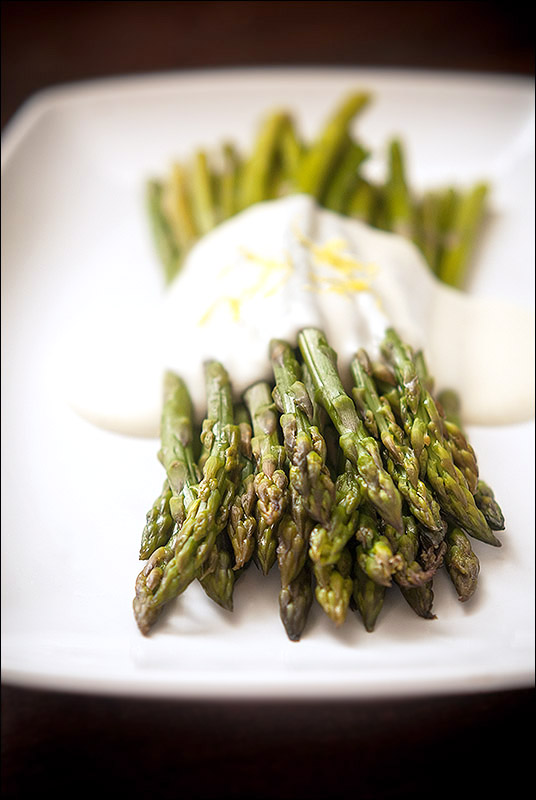
Asparagus with "the boss" sauce (chèvre-lemon béchamel). © Ryan Schierling
No disrespect to the mother sauces intended. Really. I just didn't know what to call this one. It started out – honest and innocent – as a simple béchamel but from there it became a bit ambiguous as to where it belonged on the family tree of classic sauces. I searched the interwebs – for a couple of minutes at least – and couldn't find this one anywhere.

The mother sauces, being mothers, birth offspring by the addition of particular ingredients to them, and these new sauces assume different names. Béchamel, one of the five classic French Mother Sauces, is essentially a white sauce made with a light roux of equal parts flour and butter where the liquid component is milk. When cheese is added, it becomes a mornay sauce. That is if you are prone to oversimplification. While you may find any of a number of interpretations of mornay at your local fancy-schmancy eating establishment, mornay is classically made with parmesan and gruyere – these are traditional, specific, and hard/grate-able cheeses.

My cheese of choice, chèvredid not exactly fit this profile. It is a fresh soft cheese. And, for an added complication, this sauce is finished with freshly-squeezed lemon juice. Oh, conundrums!

Sunday, August 18, 2013

Avgolemono and fried artichoke hearts.

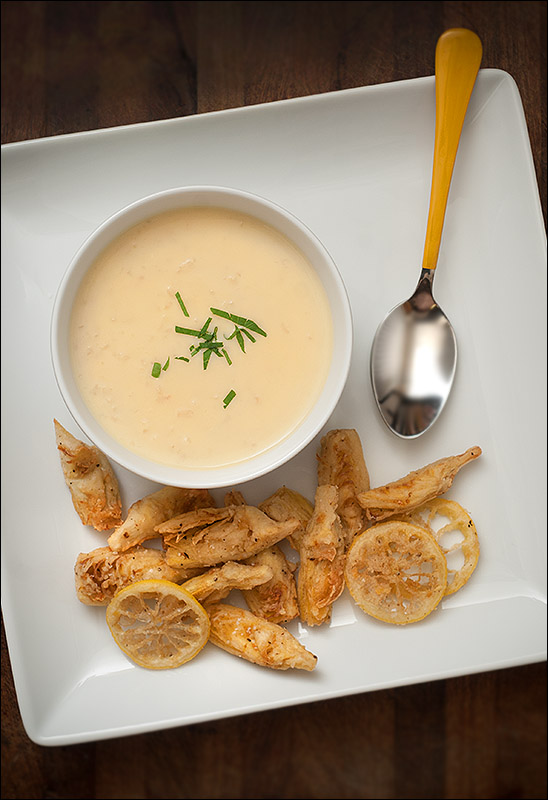
Avgolemono soup with artichoke and lemon fritto misto. © Ryan Schierling
I'm not naming names, but some of us are occasionally bent on pretending that, in those short hours after work, we're actually on a Mediterranean vacation. The perfect food vehicle for such fantasy is avgolemono. It is a cheery egg-lemon soup with all the satisfaction of a wintertime comfort food, but perfectly suited in its lively essence to the heat of summer.

It seems that really good Greek restaurants are few and far between, and I have yet to adopt a Greek grandmother, so alas, my history with the real deal avgolemono is somewhat limited. Yet, a singular experience has remained ingrained in my memory as a stalwart standard. It was at a small Greek diner, that I've long forgotten the name of, where I stopped alone for lunch one day as I was passing through town. For some insane reason it has stayed filed there in my memory, waiting patiently for this year when it finally found its way to the surface and I was inspired to work out how to make it at home.

Wanting a warm soup in Summer felt as if I was making some kind of advanced mental preparation for Fall. Or, perhaps I just had a hankering for lemon. Who knows. But on a recent morning walk, it was all I could think about. It's a shame I didn't turn my attention to this dish sooner, as a traditional avgolemono soup is surprisingly straightforward to make. Simply a homemade chicken stock, white rice, and a rather miraculous lemon and egg finish. You might think of avgolemono as the Greek counterpart to our traditional chicken noodle soup. It's a warm and silky soup with a soft yellow color, tender white rice and an unmistakable lemon brightness.

Sunday, July 21, 2013

Give quiche a chance.

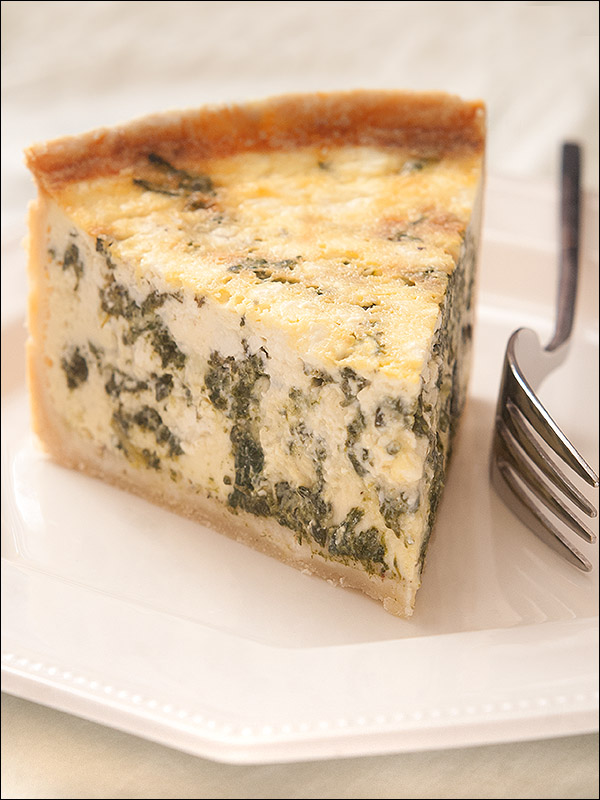
Quiche with spinach and feta. © Ryan Schierling
We crave what we crave, and oh, how I have missed my favorite spinach and feta quiche.

Believe it or not, back in the day this was one of my preferred quick, late-morning meals with a nice hot latte. There was a delightful neighborhood coffee shop that sold this delicious pie by the slice. It was a thick, custardy piece with the bright tang of feta and a generous amount of chopped spinach perfectly suspended throughout. It was just the right thing to get me through a busy afternoon on those days when I needed a little bit of protein, instead of something starchy or sweet.

It's no easy thing to find a quiche that is truly a custard; delicate and flavorful without being heavy and essentially a baked-egg casserole, as they are so often prepared. Many also suffer from the addition of abundant oily cheese, or vacuous vegetables that are neither enhanced by or serve to elevate such creamy custard. Some "quiches" are unabashedly filling-centric, where the "custard" is reduced in proportion to merely an egg-based binder instead of shining as the real star. 

It took a bit of research to find a recipe offering guidelines for the right proportions of egg and cream and milk to meet my criteria. But, fortunately for my cravings, this quiche base magnificently hits the mark. While it may seem that anything containing eggs and milk baked inside a pie shell qualifies as a quiche in the wide world of recipes online, we all know that the French are a little more particular about these things. Fact is, I almost feel bad that my favorite variety is so very Florentine. Or maybe even Greek – with the feta included, it's a little like spanakopita meets classic French cuisine – but, in the best possible way.

Wednesday, July 3, 2013

Slaw of wee little cabbages.

Brussels sprout slaw with grapefruit-fig vinaigrette. © Ryan Schierling
Where we have merely dedicated a five-day stretch to the subject, one could potentially spend a lifetime dedicated only to documenting variations of slaw. As much as we appreciate the cruciferous veg, we are not the people to make such an exploration of a specific side dish our exclusive focus. However, we would be remiss if we did not include a variation using Brussels sprouts for this "5 days 5 ways" celebration of slaw.

Brussels sprouts are oft referred to as "wee little cabbages" in our household. This is technically fitting as they are members of the same genetic family – from the Brassica genus, to be exact – and in excellent company with some other very delicious vegetables such as broccoli, cauliflower and, of course, cabbage. When it comes to sensitivity to the more bitter aspect of this family, Brussels sprouts are probably one of the trickier to develop a taste for, but the little bit of work it takes to complement that touch of bitter is well worth it. Where cooking serves to soften this bitterness, a raw salad requires an act of embracing and balancing it. 

Tuesday, July 2, 2013

Pretty in pink.

Sauerkraut slaw with red cabbage. © Ryan Schierling

Sauerkraut is, in American culture, a tough one when it comes to palatability. You either love it, or you hate it. 

I'm not ashamed to admit that my love for sauerkraut knows no bounds. I enjoy the sour taste and squeaky texture so much that I've been known to take a two-fingered pull out of the kraut jar and put that gigantic pinch between my cheek and gum, just to savor the juicy deliciousness. It's like the best cabbage chaw you can imagine. And those Frank's Sauerkraut singles? So portable. Okay, I might have a problem. 

But come on, what's not to like? Historically, sauerkraut goes back – way back – a few thousand years B.C. It's rich in vitamin C, high in fiber and low in calories. It was used to prevent scurvy. It's good for your eyeballs (uhm... taken internally, not as a topical ointment) and has been used as a treatment for stomach ulcers and canker sores. 

Whatever name you have for fermented cabbage – in all its glory – it is celebrated worldwide. The Dutch make mashed potatoes with it. The French, choucroute garnie. Russians use it in soup. Koreans have kimchi. Germans serve it with everything, from what I hear. There is always sauerkraut in our refrigerator. Always.

Monday, July 1, 2013

Ranch-style crudité slaw.

Broccoli, cauliflower and cabbage slaw. ©  Ryan Schierling
For the longest time I thought I hated cole slaw. As it turned out, I just didn't like that typical picnic-style slaw with creamy and weirdly-sweet dressing. You know, the omnipresent variety you find in tubs in the supermarket deli.

The first "cole slaw" that I remember liking made a big impression on me, so much so that I wasn't really sure if it even could be considered a slaw so much as a shredded cabbage salad. Granted that was some [blah-blah-blah-redacted] years ago. The strangest thing is that this entire episode was also a defining moment in my appreciation for ranch dressing. Weird and tangential on the surface, I know, but I will explain.

I grew up in a household where blue cheese and Roquefort were the default, everyday salad dressings of choice. I was never one of those kids who put ketchup on everything or wanted to dip anything deep-fried in ranch dressing. In fact, I didn't really find ranch of much interest except as a suitable dunk for raw broccoli and cauliflower on the crudité platter – until that one day when someone served me shredded cabbage "cole slaw" made with ranch dressing instead of the usual fare. Suddenly a variety I could get behind! It just made sense, really. While I may not gravitate to ranch dressings for my salads, there is something to be said for the way certain vegetables are complemented by the creamy, tangy, herb and garlic flavors at its essence. This is doubly true if you make your ranch-style dressing fresh and from scratch.

Sunday, June 30, 2013

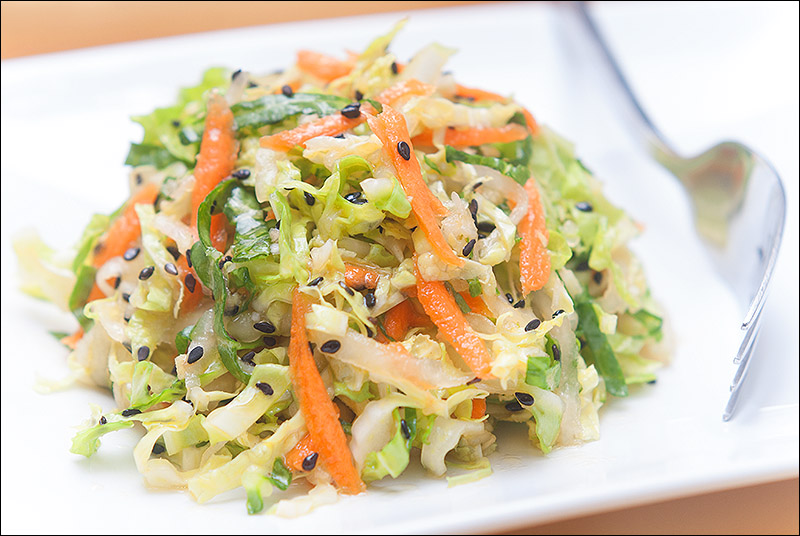
Chinese cabbage slaw with carrots and daikon.

Napa cabbage slaw with ginger garlic dressing. © Ryan Schierling
I didn't eat life-changing barbecue until we moved to Austin. That was four years ago, and that means I put a lot of passable, fair-to-middlin', sometimes downright horrible smoked meat in my craw prior to immigrating to the Great Republic of Texas. In those lean years of blasé barbecue, sides were sometimes a salvation and after so many years of side-dish subsistence, I came to love them more than the main event – the meat. 

Don't hate me, but in those years I really learned to appreciate the subtleties in a coleslaw or potato salad, and I started exploring... experimenting a bit. Napa cabbage is Chinese cabbage. It's not from Napa Valley. Who thought that one up? It's typically used in China, Japan and Korea, so that's how the flavors of this slaw came to be. It's a little tangy, a little sweet, with some nice ginger and garlic background and the toasted sesame oil rounds everything out with a big, rich hug. The carrots give a little bit of natural sweetness, and the daikon radish provides a very mild heat and more crunch.

If you've never worked with Napa cabbage, the outer leaves of the football-sized beast are a little thick, and a bit astringent, but if you peel enough back you'll get to the pale yellow-green, delicate insides. I use one or two of the outer leaves for their bright green color, and I don't mind the added bit of sharpness. The overall flavor is less pronounced than normal cabbage, and it's not nearly as heavy. It makes a very nice, light summer salad with grilled meat like bulgogi or flanken-style short ribs. 

Saturday, June 29, 2013

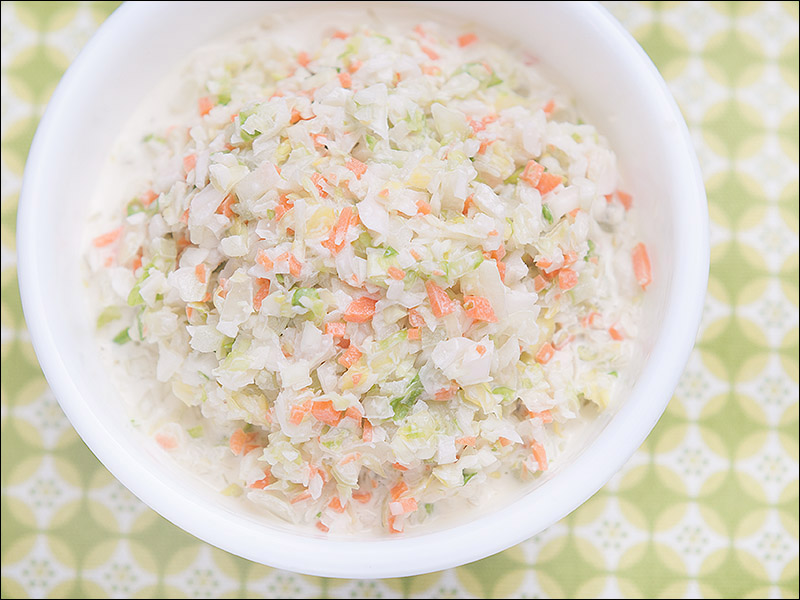
The doctor's new way of making coleslaw.


Garlic salad. © Ryan Schierling
We punish ourselves once a year or so, pushing out five posts in five days, all related to this or that. Last year it was cucumber salads. The year prior, potato salads and a good five days of grilling. 

This summer, we're all about the slaw, so we're going to give you five before the 4th of July. 

There is a gold standard for All-American picnic coleslaw, and it is Kentucky Fried Chicken. As much as I hate to say it, and as much as you might disagree, it is the truth. Name a chain restaurant that has more than 18,000 units and sells as much coleslaw as the Colonel. KFC itself calls it "The World's Best Coleslaw," says that it's "freshly prepared in store" and "sets the coleslaw standard by which all other coleslaws should be measured." My friend Gary worked at Kentucky Fried Chicken in the late 80s, and he tells me that while they made scratch biscuits back then, the chickens were disassembled and breaded on-site and the gravy was homemade – the only thing that was NOT freshly-prepared in store was the coleslaw. It came in bags. It still does, from what I hear. 

Big bags of chopped cabbage, carrots, and onions. The sauce – according to the corporate website – is a mix of sugar, soybean oil, vinegar, salt, eggs, corn starch, mustard flour, xanthan gum, the ever-popular natural and artificial flavor, paprika extractives, paprika, and caramel color. Sugar is the first ingredient, and the last time I sampled it (for research reasons, of course) it was so sweet it could have been some weird cabbage dessert.

I do appreciate it for the role it plays in KFC's menu, which is as a foil to the crunchy, salty chicken. I do have a soft spot for all coleslaw varietals, and I like that the KFC extremely-fine chop of the cabbage, carrot and onion isn't something you get with most coleslaws. If you've ever seen the term "mechanically-separated" on a chicken, pork or beef product, you can only imagine what a Robot Coupe the size of a grain silo with a few million cutting blades would do to truckloads of cabbages, carrots and onions. I'm speculating here, but only in a way that imagines there are no human hands actually involved in the preparation of this product. It's made by coleslaw robots.

I need a coleslaw robot…

Wednesday, June 26, 2013

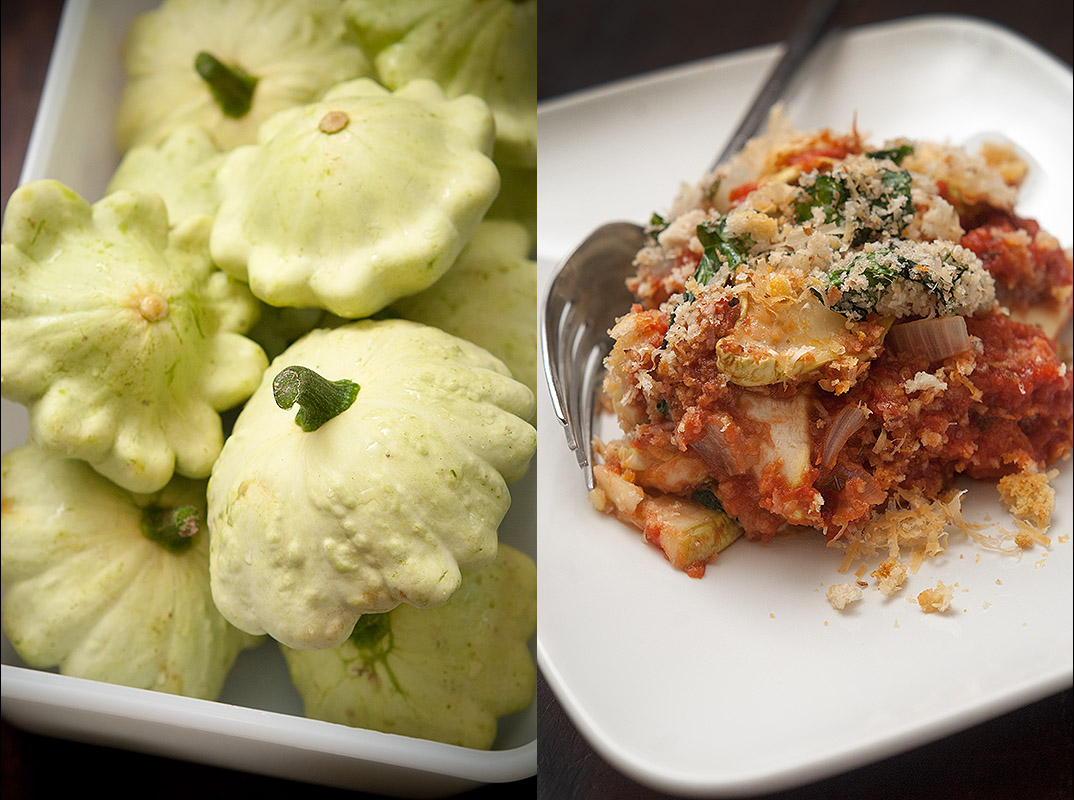
Pattypan Parmesan

(L) Pattypan squash. (R) Pattypan Parmesan. © Ryan Schierling
Pretty and petite, pattypan squash is a rare gem to find in the grocery store – which is a tragic testament to the SKU-driven times we live in. Not only are they adorable, with their flying-saucer shape and scalloped edges, they are mild and delicious to eat.

As a kid, we had these pale green lovelies in our big garden every year along with the yellow crookneck and zucchini. While squash wasn't my favorite vegetable, the pattypan was my first choice whenever squash was served plain. They can be enjoyed small (bite-sized is what you might find in stores) or as big as six inches in diameter, depending upon how you plan to prepare them. Pattypan squash also comes in varieties ranging from yellow and dark green to white, but it's the pale green ones that bring back the memories of searching for them, so-well camouflaged under the big green leaves.


It was a visit to an Austin farmer's market to that reignited my passion for pattypans. A few years ago in bee-line route to get a dozen fresh "yard eggs" before they were sold out, I passed a vendor with a bounty of pattypan and had to stop. This is why everyone should go to the farmer's market on occasion – such delightful finds! 

Related Posts Plugin for WordPress, Blogger...