Showing posts with label German. Show all posts

Monday, October 20, 2014

Sauerkraut and caramelized onion sandwich.

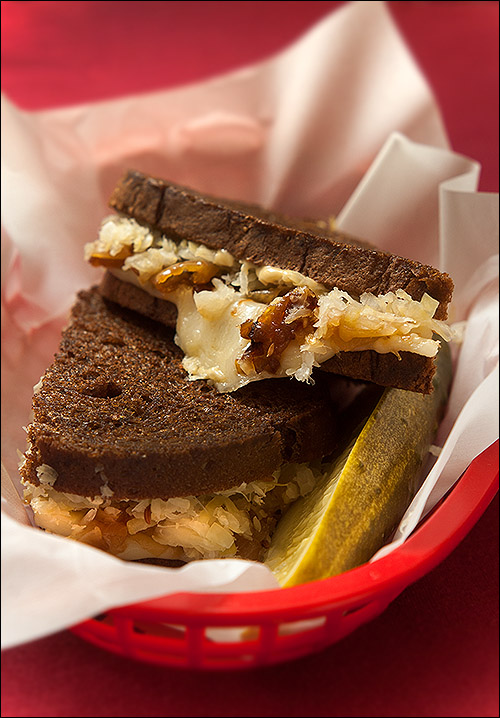
The Wilhelm. © Ryan Schierling
I love a great Reuben. It is one of my favorite sandwiches ever, and I will eat a Reuben anywhere, anytime. The sad thing is, I'm usually disappointed by thin and flaccid, flabby and fatty, tasteless corned beef brisket that's been boiled to the point of inedibility. In my opinion, if there's no respect for the meat, you might as well do away with it altogether. 

This... this is a sauerkraut and caramelized onion sandwich. Think about that for a second. It's cabbage and onions. There’s no corned beef, pastrami or turkey, or kielbasa, or any veggie substitutes like tempeh or seitan, because they're not necessary here. 

The boldest flavors of a Reuben are the sauerkraut, the Russian dressing or mustard, the rye and, if you’re going for a non-Kosher version, the Swiss cheese. Unless you’re eating a $20 Katz’s Delicatessen-style meat-pile, the rindfleisch is usually an additional sub-par, thinly-sliced, sad lunchmeat texture at best, and what little flavor it does have gets lost in the fistfight of aggressive tastes the traditional toppings hold. 

This isn’t a Reuben. It's not a West Coast Reuben, or a Montreal Reuben, and it's definitely not a Rachel. 

So, really, what is this meatless punch-in-the-mouth we made? I hereby declare this sandwich The Wilhelm. It’s not the prettiest handful you’ll ever make. If fact, it's downright ugly, but it hits all the right notes for fall – toasty warm and rich, savory, tangy, with hints of sweet and spicy. 

The caramelized onions take a while but are easy enough (see Chips, Dips and Dorks) and if you'd like to try your hand at making sauerkraut, the simple recipe is below. Löwensenf Extra Hot mustard, a staple in our "mustard locker," is great with this sandwich. 

Monday, February 24, 2014

Down where the Würzburger flows.

Veal goulash with sauerkraut. © Ryan Schierling
I've had a stuffy little red cookbook in my possession for a while now that's been begging to breathe. Compiled by Jan Mitchell and first-published by Doubleday in 1952, Lüchow's German Cookbook – The Story and the Favorite Dishes of America's Most Famous German Restaurant – is important because at the time, there was nothing like it.

And there was certainly nothing like August Lüchow's restaurant, established in 1882, in New York City.

Described by Ludwig Bemelmans – writer and illustrator of the classic and much-loved Madeline series of children's picture books (and an internationally-known gourmet) – Lüchow's attracted a diverse clientele of "...priests, students, national figures, diplomats, politicians with Italian friends in race-track suits with pearl stickpins in their neckties, theatrical folk with broad-shouldered blondes who have brought along Mama and Papa. It is alive with children and dogs." He called it "the most kaleidoscopic restaurant in New York." 

The cookbook is a time machine to the past, to a genteel and gracious establishment that unfortunately no longer exists. Lüchow's shuttered after more than a century of serving proper and traditional European cuisine on East 14th Street at Irving Place.

The very first recipe of the book is Pickled Beef Head Salad, which is followed by Pig's Head Cheese Vinaigrette.

There isn't anything easy about this book, but there is nothing more authentically and satisfyingly German.
 

Tuesday, July 2, 2013

Pretty in pink.

Sauerkraut slaw with red cabbage. © Ryan Schierling

Sauerkraut is, in American culture, a tough one when it comes to palatability. You either love it, or you hate it. 

I'm not ashamed to admit that my love for sauerkraut knows no bounds. I enjoy the sour taste and squeaky texture so much that I've been known to take a two-fingered pull out of the kraut jar and put that gigantic pinch between my cheek and gum, just to savor the juicy deliciousness. It's like the best cabbage chaw you can imagine. And those Frank's Sauerkraut singles? So portable. Okay, I might have a problem. 

But come on, what's not to like? Historically, sauerkraut goes back – way back – a few thousand years B.C. It's rich in vitamin C, high in fiber and low in calories. It was used to prevent scurvy. It's good for your eyeballs (uhm... taken internally, not as a topical ointment) and has been used as a treatment for stomach ulcers and canker sores. 

Whatever name you have for fermented cabbage – in all its glory – it is celebrated worldwide. The Dutch make mashed potatoes with it. The French, choucroute garnie. Russians use it in soup. Koreans have kimchi. Germans serve it with everything, from what I hear. There is always sauerkraut in our refrigerator. Always.

Monday, October 15, 2012

Barbecued beef bierocks.

Barbecued beef bierocks. © Ryan Schierling

I saw a lot of strange things growing up in Kansas. I saw the skies turn a deathly still, hot ochre moments before a funnel cloud dropped down and started sucking the roofs off of houses. I saw an elderly woman speaking in tongues beneath an ominous, menacing mural of abolitionist John Brown. I once saw a six-legged cow. But I ain't never seen a beer rock.

Now, I understand there are many cultural variations and spelling disparities of the bierock – a meat-filled wonder of German and Russian origin, brought to the United States by German Russian Mennonites. They call it "beer rock" in Kansas, but I'm pretty sure – even as an expat – that's got to be a successor to the horrible 90s-dance-music compilation album Jock Jams (Vols. 1-5). If beer rock is what you want, there must be a cheerleading competition on ESPN2 because of the NHL lockout. If you'd rather have a bierock, I've got your number.

Pasty or pastry, pirogi or piroshky, pirok, börek, runza, empanada, calzone… all are a regional version of stuff, stuffed into dough and baked. 

I was introduced to bierocks as a kid, probably at a Mennonite church function in Harper, Kansas. My ancestry is German/Russian, and the version I remember was filled with ground beef, onion and cabbage. If one of the church ladies got a little crazy, there might have been some caraway seed and unseemly gossip in there. 

In my early 20s, I lived in Fort Collins, Colorado and found runzas at a fast-food chain called, oddly enough, Runza. They served a delicious, fresh, beef-filled bierock facsimile that fueled my nostalgia and kept me from having to craft my own. 

If only I'd known how simple it was. 

Sunday, October 16, 2011

Braised beef and boiled bread.

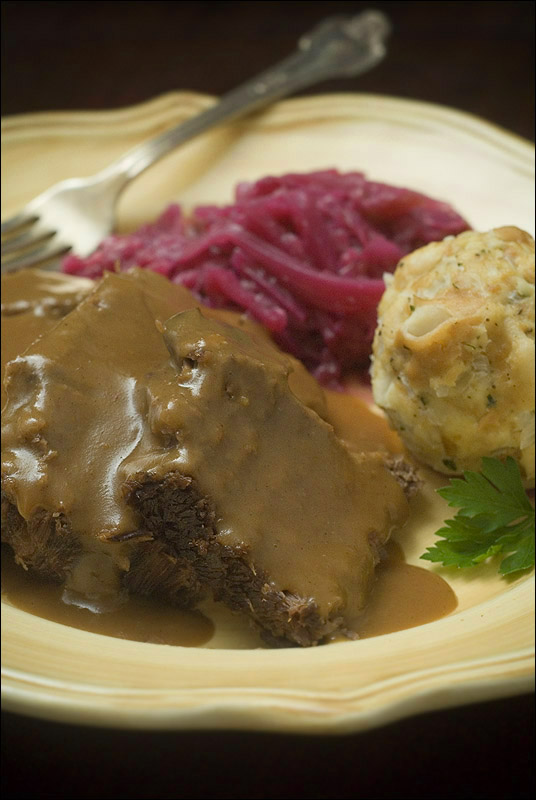
Sauerbraten, with semmelknodel and rotkohl. © Ryan Schierling
Friday night cooking show / with a horse meat dish / I had to stay in the freezer / all Thursday eve talking to that horse – The Dead Milkmen, "Dean's Dream"

I've never been known to skimp when it comes to the authenticity of a dish, but I swear there was no horse involved in this meal. Historically though, horse meat (or venison) was used when preparing sauerbraten. Maybe horse is how they did things in Germany when it's longingly, nostalgically referred to as the "old country," but I'm betting they go for das Rindfleisch nowadays.

This is a traditional meal that your Oma might cook from her grandmother's recipe cards, that you – being four generations removed from the Fatherland – give a wrinkled nose and a sideways glance before pushing it around on your plate for half an hour because German food is just so… bland.

Really? What do you need? An Oktoberfest oom-pah band, a 72 oz. Spaten and a busty beer wench that looks like the St. Pauli girl slugging you in the belly with a bratwurst brickbat?

Don't be such a tourist. Mass-market ethnic cuisine is so diluted in the United States that we're already beginning to associate the lowest common denominator with authenticity. On The Border = Mexican. Olive Garden = Italian. P.F. Chang's = Chinese. Where do you go for American food? Old Country Buffet?

German food is not easy. Most times, it is not pretty. 

It is, for the most part, a heavy, filling cuisine that American restaurants do poorly. It's difficult to find homemade pungent, puckering sauerkraut, fresh caraway-flecked sausages, sinus-imploding mustards... and when's the last time you saw choucroute garnie on a menu? We tried... but disappointed by German fare in Fredericksburg, Texas (a bastion of German-Texan heritage) on more than one occasion, I decided we were going to do this on our own – starting with sauerbraten. I consulted dozens of recipes and tried to distill the essence of what really made sauerbraten so special. What were the historic similarities? What were the regional differences? Why were there differences?

When the roast went into the Dutch oven to brown, the olfactory nostalgia began. Adding the marinade the beef had rested in for the last three days filled the kitchen with a memory for me. I don't know if I really recall eating sauerbraten as a child, but if I did, it was probably at a Schierling family gathering and the preparation smelled exactly like this – rich, savory, sweet and full of red wine and vinegar.

All afternoon the house felt like Fall married with the scent of comfort food, and I couldn't wait to tuck into a plate of beef and gravy.

Saturday, October 2, 2010

Humble beginnings.

Borscht meez. © Ryan Schierling
I didn't learn to cook until I had to. 

Which is to say, I didn't learn to cook until I moved away from home at the tender age of 19. I had a flimsy aluminum stock pot, a hand-me-down cutting board the size of a postcard, and a dangerously dull chef's knife I bought at a secondhand store. What I didn't have was any money. Groceries were budgeted to a paltry $25 a week, which quickly made a thin vegetarian out of me. Meat was far more expensive per pound, and I needed cheap ingredients that would stretch meals through the next payday. Soups were the easiest to make, reheat, and reheat again. I could get half a week's meals out of one pot full of vegetable stew, or 13-bean soup, or the very first thing I ever scratch-cooked after moving out on my own – borscht. 

I'd purchased a used, entirely nondescript, plain yellow-jacketed cookbook called "Ann Seranne's Good Food Without Meat" at a flea market for a dollar. It looked like a bad school textbook, with no photographs and a tiny, squinty font. Originally published in 1973, Seranne had been a food consultant and former editor at Gourmet magazine, and was primarily known for her dessert cookbooks. I had no interest in dessert. I could barely afford a proper main course. 

Chapter one of "Ann Seranne's Good Food Without Meat" was soups, so I figured I'd start there. The first three recipes were Potage bonne femme maigre, Soup a l'aoignon maigre, and Minestrone di verdura, all very much out of my league. I certainly couldn't cook what I couldn't pronounce, and anyway, didn't "Potage bonne femme maigre" mean something like "Soup made from the juices of a good woman?"


Related Posts Plugin for WordPress, Blogger...