Showing posts with label sauce. Show all posts

Sunday, August 23, 2015

The horseshoe sandwich.

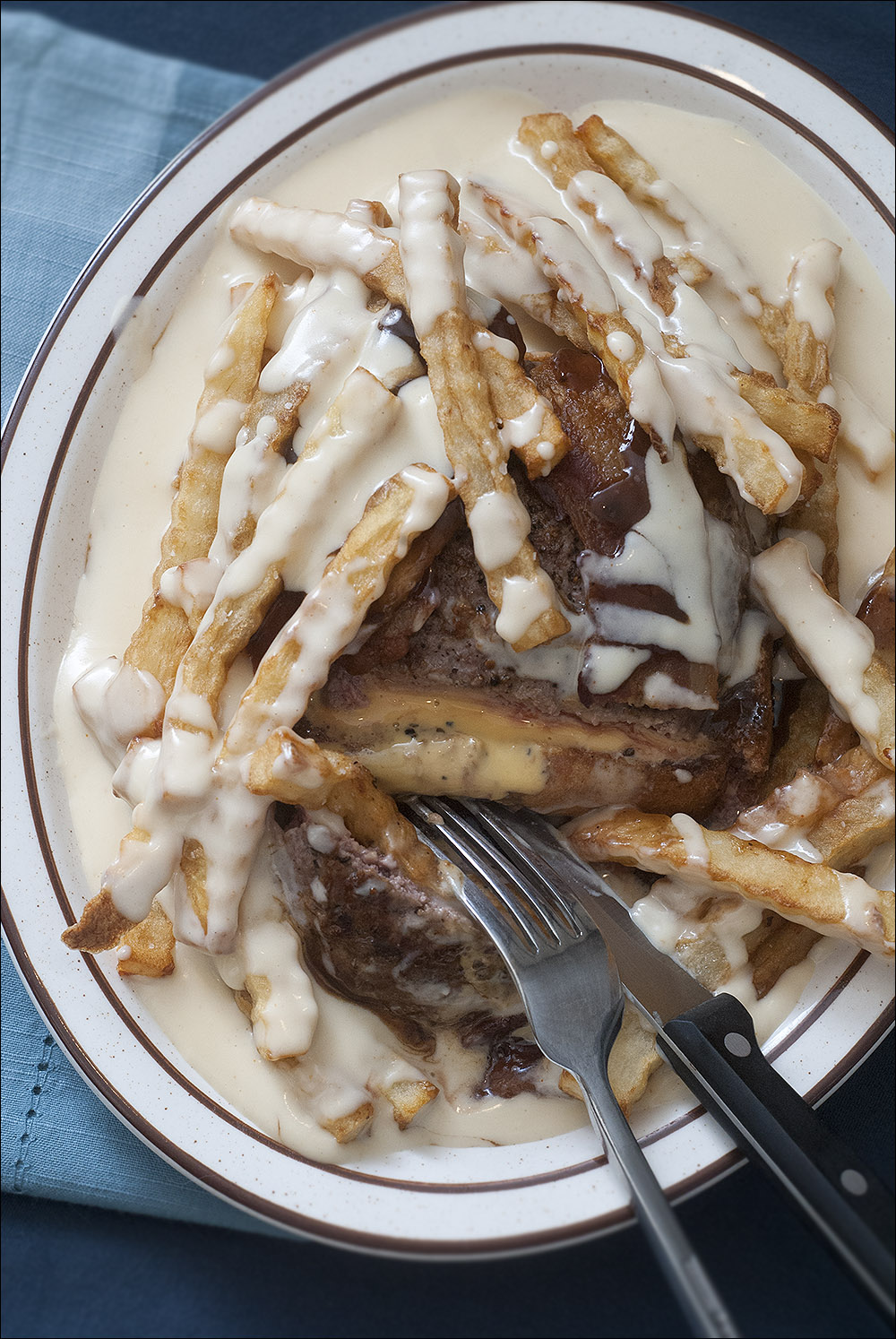
Springfield, Illinois meets Austin, Texas. Horseshoe sandwich, FGHD style. © Ryan Schierling
I'm sure there are wealthy suburbs of Springfield, Illinois that have more cardiologists per capita than any other city in the United States. I imagine when filling out new patient paperwork, there is a check-box for "Do you eat horseshoe sandwiches? If yes, how many per year?" That information is disclosed to insurance companies, you are deemed "high-risk" and your policy is put under review.

In the summer of 2007, I ate a horseshoe at storied purveyor D'arcy's Pint in Springfield. I was determined to finish it, and after 45 minutes, I did. Moments later, I felt the first tinges of angina. I was told by locals that to thin the blood I needed more alcohol. I ordered a pitcher of Old Style and a cold, wet bar towel for my forehead, and that seemed to do the trick.

Years later, I kept telling Julie I was going to recreate this Illinois staple, and it was going to be glorious. The Texas toast, the hamburger patties, the crinkle-cut fries and that incredible blanket of luxurious, velvety cheese sauce.

She took my braggadocio with a lot of grains of salt, reminding me that the heart never forgets. And yet, I got a crinkle-cutter in my stocking the following Christmas. This week, I finally tied on my apron and took that Springfield regular to Austin-level serious. Honestly, why hasn't Texas adopted this plate? It's right up there with Frito chili pie, chicken-fried steak and eggs with hash browns, and enchiladas Dan Jenkins. 

Sunday, August 16, 2015

It's time to make the doña.

Dos brujas – red and green doña sauces (and one frightened mollete). © Ryan Schierling
This recipe is nothing new, especially to Austinites. It certainly didn't originate here, but doña sauce is a bonafide Austin staple, and it has been long-studied, dissected, perfected and repeated by others well before Julie and I ever thought to make it ourselves last year. It is a puréed, pale green, fire-breathing dragon of a jalapeño sauce that was introduced by Veracruz-native Bertha Gonzales to local restaurant Tacodeli 13 years ago. She won an employee salsa contest with it, and it is as important to Austin’s culinary history as Matt’s Bob Armstrong dip, Dirty Martin’s burgers and Franklin’s brisket.

There are varied versions of it in squeeze bottles at taquerias all over town, but Tacodeli made it a locally, fervidly-famous comestible.

The food blogger and bulletin board arguments over ingredients are legend, because the original recipe is closely-guarded. Are the peppers roasted or boiled? Some say there’s avocado, or crema, or raw egg, mayonnaise or even mustard in the sauce. Others swear there’s only a touch of oil, and mostly water so the sauce doesn’t gelatinize in the fridge. Everyone’s got an opinion and a recipe.
 

I was a little baffled though, at why I’d never seen a rojo version of it using red jalapeños. Doña sauce is always green.

Friday, July 10, 2015

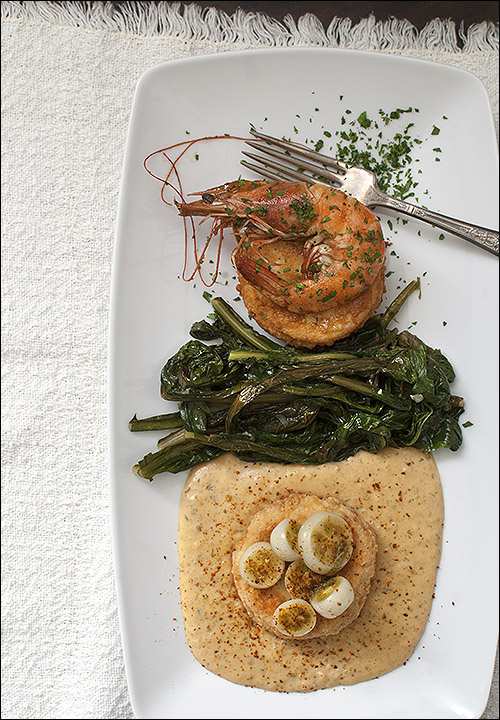
Shrimp, grits, gravy and greens.

Fried grit cakes with boudin gravy, dandelion greens and shrimp. © Ryan Schierling
Every Southern cook worth their heritage cast iron pot-and-pan collection has a shrimp and grits recipe that's the best. Of course, it's a recipe that was bestowed to them in hushed tones by their mama, from their mama's mama, and so on and so forth, down a long line of mamas. My mother doesn't have a shrimp and grits recipe and I'm not a southern cook. I rock the cast iron, but there is no lineage that would tie me to a historically time-honored shrimp and grits recipe.

I'm not looking to give you one more traditional (or non-traditional) reinterpretation of what started as a Low Country breakfast dish. It's been done.

While I have a deep and abiding respect for the classics, I wanted a fussy, sassy, gussied-up little Southern belle that was more a complete plate than just shrimp and grits. Call me a Yankee all you want – but when you taste these fried grit cakes and boudin cream gravy, the little pickled green tomatoes, the robust, biting dandelion greens and that rich New Orleans-style barbecue shrimp – you will slap your mama.

Wednesday, May 20, 2015

Chuck, Charlie®, Charles.

Tuna croquette with plum salsa and jalapeño honey mustard. © Ryan Schierling
In food circles I will never run in, there are Chihuly-blown glass jars of Japanese-auction-sold, million-dollar Pacific bluefin tuna scraps, packed in the oil of olives so extra-virgin they’ve been immaculately conceived and harvested by eunuchs. This tuna detritus – the least of the leftovers of the left-overs from the best of the biggest of the big-bucks maguro – will find their way to children of the nouveau riche for tuna salad sandwiches with the crusts cut off by a butler, or governess or au pair. These children will still turn up their noses. Or so I imagine.

I grew up with tinned tuna that on the good days might have been StarKist® spokes-fish Charlie®. On bad days, it might have been down-on-his-luck Chuck – generic label, definitely not dolphin-safe, extra-mercury-packed, probably not even actual tuna canned tuna. My beloved childhood tuna salad sandwiches always tasted predictably perfect – smashed, flaked fish, heavily-laden with mayonnaise and sweet pickle relish, served on Roman Meal wheat bread (crusts on) by mom.

You can buy whatever tuna you want for this recipe. Maybe you went sporting in the Sea of Japan and got big, fresh and lucky. Perhaps some spendy Italian tonno in oil or just cheap chunky albacore in spring water? Maybe some of that new-fangled tuna in packets. Don't care. We do this recipe fast and cheap, so use whatever you want or feel morally, socially or financially inclined to.

What you will get is a surprisingly bright, nuanced plate. The jalapeño honey mustard is an anti-tartar sauce – sweet, spicy and with a tang that when paired with the plum salsa is a left-right combination punch. The tuna never knew what was coming. We've made this dish so many times with just the mustard sauce, and it's still wonderful. Visually, the now in-season plums suggest a pretty tuna crudo preparation, and paired with Texas sweet onion, jalapeño, cilantro and lemon juice, they'll take you from Chuck to Charles in no time.


Sunday, January 4, 2015

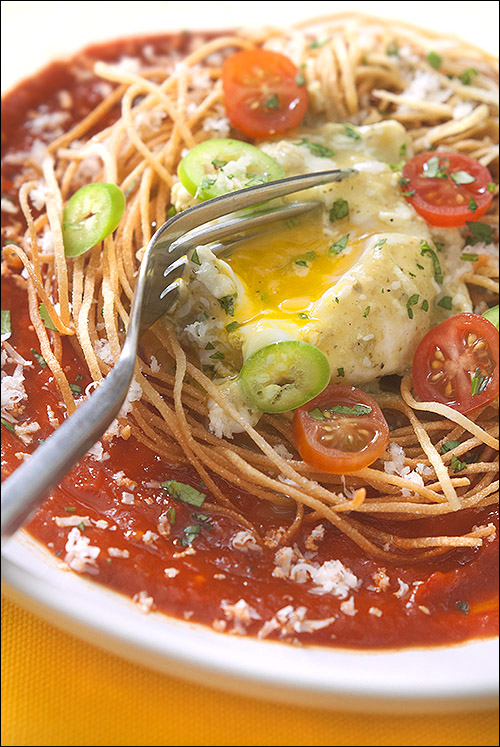
Huevos ahogados mas fácil? Nope.

Huevos ahogados with crispy masa nest. © Ryan Schierling
Historically, on New Year's Day, we make a big deal out of eggs. Anyone can scramble, fry and boil. If you're adventurous, you can sous vide or smoke, or just straight up Rocky Balboa it, and swallow them raw. 

For the last decade, we've prepared Scotch eggs on the first of January, which are hard-boiled eggs, peeled and wrapped in heavily-spiced breakfast sausage, breaded, and deep-fried. They are ridiculously satisfying, delicious dragged through tangy HP sauce, but so intense and heavy we could only justify eating them once a year. So we've been thinking about this since... last New Year's eggs.

Maybe it was time for a change?

For 2015, we adapted a Mexican poached egg dish, huevos ahogados – drowned eggs – with a pair of sauces and a fried masa nest. It was so simple when we concepted it months ago. It ended up absolutely ridiculous when we were trying to figure out the nest. It was silly, and better than it had any right to be once we figured it out, prepared, brought everything together and ate it. 

Friday, May 2, 2014

Enchiladas Dan Jenkins.
Eat these with an over-easy egg and say your prayers. © Ryan Schierling
When I was a kid, the whole seatbelt thing was something folks were just warming up to. I don't know the reason the moment stands out in my memory so, but one day as we piled in to the back of our family station wagon, I was a little slow to put my seatbelt on. My younger brother took it upon himself to harass me about my lack of safety precautions. Finally, in exasperation, he exclaimed, "Do you want to die?!" 

The feeling I had when he said that is kinda the same one I have when I eat these enchiladas. They are stupid to eat, but there's a liberation in the ridiculousness of it all. Between the gooey, salty, Velveeta, the bright tang of onions on the tooth, and that river of enchilada sauce – it seems like the food equivalent of what the free-lovin' 60's must have been like. Drape an over easy egg over the top and you just did it on acid, man....

Our first introduction to this hard-core Tex-Mex standard was at Dart Bowl in Austin. This recipe is from Texas culinary historian-curator-troublemaker Robb Walsh's Texas Eats: The New Lone Star Heritage Cookbook. There are two sauce options in the book – chili con carne sauce or original chili gravy – one with meat and one without. I rather prefer the smoother, meatless style (looking at you vegetarians who care not a hoot about your arteries this week), but there's a fairly narrow margin of difference between the two.

You'll be all set for a stiff drink and a nap when you're done. And, you know, we kinda had to make up for all those light enchilada recipes we've posted this week some way or another... but you'll only get lame apologies for that until you've tried these.

Recipe not included below because it's not our recipe to offer, and we make it exactly as it was written with no adaptations. Go buy a copy of Texas Eats, turn to pages 112-113 and fold the pages back until the book's spine breaks. It will now always open to this dish. It's worth it. 

Well, at least once a year, or until your cardiologist finds out.

Thursday, May 1, 2014

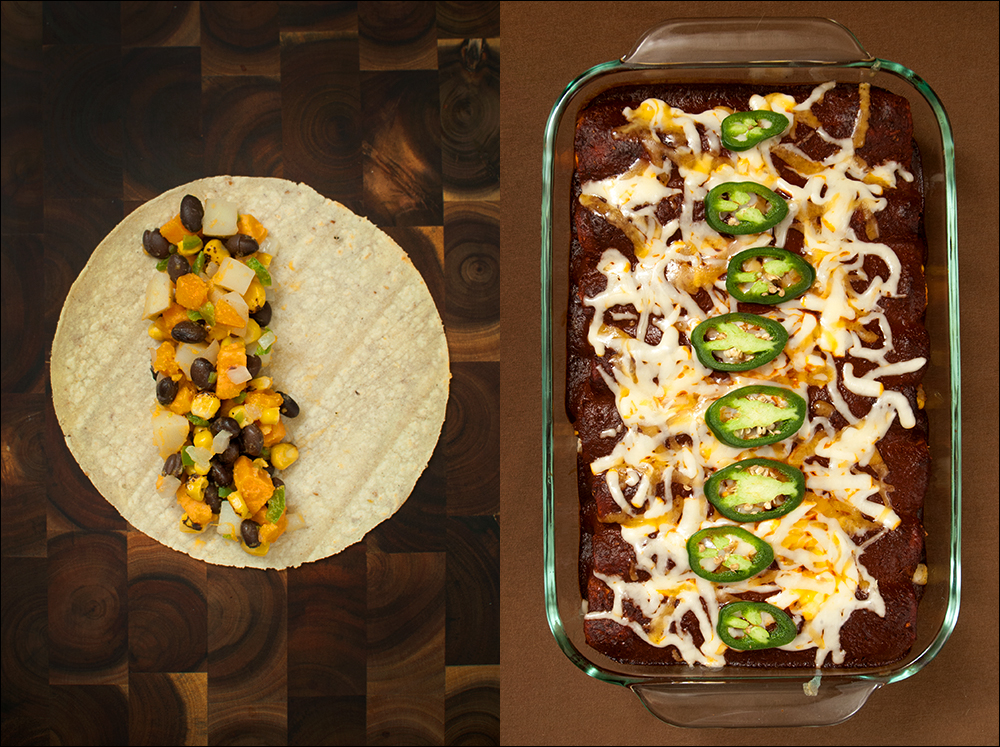
Enchiladas de la tierra.

Sweet potato, potato, back bean and roasted corn enchiladas. © Ryan Schierling
Once upon a time, I came across a taco joint in a northwestern town that served a veggie burrito which included sweet potato. It's a rare item to see featured as a vegetable in most Mexican restaurants, and I thought it was downright delightful. The filling for this enchilada recipe was born from that inspiration and my love for simple black bean and corn enchiladas. Nothing fried here, just a hearty mix of colorful goodness with a tasty homemade red chile enchilada sauce.

Can we just have a word here about red enchilada sauces? Somehow I got hung up on this topic at an early age. My mother was raised in Southern California and somewhere along the line developed some very strong opinions about a certain few ingredients. She always insisted that "Las Palmas" brand red enchilada sauce was the real deal – the gold standard in a can. A little label reading in later years proved her point. Most commercial red enchilada sauces are made with a pureed tomato base. Apparently, as far as Mom is concerned, authentic enchilada sauce is made with only red chiles, not tomatoes. As it can still be a little tricky to find the chile-only variety in the average supermarket, I completely understand her brand loyalty. There is definitely an important difference in both flavor and texture, and if you choose to go the canned-sauce route for these enchiladas, I implore you to do a little label reading of your own before making that purchase.

Homemade enchilada sauce is an easy thing to make if you have a good blender and can source the dried chiles. I like the flavor of the New Mexico or California chiles with the Pasilla chiles, as the combination has more of the "enchilada sauce" flavor profile I grew up with. The Arbol chiles give it a friendly touch of heat. However, you can substitute some of the dried chiles to suit your taste. Many traditional recipes recommend using a combination of  guajillo and ancho chiles – which happen to be two of my favorites in other contexts for their particular richness and depth of flavor.

Forgive me, but the proportion of filling to sauce between these recipes are not very well aligned. The enchilada sauce recipe will be just about right (maybe a tad bit extra) for a 7x11 pan of 8 enchiladas. The filling you will definitely find yourself with plenty extra. I suggest either making a double batch of enchilada sauce, or plan on using the extra filling for tacos or burritos in the next couple of days.


Wednesday, April 30, 2014

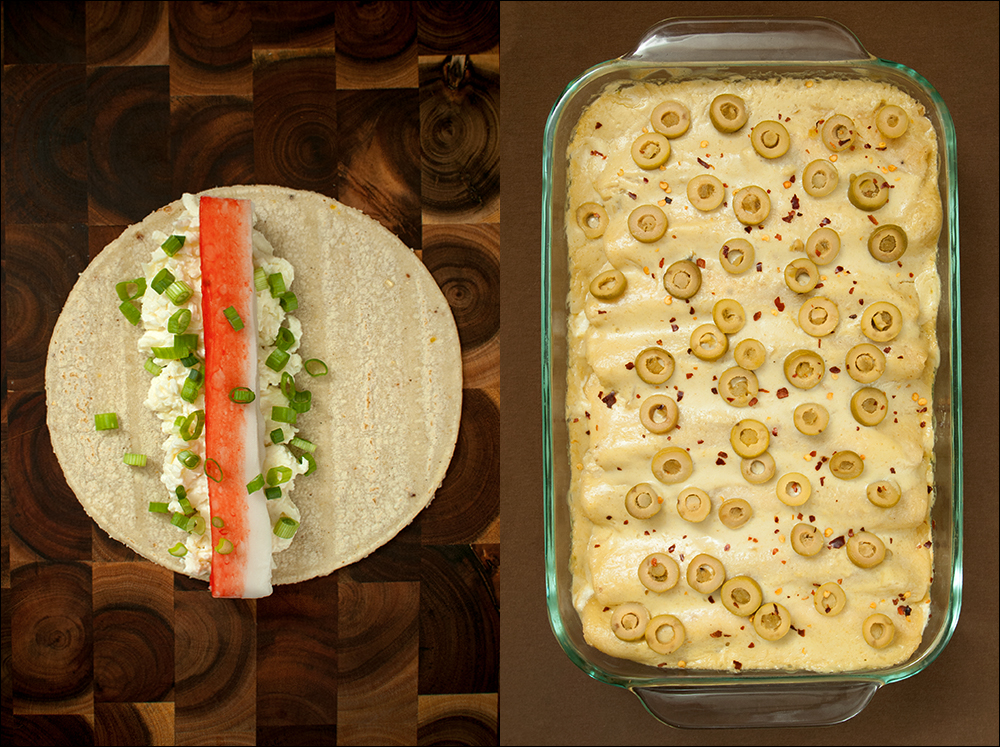
Krab enchiladas.

Krab enchiladas – do not attempt without proper supervision. © Ryan Schierling
I have a few favorite, revered dishes from when I was a kid. This one is kind of a geographical anomaly, as growing up in Kansas was as far away from any coastal waters containing crab could possibly be. Billboards advertised "Beef, it's what's for dinner!" (But if you want crustacean, it's probably going to be spelled with a "K.")

And so it was. Krab (aka Sea Legs or Ocean Sticks) – constructed primarily from Alaska pollock, egg white, crab flavoring and red food coloring – was what we got at the grocer in Emporia, Kansas. Mom made these enchiladas with flour tortillas, jack cheese and a white sauce. Think enchiladas suizas, middle-of-the-midwest-style. 

I don't make them exactly the way mom did. I've tried lump crab meat and cod, and both taste a little fancier than they should for this preparation. This is, in a sense, modern day depression-era cooking – trying to make something elaborate out of an amalgam. The cream cheese tempers the whole dish well, adding a perceived richness that the faux crab doesn't provide on its own. Kind of like pulling up to Red Lobster for senior prom in a limo that you really can't afford. 

So I did switch up the filling up a little and bossed-out the garnish, but had to stay true to the shockingly-red Krab sticks, which are a little like sweet, sweet crabby-flavored string cheese. Don't hate me for loving these. 

Tuesday, April 29, 2014

Mole mushroom melee.

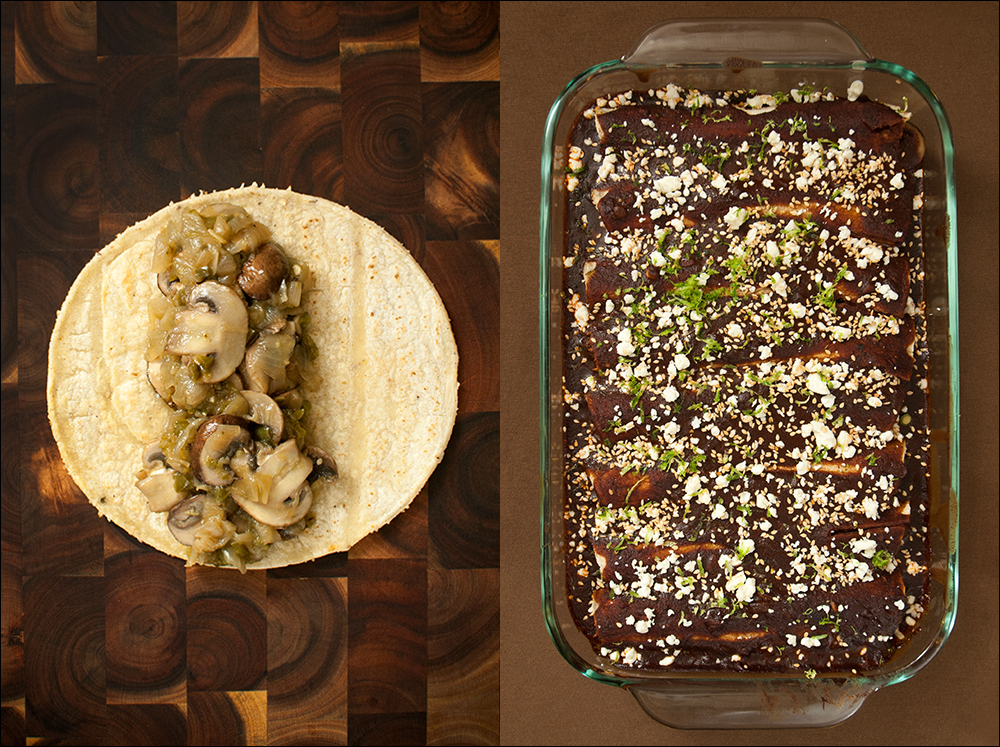
Enchiladas with mushroom and caramelized onion. © Ryan Schierling
When most of us consider sautéed mushrooms and caramelized onions, we don't immediately think "Oh, Mexican food!" First inclinations might turn to a pizza topping, a side for steak and potatoes, or a stroganoff staple. 

Not around here.

One of our longtime-favorite enchiladas is this simple en mole recipe. The mushrooms lend a meaty texture and the sweetness of the gently-caramelized onions – with an added kick of heat from some chopped jalapeños – make for a very satisfying and well-balanced filling. A good mole sauce with all its chile pepper bravado, nutty complexity and hint of sweetness, is the perfect compliment. Mole sauce is usually served with chicken, and all too often that chicken is boiled, beaten and barren – dry as the desert. It is rare to find a meatless alternative that is savory enough to stand up to the richness of mole sauce, and this one works rather splendidly.

All this talk of mole – I don't want anyone thinking they have to either reach for a grocery store jar or make one of those 47-ingredient recipes that take three days to prepare. There is a happy medium, and it isn't the least bit difficult. Some version of this recipe has been floating about the inter-webs for years, and for enchiladas, it is perfect. Do be careful with the addition of nut butters, though. While peanut butter is likely in your pantry, and is perfectly acceptable to use, be cautious with the quantity, or it may taste a little too much like peanut sauce. Alternate nut butters such as almond or hazelnut impart a nice nutty flavor without being quite so distinctive. You can also play around with the use of seed butters such as sesame (tahini) or pepitas for a twist on the complexity the nut butters provide. If you're really, truly desperate, you can use those six-month-old Reese's Peanut Butter Cups from your Halloween candy stash. (I can neither confirm nor deny that this has been attempted in our household, by Ryan, on at least one occasion.)

Wednesday, January 15, 2014

Cornbread Florentine Benny

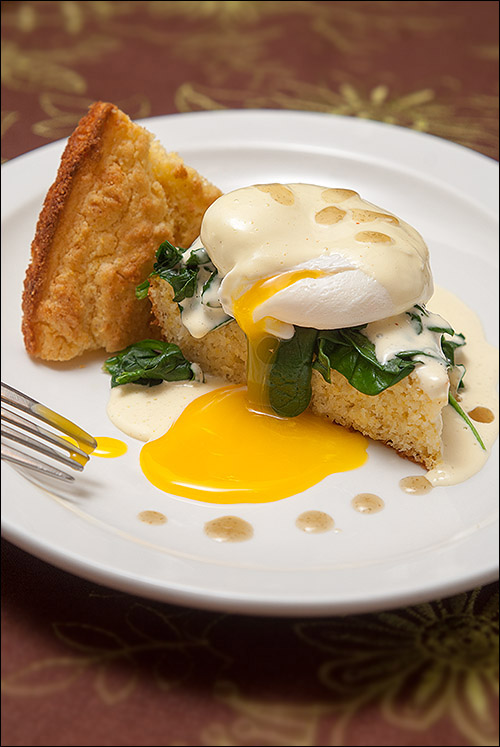
Cornbread Florentine with sour cream hollandiase. © Ryan Schierling
One of my favorite breakfasts is Eggs Florentine with hash browns. I developed this strong affection when we were in Seattle and lived walking distance from The Shanty Cafe, whose straight-forward Florentine Benny and hash browns were delicious comfort on many a chilly Northwest morning. I'll resist making this a diatribe about the rarity of finding really good, crispy, diner-style shredded hash browns in this town (no, really, it's invariably "home fries" in these parts), because today I'm all about sharing another way to enjoy runny eggs and spinach greens.

There's something all sparkly-sawdust about living in Austin that causes us to eventually give all of our favorite dishes a Texas twist. In this instance, a not-too-sweet cornbread finds its place in lieu of the traditional English muffin, and the hollandaise is modified to include a touch of lime and sour cream.

The cornbread recipe is my adaptation of “Yankee Corn Bread” from Bernard Clayton’s New Complete Book of Breads, but using a hot cast iron skillet method for baking. I omitted the bacon, of course. I also added some masa harina (a type of corn flour used for making tortillas and tamales) – because if you know me well, you know that I am loath to bake anything containing corn that doesn't include a bit of masa harina for the delicious flavor it imparts. Hell, I even put it in my pizza dough. Ahem... I've also reduced the amount of sugar considerably, because I don't need or want a sweet cornbread for this preparation, and the addition of frozen corn kernels naturally adds a bit of sweetness. And – to digress for the second time in this paragraph – this cornbread is also pretty awesome to use for making stuffing/dressing during the holidays.

We like the Cornbread Florentine with my Southwest Sour Cream Hollandaise because, well, how can you not offer up a bit of the rich yolky goodness that makes poached eggs happy the world around. This is essentially a blender hollandaise with lime juice in lieu of some of the lemon and sour cream in place of some of the butter. It's a little "softer" than the traditional variety and compliments the cornbread. Ryan generally doesn't dig regular hollandaise sauce, but this one he finds delightful. Go figure. That said, if busting out the blender seems like too much of an stretch on a given morning, I won't hesitate for a second to just use plain ol' sour cream and a good hot sauce drift. I assure you it is really quite good both ways.

We typically make this with cornbread that was baked the night before, so it makes for a relatively quick and easy breakfast. 

Sunday, August 25, 2013

Dan's blackened-chicken pasta salad.

Blackened-chicken pasta salad with honey mustard dressing. © Ryan Schierling
When you move away from things you love, you will find there are some very necessary instances where you'll attempt to recreate them as best you can. Sometimes it's trying to find a feeling, a recollection, or a solid sense of place. The intangibles are always the most onerous to rediscover. Thankfully, when it comes to reviving a food-related impression, it's not terribly difficult to do. Olfactory and taste perceptions bring back memories in powerful ways that other senses seem to clumsily mishandle with feeling and emotion. My most-cherished meals are wrapped with importance and warm remembrance – a single bite will bring forth a flood of memory and stories to retell. 

This simple blackened-chicken pasta salad with rotini, black olives, tomatoes and honey mustard dressing is not my food memory – it is the fond reminiscence of a lifelong friend who has carried it with him and shared it with his friends and family. I am thankful to be a part of that group, and it has been a part of our wee suburban cabin family collection for a while now.

Dan shared this dish with me when we were living at Ghetto Melrose in Seattle. He's been making it since he moved from North Carolina to Kansas, to Washington state and then back to Kansas. Originally a favored menu item at the now-defunct Harrison's Bar & Grill in Cary, North Carolina, not much has changed in his (and our) preparation. 

Wednesday, April 10, 2013

Tortas de coliflor tacos.

Our new "house" taco - tortas de coliflor (cauliflower). © Ryan Schierling
It's been some time since a new taco recipe has graced the pages of this humble blog. There are taco joints a-plenty in this town and every home cook has a private claim to fame – such is the nature of good Austin living.

To date we've stayed true to our mission statement, entertaining ourselves here with stupendously highbrow and treacherously lowbrow tacos, plus a couple in between. But these tacos with their little cakes of tender, sweet cauliflower have, in a matter of just a few weeks, become our new "house" taco. As in "just you try and stop me from eating these every day!" 

I wish we could take credit for the concept, but we know a good thing when we taste it and Papalote Taco House on South Lamar in Austin gets our respectful nod. Papalote is a friendly little taco purveyor with an assortment of creative and delicious fare, and some of the more interesting vegetarian options you'll find in town. Unique among these offerings is a taco starring a fried patty made with cauliflower, dressed in guajillo chile sauce and topped with cabbage and queso fresco. Delicious! It's a stroke of genius with a very low guilt quotient. 

How we first made these at home is most certainly not a story of scientific inquiry or deliberate re-creation. We just had a head of cauliflower that needed to be used, a stack of corn tortillas in the fridge, and we were hungry. We were working from vague memory of a previous visit, but with the basic concept and flavor profile in mind, and simply began making them as we saw fit. The cauliflower, we thought, would be most flavorful if roasted, and in order to let it shine we kept the patty seasonings minimal, simply adding an egg and some flour to tighten up the mixture. Loose as it was, we were able to form small patties, coat them in fine breadcrumbs and fry them up moist and delicious. 

Instead of making our own sauce that first time, we tried using the Frontera Guajillo Salsa which is looser, chunkier and milder but makes a bang-up shortcut if you're pressed for time. If you like them this way, you'll eventually want to try our Guajillo Sauce recipe below for the richer depth of chile flavor it imparts.

Sunday, March 17, 2013

Better than take-out Thai green curry.

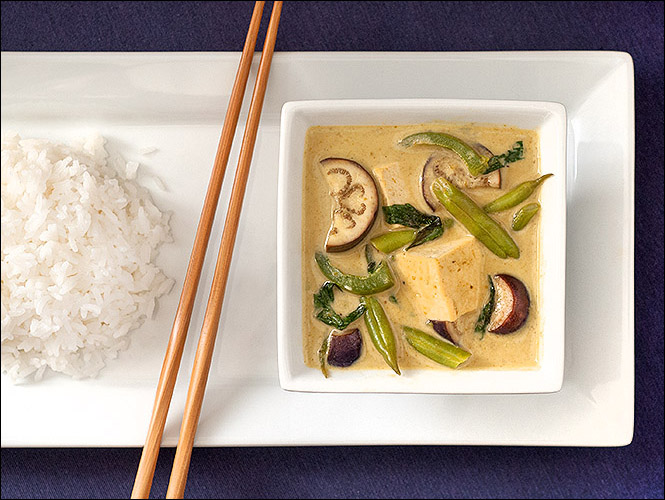
Thai green curry with tofu. © Ryan Schierling
I'm not sure why it's taken so long for me to finally write about this dish. Even with a fair number of requests for the recipe, we've never managed to detail how we make it. We've just made it. 

So, the few who have had it – in the spontaneous and informal space of an evening at home – have been friends stopping by the wee suburban cabin when no plans were made and there was no special occasion to celebrate. It represents to us the simple comfort of family and nourishment to warm the belly. 

How green curry came to be part of our repertoire is one of the earliest food stories that Ryan and I share. Before I moved into the bungalow next door to Ryan in Seattle – before we'd even met – I lived a short block away in a sweet, old third-floor apartment right above a Thai restaurant. Once every week or two I would either stop by or call in an order for pick-up. The were five or six dishes I particularly enjoyed, but the curry (especially the green curry) was my rich and delicious "usual" on a cold and rainy night.

Monday, October 15, 2012

Barbecued beef bierocks.

Barbecued beef bierocks. © Ryan Schierling

I saw a lot of strange things growing up in Kansas. I saw the skies turn a deathly still, hot ochre moments before a funnel cloud dropped down and started sucking the roofs off of houses. I saw an elderly woman speaking in tongues beneath an ominous, menacing mural of abolitionist John Brown. I once saw a six-legged cow. But I ain't never seen a beer rock.

Now, I understand there are many cultural variations and spelling disparities of the bierock – a meat-filled wonder of German and Russian origin, brought to the United States by German Russian Mennonites. They call it "beer rock" in Kansas, but I'm pretty sure – even as an expat – that's got to be a successor to the horrible 90s-dance-music compilation album Jock Jams (Vols. 1-5). If beer rock is what you want, there must be a cheerleading competition on ESPN2 because of the NHL lockout. If you'd rather have a bierock, I've got your number.

Pasty or pastry, pirogi or piroshky, pirok, börek, runza, empanada, calzone… all are a regional version of stuff, stuffed into dough and baked. 

I was introduced to bierocks as a kid, probably at a Mennonite church function in Harper, Kansas. My ancestry is German/Russian, and the version I remember was filled with ground beef, onion and cabbage. If one of the church ladies got a little crazy, there might have been some caraway seed and unseemly gossip in there. 

In my early 20s, I lived in Fort Collins, Colorado and found runzas at a fast-food chain called, oddly enough, Runza. They served a delicious, fresh, beef-filled bierock facsimile that fueled my nostalgia and kept me from having to craft my own. 

If only I'd known how simple it was. 

Sunday, August 12, 2012

The sandwich days of summer.

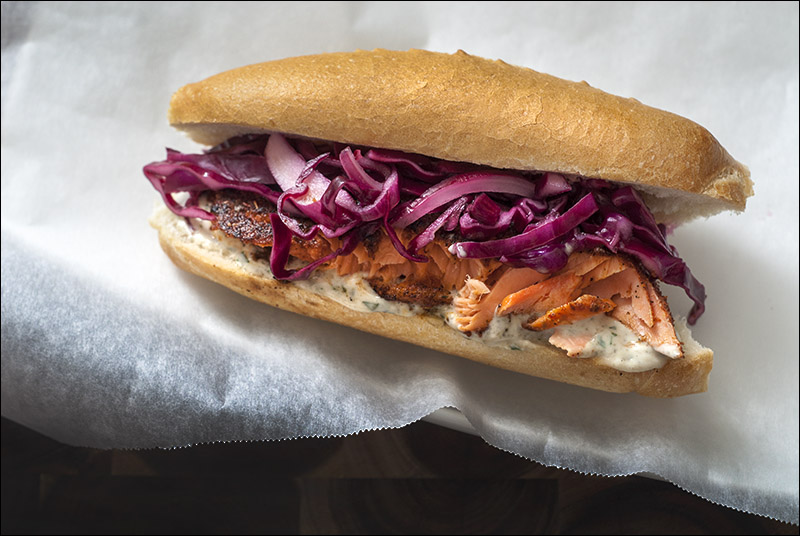
Blackened salmon with caper remoulade and red slaw. © Ryan Schierling

Ah, the salad days of summer. Who can forget those times of carefree frivolity and youthful enthusiasm, of innocence and sweet naiveté?

Back in the moderate month of May, we tackled five cucumber salads in five days. It was the perfect prelude to summer preparation. Now, we're in the thick of it in Austin – 100-plus-degree days, the sun beating down like a white-hot smith's hammer on our garden plots, perspiration aplenty. We spend cooler evening-time hours on the deck drinking aguas frescas and the occasional ice-cold wheat beer mixed with Limonata. Dinners are small, fresh – and while usually thrown together – well-planned for a minimum of ingredients. So we try to let those ingredients shine.

We're on to the sandwich days of summer.

And tonight, the salmon is King, dirtied with a little blackened seasoning and cooked on a ripping hot cast-iron skillet on the grill. Individual baguettes are split and toasted, brushed with a caper and parsley remoulade and adorned with a bright slaw of red cabbage and red onion. This easy summer fish sandwich couldn't ask for anything more.

Friday, July 27, 2012

Chicken-fried Chicken à la King Ranch Chicken.

Yeah, it's a mouthful. © Ryan Schierling
As with any recipe that's been around for more than 75 years, there will always be nebulous narratives about the origins. Vague references to obscure cookbooks – long out of print, written by chefs long-since dead – are all we have to rely on. Well... that, fond and faded memories, and Wikipedia.

Fried chicken has been around since chickens evolved from dinosaurs. Delicious, delicious dinosaurs.

Chicken à la King dates back to the late 1800s – a hotel cook in Philadelphia, perhaps. In the simplest forms, it is diced chicken in a cream sauce with sherry and mushrooms, usually served over toast points.

King Ranch Chicken can be traced to a 20-year stretch between 1945 and 1965 and despite the moniker, has no ties to the sprawling Kingsville, Texas ranch of the same name. It is, roughly, a chicken enchilada casserole with a spicy cream sauce and a boatload of Colby and Jack cheese.

Junior League cookbooks and soup can labels will provide a wealth of knowledge when it comes to the standards like fried chicken, chicken à la King or King Ranch Chicken. Follow recipes to the letter and you will be blessed with crowd-pleasing, pleasantly bland, rib-sticking, middle-of-the-road, middle-of-America fare. However, venture off the path into the hinterlands, and you will find the bastard chicken, I mean children, of these tried-and-true classics.

Boned, butterflied, and buttermilked chicken thighs are dredged in well-seasoned flour and fried until crispy. Texas toast is slathered in butter and griddled. Tiny brown mushrooms are quartered and sautéed with a hit of sherry. The pale green sauce is born of roasted tomatillos, poblano and serrano peppers, onion, garlic and a lot of heavy cream.

It is fried chicken. It is Chicken à la King. It is King Ranch Chicken. It is all of these, and still none of these.

Sunday, July 22, 2012

My coleslaw can beat up your coleslaw.

BFF on a bun. Slaw on pulled pork with mustard sauce. © Ryan Schierling
There is only one coleslaw recipe in this household. I will admit, we have prepared others on a whim, when experimenting with dishes that seemed like they'd benefit from a crunchy, slightly sweet and tangy cabbage salad on the side. As much as I love cabbage in all forms, none of them stuck.

This one, I wrote down for the first time in 2005. I don't remember how long I'd been making it before it was finally put to paper, but full of bluster and bravado on an old blog, I branded it Ryan's Bad Ass Coleslaw. Somehow the moniker stuck. If I had to rename it now, in 2012, I might be a little more humble. I'd call it... Ryan's Bad Ass Coleslaw. Hey, we're all proud of our children, right?

Alright, sorry, it is a nice slaw, and it's a perfect barbecue side. It also has no mayonaisse, which is a sticking point for some coleslaw traditionalists, but mayo weighs down a lot of picnic dressings and I wanted to keep this as light as possible to give the cabbage, carrots, green apple and jalapeños center stage. The simple dress for this salad is a mixture of cream, apple cider vinegar, honey or agave nectar, and salt. That's it. That's all it needs.

Unless you wanted a little help from Bad Ass Coleslaw's friends – pulled pork and mustard sauce. 

Friday, June 15, 2012

Don't call it a comeback / I've been here for years.

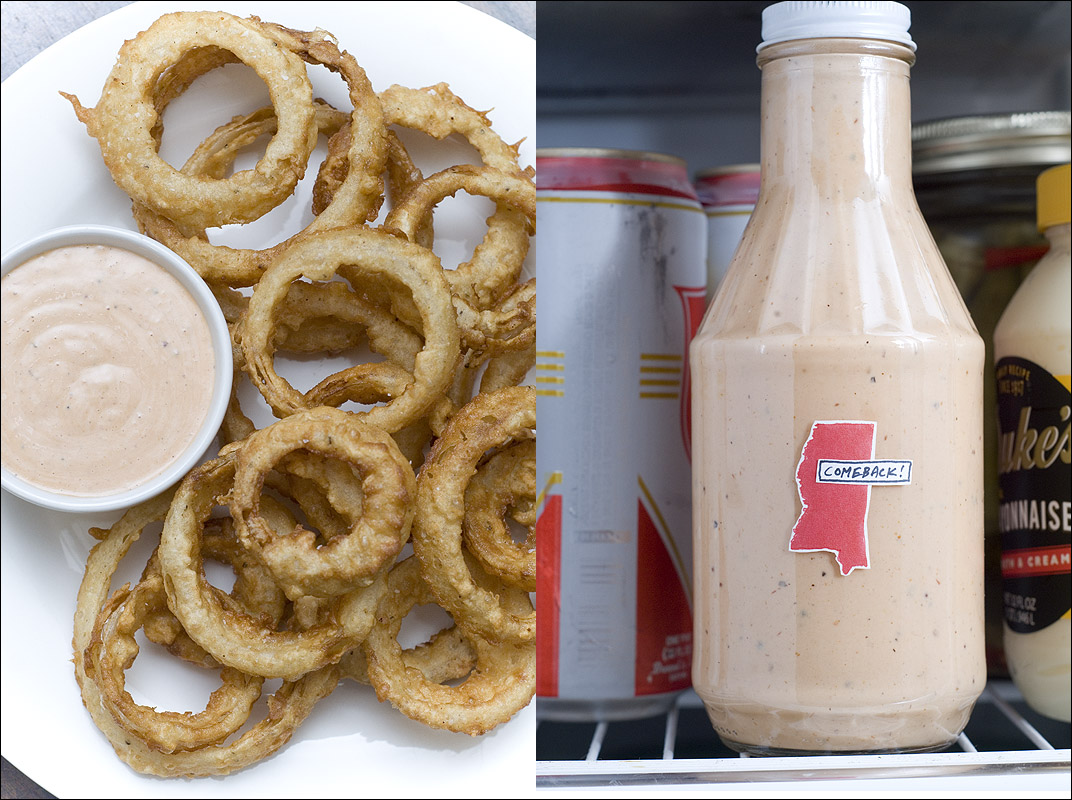
Homemade Mississippi Comeback Sauce. © Ryan Schierling
Twenty years ago, in Fort Collins, Colorado, I was a store manager working for the clown. Say what you will about McDonald's Corporation, they were my first job and an invaluable life lesson in the business end of food. When it was time to move on, I took the good, left the bad and haven't really looked back since.

Until a few weeks ago, that is, when I developed a single-minded focus on Mississippi's mother of all condiments, Comeback Sauce. I've taken a shine to some specific regional Southern specialties, especially ones that aren't often found outside their culinary stomping grounds.

Comeback Sauce (née Kumback Sauce, Cumback Sauce) is a Jackson, Mississippi (that's MS, Jackson if you're nasty) original from the 1930s, widely credited to Greek immigrant Alex Dennery at his restaurant The Rotisserie. Used as a "house dressing," comeback seems to be closely related to 1000 Island, Russian, Catalina and French dressings in spirit. A British Marie Rose? Parallel invention, perhaps.

The only differences in these very similar sauces are in the… subtleties. A bit of grated horseradish there, some minced onion here, tomato paste instead of chili sauce, yogurt instead of mayonnaise, a touch of white vinegar or pickle juice; like every sauce or dressing the whims of the cook and the plenty of the pantry come into play.

But I digress. For me, this really all goes back 20 years to french fry sauce. McDonald's french fry sauce.
Related Posts Plugin for WordPress, Blogger...