Showing posts with label potato. Show all posts

Wednesday, October 14, 2015

Calamari Provencal.

There's a steak in there. © Ryan Schierling
There are a lot of things I don't understand about the ways of food wording. When a cow is grazing, wandering, giving milk, it's a cow. When it's butchered, it's beef. Baby cow... calf. Unless you're eating it, then it's veal. A pig is a pig until it's pork, a moniker issued upon its demise. Chicken, well, that's just... chicken. A squid out of the water and on its way to your plate is calamari, unless you're Italian. In that case, in whatever state, it's still calamari.

Most people are familiar with the breaded and deep-fried rings of calamari, oft-dipped in marinara or aioli. This chain-restaurant appetizer staple endured somewhat of a scandal a while back. Given the shape, color and texture of calamari rings, some insidious folks had been passing off "imitation" calamari as the real thing, and you don't want to know what the faux calamari was made of. Or maybe you do. Let's just leave it at the fact that "seafood fraud" is apparently a common occurrence in the food industry, and you may have been enjoying a delicious plate of sliced, deep-fried hog rectum. Prepared in a similar fashion, pork bung has a texture that is frighteningly close to calamari rings. Fried and dipped in a sauce that masks most flavor, not many would be able to tell the difference. Hell, after a few glasses of wine, most people would mistake supple Italian shoe-leather for milanese if you breaded, deep-fried and seasoned it nicely.

Sunday, August 23, 2015

The horseshoe sandwich.

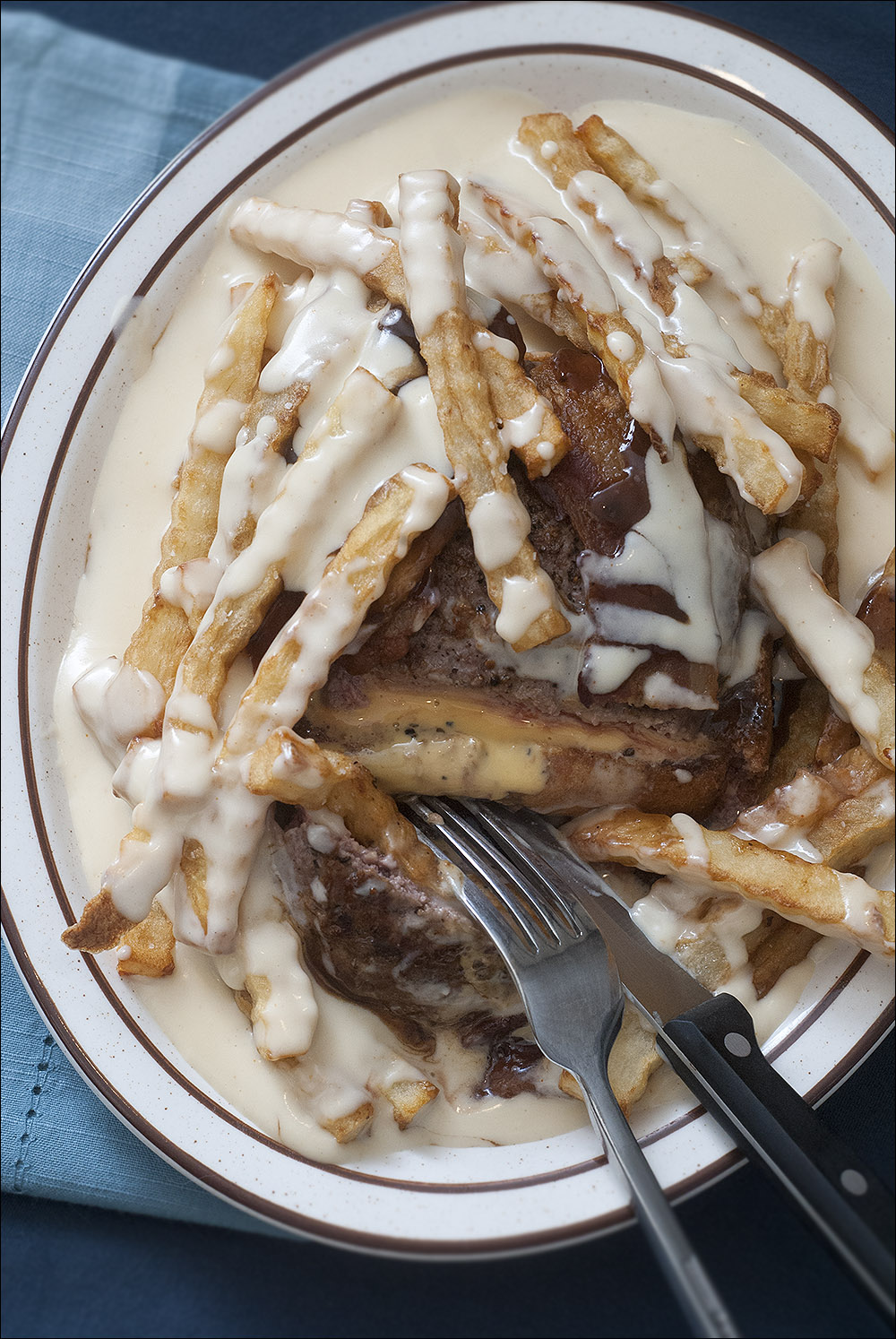
Springfield, Illinois meets Austin, Texas. Horseshoe sandwich, FGHD style. © Ryan Schierling
I'm sure there are wealthy suburbs of Springfield, Illinois that have more cardiologists per capita than any other city in the United States. I imagine when filling out new patient paperwork, there is a check-box for "Do you eat horseshoe sandwiches? If yes, how many per year?" That information is disclosed to insurance companies, you are deemed "high-risk" and your policy is put under review.

In the summer of 2007, I ate a horseshoe at storied purveyor D'arcy's Pint in Springfield. I was determined to finish it, and after 45 minutes, I did. Moments later, I felt the first tinges of angina. I was told by locals that to thin the blood I needed more alcohol. I ordered a pitcher of Old Style and a cold, wet bar towel for my forehead, and that seemed to do the trick.

Years later, I kept telling Julie I was going to recreate this Illinois staple, and it was going to be glorious. The Texas toast, the hamburger patties, the crinkle-cut fries and that incredible blanket of luxurious, velvety cheese sauce.

She took my braggadocio with a lot of grains of salt, reminding me that the heart never forgets. And yet, I got a crinkle-cutter in my stocking the following Christmas. This week, I finally tied on my apron and took that Springfield regular to Austin-level serious. Honestly, why hasn't Texas adopted this plate? It's right up there with Frito chili pie, chicken-fried steak and eggs with hash browns, and enchiladas Dan Jenkins. 

Wednesday, March 11, 2015

New Mexico-style green chile stew.

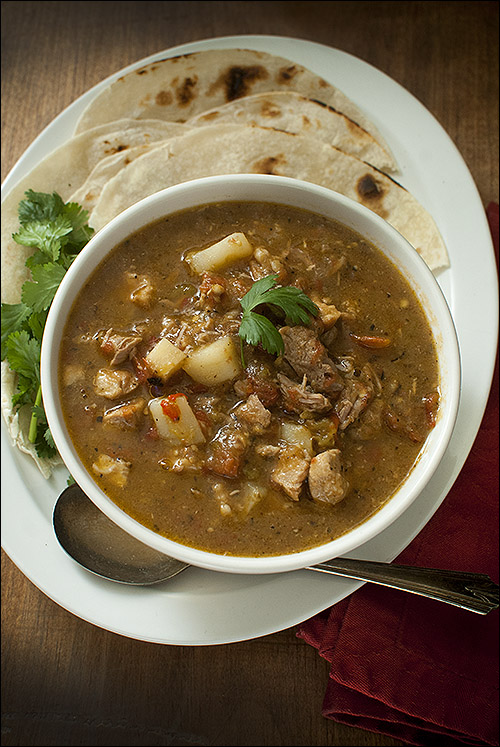
Green chile stew with pork and potatoes. © Ryan Schierling
I am not from New Mexico, and I am not from Texas. I am originally from Kansas, but I understand the reverence held for their respective chile and chili. 

There is no question as to the permanence of Texas red chili being the Lone Star State's one and only. It was declared to be the state dish of Texas in 1977 by House Concurrent Resolution No. 18, with President Lyndon Johnson brazenly declaring that "chili concocted outside of Texas is a weak, apologetic imitation of the real thing."

I wouldn't go so far as to call chili in New Mexico weak or apologetic, but I wouldn't go so far as to call it chili, either. It's chile stew.

Technically, there is no state dish of New Mexico. They do have an official state question which is directly related, and that is "Red or green?" If you can't decide, you just say "Christmas," and whatever plate you've ordered will get smothered in a little bit of both red and green chile sauce. 

The green version of this stew is my favorite, and it's fairly easy to make. My recipe is not "authentic," as I use poblano and jalapeño peppers in addition to the Hatch green chiles, but like I said, I'm not from New Mexico. This is my Old Mexico recipe for New Mexico green chile stew – by way of Washington state, Virginia, Colorado and Kansas – which is a little closer to a caldillo

It is as far away from the Midwestern red chili of my youth as can be, which was a thickly-tomato sauce-based, ground beef and kidney bean-filled bowl, heavily-spiced with ground chili powder and cumin. This green chile stew is thinner, tangier and focuses the flavors of the roasted chiles themselves. The tender pork adds a hearty sweetness and complimentary texture to the stew. It is a fantastic winter meal.

FGHD editor's aside/note/distraction: I spent my formative years in Kansas, and just so you know, there's no official state dish of Kansas either, but The Kansas Historical Society has a recipe for Mr. White's Famous Tossed Lettuce Salad, which legendary, storied newspaperman William Allen White – who was born and died in my hometown of Emporia – apparently prepared at the table "in a rite he stood up to perform." Now, no matter how much pomp and circumstance you're bringing, the tossing of a head of lettuce, a bowl of minced onion, vinegar, oil, salt and curry powder seems a bit unlikely for a state dish contender. State Dish of Kansas – Tossed Salad? No. I will defer to Joe from Oklahoma, and his pork ribs and fries on the Kansas state line side of Kansas City. Now, that's a state dish.

Sunday, February 15, 2015

Smoked salmon chowder with salmon bacon.

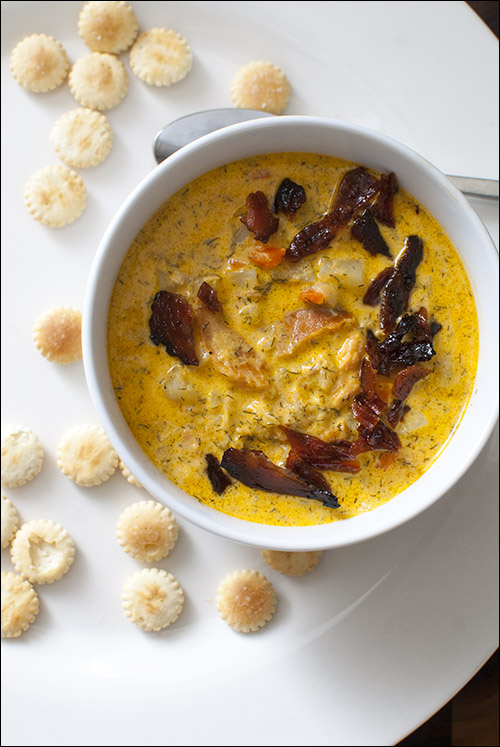
Smoked salmon chowder with salmon bacon. © Ryan Schierling
There are so many brilliant smoked meats in Texas it's a shame that no one really pays much attention to the fishes.


Granted, this is bovine country and the nearest salmon, be it Pacific or (heaven forbid) Atlantic, is an ocean away. Wherever you hail from, there’s always something sacred about cooking with smoke. Brisket is the gold standard by which barbecue joints are judged in the Great Republic, and if you've got a line out the door for beef, then pork ribs and chicken are pretty much a gimme.


Geographically, barbecue in this part of the country has never had a reason to be about the fish. Southern barbecue is beef and pig and yard bird. About the only ocean-sourced thing you’re likely to see on the grates of a Texas smoker are gulf oysters.


Salmon has a little less real estate to work with than most things that end up in the smoke. If someone could engineer and farm a salmon the size of a cow, you'd have cheap sides of salmon cluttering up everyone's offset, and apple trees would be shaking in their boots, err... at their roots. But salmon are not the size of cows and they're a little harder to catch than cows, pigs and chickens, so their most delicious parts are at a premium. 

Friday, June 20, 2014

Hangover breakfast, part two.

Caramelized fennel and onion hash. © Ryan Schierling
Sometimes, there’s not a definitive narrative to the things we make.

Sometimes we mumble. 

Sometimes there’s just an overflowing refrigerator and a short-order cook aesthetic – throw some stuff together and put an egg on it. The treatments will vary depending on what we’ve been cooking lately (have you ever eaten taco salad variants five nights in a row?) and what happens to be in the pantry, but shaking things up sometimes requires a reset and breakfast is always where I begin again.

We had pounds of potatoes, tons of onions and two generous fronds of fennel. How am I supposed to be fabulous with fennel?

I don’t enjoy anise-flavored things in the least – Jagermeister and NyQuil (which may as well be the same disgusting thing when you have a cold), absinthe (love the old-world concept and execution, hate the liquor), Black Jack chewing gum (what the…?), star anise (pretty, but pretty repulsive) uhm… black licorice (sue me, it's foul). Some spell it “liquorice” and that would seem to imply I’d love it, seeing that it’s a compound word containing “liquor” and “ice.” Not so. Definitely... not so

But fennel that is slow-cooked down with onions until it’s brown and supremely sweet isn’t something we’ve ever done before. The fennel flavor changes from a bracing, bright anise hit to a far more complex, mellow mouthful that’s so very nice with potatoes. A squeeze of lemon juice and a couple of garden-fresh tomato slices add some acidity, and the egg on top is required whether this is for breakfast or not. Enjoy.

Tuesday, December 18, 2012

Root down.

Roasted beet and cranberry soup with pickled beet greens. © Ryan Schierling
I've been told a number of times that I could make soup out of anything. For a while, I took that as a challenge. Some days it meant mind-bendingly turning a leftover chickpea, feta and black olive salad into African peanut soup. Other days it meant making proper stock and clearing the crisper (read as: rotter) drawers of our refrigerator. Have you ever made lettuce consommé? No, you haven't, and you don't want to. Soup – as the saying goes – may be good food but it is also, occasionally, a grim test of a cook's mettle.

All of the tried-and-true classics are already in cans, so the challenge is to either make a soup can soup better, or make something that no one's thought of yet. The problem is, I did some research on the internet and apparently, everything's already been thought of already, soup or otherwise… and it's on a blog, or Facebook, or Instagram, or Pinterest, or whatever.

This information overload pushes me back toward simplicity, and sometimes that's the best thing about the massive, endless, big old stupid-head internet. I turn the computer off, scribble the first three ingredients that come to mind on a scrap of empty envelope and race to the grocery store. That's it, and it's soup. I don't need truffle oil for this, or wild game, or heirloom anything.

Now, it's winter. I want to make something that's a foil to the chill, the wind and the frost, but celebrates the meager ingredients available in this coldest of seasons. So far, we've put together potato chowder with roasted green chiles, proper Texas red, and chicken stock with chunks of onion and carrot and gently-simmered pesto-filled tortellini. All are simple, and filled with robust flavors that shine on their own.

Sunday, December 9, 2012

Tortilla Española-dilla.

Walking Tortilla Española? Indeed. © Ryan Schierling
Disclaimer: This is not a recipe for authentic tortilla Española, so don't get your calzoncillos in a bunch.

Julie didn't set out to make tortilla Española when she decided to whip up a quick, portable breakfast with a bare minimum of ingredients, but at its simplest, that is what it has become. Similar to the Spanish bocadillo, but subbing a big flour tortilla for bread, this delicious and deceptively-easy egg, potato and onion dish has quickly become one of my all-time hand-holdable morning favorites.

It's not a stretch, because tacos of all kinds find their way into my waking routine at least a few times a week, but this is a fast, one-pan breakfast that takes nothing more than one tortilla, one egg, a serving of hash browns and a little chopped onion. 

It doesn't need bacon or roasted red pepper or basil or tomatoes or cheese, but any additions or substitutions make for effortless frittata-like possibilities (as long as the overall moisture-level and consistency stays the same), and we do mix it up occasionally. This morning's version included leftover mashed potatoes instead of hash browns, a little fresh salsa verde, a chopped-up Morningstar Farms® sausage patty, onion and egg. Tater tots, frozen shredded hash browns, chopped-up hash brown patties or leftover latkes also work well. 

We've been joking about how this should have been our Today Show Home Chef Challenge entry, because it's much closer to what our Papaquiles were re-imagined as for large-scale preparation and service by the Today Show food trucks at SXSW. Perhaps next time...

This is a simple, single-serving tortilla Española that gives you creamy potato, custardy egg and a bit of bright onion, all in a fraction of the time it would take to create the superlative Spanish classic. As an added bonus, you can eat it while driving. Try that with a proper tortilla Española.

Tuesday, February 14, 2012

The Flemish flourish.

Carbonnade flamande over horseradish mashed potatoes. © Ryan Schierling
The winter weather here in Austin has me supremely torn. I love that I can wear flip-flops, jeans and a t-shirt to the grocery store when it's a seemingly-freakish 70-degrees mid-January. But, there's a part of me that absolutely hates it's mid-January and I'm making salads and agua fresca instead of a fiery chili, a hearty rib-sticking ragu, or Julie's ghetto mac-n-cheese. The rest of the country is in a deep freeze, and we've still got lettuce happily bursting out of the garden. There is no chill to stave off. 

Thankfully, there are some temperature swings and dips here and there, and after throwing a few logs in the fireplace, I take advantage of the kitchen and the cravings that come along with a (slightly) chilly day.

This recipe came out of a recent evening where the temps dropped into the low 30s, and knowing it wouldn't last, I was bound and determined to open all the windows and make chili, or a stew, or some seriously thick, thick soup. I wanted warm and comforting, rich and delicious. I also wanted a familiar feeling, but a little challenge with something I'd never made before. Something foreign. As it turns out, the recipe I needed was The (other) National Dish Of Belgium – not moules frites, but a Belgian beef and beer stew called carbonnade flamande (or a la flamande). 


Wednesday, February 8, 2012

Papaquiles.

Papaquiles (the imaginary friend of chilaquiles). © Ryan Schierling
Disclaimer: The name chilaquiles comes from the Nahuatl word chil-a-quilitl, which means "herbs or greens in chile broth. "Papaquiles" is not actually a word. We made it up. That's alright, though, because this concoction bears only a passing resemblance to one of our other favorite breakfast dishes. You guessed it... chilaquiles.

Since our very first introduction to this Mexican breakfast, we've been huge fans. Fried tortillas all sauced up in red or green salsa, with sour cream or fresh crema, a little diced onion and the glorious yellow of yolks spilling from fried eggs – what's not to adore?

One weekend morning about four years ago, after we had been making chilaquiles at home for a few months, I woke up wanting all those delicious flavors. Except, I was in the mood for hash browns... and why not instead of totopos? Barely into my first cup of coffee, I articulated this to Ryan and within the hour he had created a breakfast dish that met my craving with wild success.

It's ridiculously simple, actually. Hash browns cooked to perfection with nice crispy edges, a big spoonful of salsa verde, a dollop of cool sour cream, chopped white onions for their brightness and crunch, and crowned with an over-easy egg. Finish this with a drift of your favorite hot sauce and your day is at once off to a fantastically rich and savory start.

We don't play favorites between roja and verde versions of chilaquiles, but with hash browns the salsa verde has been our mainstay and the best fit in terms of consistency and flavor. While we're still running all over Austin exploring the plethora of amazing chilaquiles at local taquerias, for breakfast at home "papaquiles" remains one of our very favorites.

Wednesday, January 25, 2012

Give me your ugly, your lumpy, your misshapen...

Root vegetable-creamed linguini with bacon and parsley. © Ryan Schierling
…and I will make soup of them. Now, I realize you might be thinking "Wait a minute. That's not a picture of soup at all, it looks like some creamy, cheese-drenched pasta with bacon on it." You would be partially correct. It is not soup.

But it was.

Some of the best soups in my repertoire are straight from Crescent Dragonwagon's Dairy Hollow House Soup & Bread Cookbook. Her Spanish-style split pea is one of my all-time favorites, and along with Hungarian Green Bean and Potato, and Cuban Black Bean, I could easily be soup-satiated all winter long. Problem is, there hasn't really been a winter this year in Austin. Sure, it's dipped into the 30s for a day or two, but most of January we enjoyed mild 70-degree days. While our friends in Seattle were getting eight inches of snow last week, we were wearing t-shirts and flip-flops, harvesting lettuce and spinach from our garden. But this month's Snowmageddon in the Pacific Northwest made me remember another Seattle snow day... oh, way back in January of ought-seven.

"With flurries predicted for the following day, I made a list before I went to bed.

Monday, January 16, 2012

Fancy pants humble pie.

Galette with carrots, potatoes and spinach. © Ryan Schierling
This one time, I got an idea for a recipe... Yeah, sometimes talking about it feels a little less exciting after you've had a couple days of space from the process. But when you are in the midst of innovation, immersed in an idea and its possible variants and unable to shut off the running dialogue as you craft your dish, every little choice is a small thrill on top of the rush of simply making something new.

So, what's the story? I was possessed by the desire to make something kinda post-holidays thrifty, beautiful, vegetarian and main-dish worthy. Those poor veggies; they really do get short shrift sometimes when it comes to prime time on the plate. A true "entree" featuring vegetables is a tricky one to pull off without resorting to some form of a casserole. One elegant attempt that comes to mind all too clearly was a mixed vegetable pave I was once served for dinner on a wine train excursion. It was over a decade ago, but I remember it well because as lovely an idea as it was, it tasted terrible. I'm not sure exactly what was in it, but there were suspicions that it included some poorly-seasoned okra. The idea, however, was interesting to me.

Last year Ryan pulled out the mandolin and made a wonderful potato pave. I loved the structure of the layered potatoes, but I was thinking of something a little more rustic that incorporated more colorful vegetables – carrots and spinach – and that wasn't quite so time intensive.

Elements. © Ryan Schierling
The recipe below will flush out the technical details, but I want to note a few things that were important to me in the making of this galette. I could have used any kind of dough, but I wanted it to be distinctly savory, so I made it with 1/4 dark rye flour. It was actually the rye flour that inspired the cream cheese on top. (That and the fact that we had a copious quantity of it still in the fridge left over from the holidays.) Cream cheese and rye are a brilliant flavor combination. The tang of cream cheese also turns out to be a nice complement to the sweetness of the vegetables, and we found ourselves realizing more, not less, was the way to go.

The quality of the carrots makes a huge difference in a dish like this, so the best organic specimens you can find will be well worth it.

I've made this twice, now. The first time I used a recipe from our 1961 copy of Gourmet's Basic French Cookbook as a guide on the pie dough recipe.The second time I was considering using a pastry recipe intended for galettes that includes eggs, but I was so happy with how the first one turned out, I stuck with it. (One of these days I'll try it that way, though.) This is a relatively tall galette, however, and when you fold pastry dough full of butter like this over those high edges, it has a tendency to melt and slide down the sides a little before firming up. The second time I made it I wanted to go even taller, so I used the ring portion of a spring-form pan to support the sides through the first half of baking time. It was a little tricky, but worked out pretty nicely in the end to allow for a tall, if not a little more uniform around the edges, rustic pie.

Yeah, there are a couple of "fancy gadgets" I put to good use... But we're thrifty – both our food processor and mandolin were used finds we paid a fraction to acquire. The ingredients are downright elemental. This will easily serve 6-8 and shouldn't set you back more than about ten bucks.

Tasty hot or cold, I hope you enjoy this as much as we do.

Thursday, August 11, 2011

Hey François, look what I done to your 'taters!

Potato pavé w/ bison Texas red chili and smoked cheddar. © Ryan Schierling
On a preparation scale of one to ten, a baked potato is... a one. You bake the whole potato. On that same scale of one to ten, potato pavé is a ten. It is French fussy, and requires uniformity and a strict adherence to procedure. It is most famously a Thomas Keller recipe from the wildly-popular Ad Hoc at Home cookbook.

Just about every food blogger worth their fleur de sel has already proudly pooped out a proper potato pavé post, per the recipe, and I'm sure they were delicious – but it's all just a little repetitious. It is an exceptionally visually-pleasing dish, spare in its ingredients and simple in its presentation. But I felt like there was more that could be done with these fancy 'taters, something a little more grandiose, something a little more Texan.

So once the pavé was baked, cooled and pressed, I sauteed the cuts in jalapeño-infused olive oil and topped them with a bison Texas red chili, Tillamook smoked cheddar cheese, and a toss of garlic chives. Sometimes you just shouldn't leave well enough alone – you might end up with a dish that is stupides américains, but above and beyond what it was ever intended to be.


Potato pavé

1 cup heavy cream
Coarse salt and freshly ground black pepper
3 pounds russet potatoes (three 1-pound potatoes if possible)
5 tablespoons unsalted butter, 1 tablespoon softened and 4 tablespoons cut into 1/2-inch cubes
Olive oil

(These are just the ingredients for potato pavé. Googly instructions for potato pavé are all over the internet. Everywhere. There are videos, some of which may include both Thomas Keller and Martha Stewart. I am not reinventing wheels here, I am only showing you how to the rock the ridiculous deuce-deuce chrome ones. See every other food blogger for how to assemble proper potato pavé. Just be aware that it takes about two days since you're baking, then compressing the brick of potatoes in the refrigerator. Might as well start your long-simmering chili to go with it.)


Potato brick. © Ryan Schierling


Bison Texas Red

1 pound ground bison
1 1/2 pounds bison steak, cut into 1/2" pieces
1 whole white onion, diced
6 large jalapeño peppers, seeded and diced
3 dried ancho chiles, soaked in water until tender, seeded and pureed with 1 cup of the soaking water
1/2 cup black coffee
1/8 cup ground piloncillo or brown sugar
3 tablespoons chile powder
2 tablespoons kosher salt
1 tablespoon cumin
1 tablespoon Mexican oregano
1 tablespoon cinnamon
juice of 1 lime

Soak three dried ancho chiles in water until they are pliable, like delicious soft leather gloves. Remove the stems and seeds and put the chiles into a blender or food processor, adding one cup of the soaking water. Puree.

In a cast iron dutch oven or heavy soup pot, grey the bison steak chunks in a bit of vegetable oil over medium heat, or if you're feeling really randy, use a bit of beef suet. Add the ground bison, the onion and jalapeño peppers and cook until the ground bison is no longer red. Add the ancho chile puree, the black coffee and the piloncillo or brown sugar. Stir well, then adjust the liquid level if needed - if it's too thick, add a bit of water or beer. If it's too thin, don't worry, it'll reduce. Add the salt and rest of the spices. Cover and simmer over low heat for... a long while. About eight hours.

Check every half-hour or so to stir and make sure the consistency is good. If too thick, add a splash of that beer you're sucking on. If too thin, well, it's really never too thin after hours of cooking. Taste it every once in a while, adjust salt if needed. When the chunks of bison steak are finally falling apart, you're ready to add the juice of one lime, and start prepping your pavé.

Per that perfect pavé recipe you found, pull it out of the pan and square the edges off with a knife. Slice it into however many servings you're looking for (I did eight servings from a roughly 10 1/2" by 5 1/2" bread pan), and heat up some oil in a large skillet over medium-high heat.  Saute the pavé blocks on all four cut sides, until browned and just a bit crispy, then remove to a rack with a couple paper towels on it. Plate pavé, top with chili, garnish with slices of smoked cheddar and finely-chopped chives.

Related Posts Plugin for WordPress, Blogger...