Showing posts with label vegetarian. Show all posts

Wednesday, July 2, 2025

The New State of Chilaquiles in Austin, Texas
(or, what a long, strange trip it's been).

150+ plates of chilaquiles in Austin, Texas. © Ryan Schierling
As a lot of you know, we've been on a epic, epicurean quest – a grand gustatory gamble with breaking the fast deep in the heart of Texas.

We've been scouring Austin for the very best chilaquiles it has to offer. We've torn apart the town, top to bottom, for almost fifteen years sampling both highbrow and humble versions of this traditional Mexican dish. 

There are no shortage of restaurants offering up their take on what shouldn't really be more than crisp fresh-fried tortilla chips (totopos) simmered with a red or green sauce until just slightly softened, crowned with a pair of properly-cooked eggs. With such a simple preparation, you'd think it would be difficult to screw up this classic.

We weren't looking for haute cuisine a la Mexicana, we just wanted an honest, reliable, simple Sunday morning comfort-food breakfast at a joint where everyone might eventually know us (and our broken Spanish).

There were standouts, certainly, but just as often there were store-bought chips, soggy and swimming in sub-par sauces, eggs that were under-cooked, over-cooked or not even offered as an option. There were some surprises, and there were some disappointments. 

There were also some stunningly brilliant breakfasts. 

If a restaurant presented only one salsa option for chilaquiles, Julie and I would typically order the same dish. If a restaurant had both verdes (green) and rojos (red), we'd order one of each. The majority of the time, we'd order eggs over-easy. If we knew the eggs were hopefully going to be happy eggs (see $14-plus chilaquiles), I'd go for sunny-side-up. Beans, potatoes and accoutrements (if available) were taken into consideration, as was the coffee or aguas frescas. The overall experience was key, but really, it all came down to the chilaquiles. 

After eating 150-plus different restaurant and food truck plates of chilaquiles, I can say we've done our due diligence, and now, we humbly present to you establishments that Julie and I both agreed have the finest chilaquiles in Austin. These are our favorites, the places we return to time and time again. 

These chilaquiles are Austin's best of the best

Wednesday, March 2, 2016

The 'New' State of Chilaquiles in Austin, Texas.

100 plates of chilaquiles. © Ryan Schierling
(FGHD editor's note: Originally updated March 2016 for the AFBA City Guide with 100 plates of chilaquiles.)

As a lot of you know, we've been on a epic, epicurean quest – a grand gustatory gamble with breaking the fast deep in the heart of Texas.

We've been scouring Austin for the very best chilaquiles it has to offer. We've torn apart the town, top to bottom, for more than two years sampling both highbrow and humble versions of this traditional Mexican dish. 

There are no shortage of restaurants offering up their take on what shouldn't really be more than crisp fresh-fried tortilla chips (totopos) simmered with a red or green sauce until just slightly softened, crowned with a pair of properly-cooked eggs. With such a simple preparation, you'd think it would be difficult to screw up this classic.

We weren't looking for haute cuisine a la Mexicana, we just wanted an honest, reliable, simple Sunday morning comfort-food breakfast at a joint where everyone might eventually know us (and our broken Spanish).

There were standouts, certainly, but just as often there were store-bought chips, soggy and swimming in sub-par sauces, eggs that were under-cooked, over-cooked or not even offered as an option. There were some surprises, and there were some disappointments. 

There were also some stunningly brilliant breakfasts. 

If a restaurant presented only one sauce option for chilaquiles, Julie and I would typically order the same dish. If a restaurant had both verdes (green) and rojos (red), we'd order one of each. The majority of the time, we'd order eggs over-easy. If we knew the eggs were going to be happy eggs (see $9 chilaquiles), I'd go for sunny-side-up. Beans, potatoes and accoutrements (if available) were taken into consideration, as was the coffee or aguas frescas. The overall experience was key, but really, it all came down to the chilaquiles. 

After eating 100 different plates of chilaquiles, we've done our due diligence, and now, we humbly present to you ten establishments that Julie and I both agreed have the finest chilaquiles in Austin. These are our favorites, the places we return to time and time again. 

These chilaquiles are the best of the best

Tuesday, February 23, 2016

Lemon-lentil soup with mustard greens

Lemon-lentil soup with mustard greens. © Ryan Schierling
Ryan asked me an interesting question this week, "What are your three favorite soups that we make?" That's a tough question because Ryan has a knack for making soup out of virtually anything, and there are plenty of delicious one-offs that never make it to the blog or get repeated. To him, just about every soup created on the first go-round is a "throw-together" recipe. Knowing this, I have learned that if I really like something and want to see it in regular rotation, I cannot rely on him to write it down or remember what he did – I must take it upon myself to transcribe it immediately.

This was the case for me last Fall when I kinda totally went nuts for this lentil soupI like lentils in spite of the terrible "lentil loaf" I was fed as a kid (sorry Mom!) but generally don't get effusive for them in this way. I was putting this recipe to paper before the dishes were cleared, and then made it again myself a week later. After that I went a bit off the rails and started sending the recipe in unsolicited emails to friends and family members because... "OMG these plain old cheap brown lentils are amazing and this soup is so fiber-rich and good for you...!"

Alright, on some level Ryan was right about this being a "throw-together" recipe. It begins with a classic mirepoix and builds simply from there with lentils, mustard greens and fresh lemon juice. It is filling and bright, and leafy greens bathing in a warm broth is one of my favorite ways to eat them. So, while in no way shocking or revolutionary, this has already been made repeatedly in our home and deserves its moment on this blog. Plus, it gives me great joy when food this satisfying is also excellently nutritious and ridiculously economical.

Wednesday, November 4, 2015

Sweet, hot, pickled, beer-battered bliss.

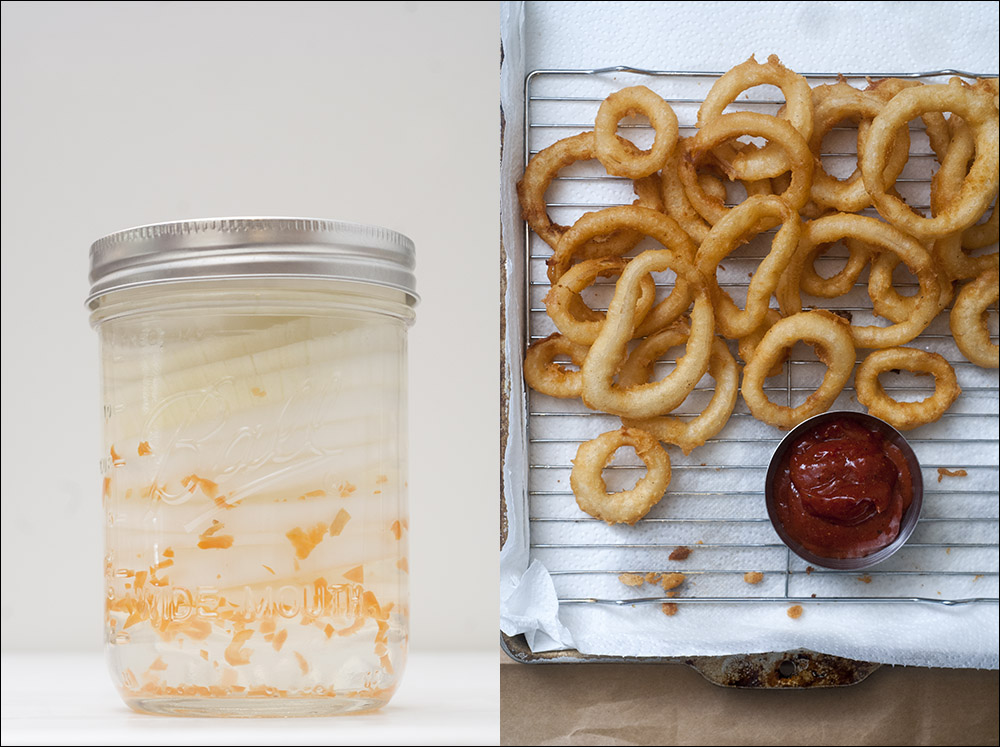
(L) Sweet, habanero pickled onions. (R) Fried, sweet, habanero pickled onions. © Ryan Schierling
Ultimately, this all started on a clearance table at our local grocer with a Texas brand of hot, sweet, pickled onions being blown out at 50-cents a jar. Regularly $5.99 each, we bought four, and were surprised at the simplicity of the sweet, spicy, clean and crisp flavors. They worked on all kinds of sandwiches, were divine in deviled eggs, great grilled, fabulous on top of steak, and they shined in salads. We were a bit distressed that this product wasn't popular enough for the store to keep around and we were afraid we'd never see it again. It's not the first time this has happened with something we really liked (but found out about a little late), so we figured we'd better reverse-imagineer it. 

There were six ingredients – onions, vinegar, sugar, habanero peppers, salt and citric acid. Based on percentages of sodium, carbohydrates, sugar and vitamin C on the label, we were able to approximate salt, sugar and citric acid components per serving, and per jar. Taste-testing got us pretty spot on with the pickling liquid, though we weren't sure if the onions were originally white, yellow or sweet, so we went with white based on what we had on hand. Of course we didn't hold back on the habanero, because we roll caliente, and they were goooood

We tried them quick-pickled, then left those in the fridge for a two-week pickle to see how to texture and flavors would change. Later, we did them properly canned in a hot water bath for longer-term storage. The longer the jars sit, the more the flavors and the heat intensify.

But I couldn't leave well enough alone. I kept thinking about deep-fried pickled things, and how these onions might taste if we beer-battered them using a spicy pilsner and took them to the hot oil-filled cast iron. The result was surprising, but not terribly unexpected – they were ridiculously good. 

Sauceless, these are amazing onion rings. They are crispy, tangy, spicy, sweet and salty without ever seeing a swipe of Ranch or buttermilk dressing, or ketchup/catsup, honey mustard or whatever other crazy things you dip your onion rings in. We made a two-pepper ketchup just in case, and it paired perfectly with the hot little ringlets.

Friday, September 25, 2015

Root veg kaleidoscope.

Steamed carrot slaw with roasted beets. © Ryan Schierling
The challenge: Create an unforgettable side dish from random items in your refrigerator before time runs out. Who will rise to the occasion, and who will be… CHOPPED.

(WE INTERRUPT THIS POST FOR COPYRIGHT LIABILITY REASONS. IN THIS CONTEXT, THE TERM “CHOPPED” MIGHT BE A REGISTERED TRADEMARK OF TELEVISION FOOD NETWORK G.P. AND ITS AFFILIATES. CONTINUED IMPLIED USAGE AND/OR VIOLATION WILL RESULT IN TED ALLEN’S HANDLERS ASCERTAINING YOUR LOCATION IN FETCHING BLACK HELICOPTERS, DESCENDING ON YOUR KITCHEN, WHERE YOU WOULD BE… BOPPED. IF THERE ARE ANY BISCUITS AROUND, YOU MAY BE… SOPPED. REGARDLESS OF THE CONTEXT, YOU WILL BE… STOPPED. UNLESS YOU ARE ABLE TO DEFEAT MASAHARU MORIMOTO AT THE IRON CHEF AMERICA NINTENDO Wii GAME. ALLEZ-CUISINE!!*)


I'm fairly certain I would be a terrible contestant on one of those competition-based cooking shows. You know the ones where contestants have to execute something spectacular in under 20 minutes with a limited number of disparate ingredients? Not a minute to spare rethinking or redoing anything? I’d probably knock it out of the park about one in three rounds, and full-on crash and burn the rest. Pressure cooker situations are just not for a planner like me. However, that’s not to say I don't enjoy rising to a challenge when the opportunity presents itself.


Sunday, August 30, 2015

Texas wildfire salad.

Texas wildfire salad. Arugula and seared zucchini with habanero herb dressing. © Ryan Schierling
We've been running a bit of a hot spell here in Central Texas, and the pepper plants are about the only thing in our garden that are tolerating the heat. Our patch consists mainly of jalapeños and habaneros this year. The jalapeños we use with frequency, but the habaneros are a little tricky because we either need a fresh harvest large enough to make hot sauce, or we have to find ways to use what ripens in a steady trickle. If you're familiar with habaneros, you know that this little orange pepper packs a wallop of heat. While it may not rank at the top of the Scoville scale, it is up there high enough to warrant wearing gloves when cutting them and taking measures to avoid any juices that may aerosolize in the chopping process.

So, I decided to make a habanero salad dressing out of a couple of them. Of course, right? For continuity of color, I chose to include orange bell pepper – well, in addition to the fact that there is nothing meaty about habanero peppers and I wanted to add some substance and body. There is a reason for the popularity of habaneros and it's not all about its spicy reputation. Habs have a wonderfully distinct, almost fruity, flavor that transcends the heat. With the addition of garlic and some fresh Texas tarragon (Mexican mint marigold) leaves from our garden, the resulting dressing is creamy in texture without being heavy and has a boldness that is both tangy and mildly herbacious.

Monday, August 10, 2015

A simple, tiny taco tome.

(L) Our beautiful flea-market machacadora. (R) Pinto beans. © Ryan Schierling
This is a story about a humble taco. It’s a bit of a love story, where homemade corn tortillas are concerned, and where my love for anything made of masa harina was born. These tacos reach back deep into the earliest grasp of my childhood food memories.


My mom grew up in southern California, but as it would happen, the craft of making homemade tortillas was learned as a young working mother in the Pacific Northwest from our neighborhood bread baker and all-around food-geek, Mrs. Cooper (who, impressively, milled her own flour at home!) Using masa harina, water and a sturdy cast-iron tortilla press, we made these delectable little homemade tortillas on a pretty regular basis when I was a kid. It was great fun to roll the masa dough into little balls and then smash it between the waxed paper or plastic on the press. Then there was the trick of peeling it off the plastic (usually a deconstructed large zip-bag) without it breaking into pieces in my young hands, and onto the cast-iron griddle they went. 
It was a team effort and family activity all its own, with a delicious payoff.

The toppings were always just this simple – refried beans, shredded cheddar cheese, iceberg lettuce and (if you felt like it) a little bit of old-school grocery-store taco sauce. Simple and honest. For me, the flavor of beans and cheese on fresh corn tortillas is about as comfort food as it gets. The lettuce adds a cool contrast and a bit of crunch.


There’s plenty of fancy to go around these days. Always a new take to be found on an old recipe or the temptation to take two perfectly good food items and wrangle them into a mind-bending knot and call it "fusion cuisine." But every time I feel like I might be over-complicating my food experience, I think of these tacos. They don’t need “more” to be better. In fact, what makes them so delightful are the plain and clear flavors. A little crema or drizzle of a favorite sauce would be delicious, too, but these tacos truly do not require any of those things to be wonderful.
 In a world of "bolder, spicier, more complex!" these are gentle, simple and straight-forward.

Monday, May 11, 2015

Pesto. Do it with collards.

Collard green pesto flatbreads with boudin, peppers and tomato. © Ryan Schierling
Before I become a victim to my own verbosity, let me to cut to the chase – please try this pesto. It’s delicious. It’s nutritious. It’s economical. And, if not more versatile than traditional basil pesto, it certainly is more accessible

We’re comfortable with greens, but those most used in our repertoire have traditionally been spinach, kale, mustard and beet. Collards are more regional to our home here in Texas and until now we have been unremarkably straightforward in our use of them. You know… chopped, cooked greens with some onion, a splash of lemon or vinegar and seasoning.

Compared to other greens, collards have a thick and sturdy, almost leathery leaf on a hearty stalk. They take longer to cook than other greens and have a robust flavor to match. Quite frankly, they have been a bit of trick to incorporate into our menu plans. We’ve struggled awkwardly with new regional produce in the past. Last Fall we finally realized the delicious miracle that is roasted okra, and a vegetable I have had a disastrous relationship with previously is now one I’m looking forward to coming back into season. Breakthroughs such as these are defining moments in our personal food story, and this Spring we had that surprising moment with collard greens.

It started with a Saturday morning perusal of my Instagram feed. An artful image of large collard leaves and some thick-sliced ham scrolled onto my screen. Not exactly my thing, so far, but the maker of that image was Maggie Perkins and I always enjoy the “in-progress” photos of her impromptu creations as a farmer’s market demonstration chef each weekend. The caption that day is what caught my eye, “Good morning from the market! I’m whipping up a collard green pesto to top flatbread pizzas…”

Wednesday, April 22, 2015

Baking a pot of beans.

Baked beans. © Ryan Schierling
Family recipes were the hook that reeled us in to blogging about food. We are nostalgic ones at heart, and were just looking for a way to give all those tenuously-preserved, barely-written-down mealtime staples a place to live on with some degree of veracity.

The funny thing I've learned along the way is that the recipes from my family share several things in common: they are typically minimal in ingredients, the recipes are virtually never deviated from, and even in light of these first two facts, they are universally the most nebulously documented recipes I've ever encountered. The sauces are “to taste." The quantities are sometimes not even estimated because the cook is presumed to “just know." These are the kind of recipes where, if you haven't had the privilege of standing at the cook's side carefully observing the nuances, and tasting along the way when a dish has been prepared, you have to call upon a family member who has been in that place a time or two and taken very good notes.

My family's recipe for baked beans is exactly this kind of recipe. It is a five-ingredient wonder that came by way of my great-great-grandmother (my father's mother's father's mother) who immigrated from England via Canada. I have no way of knowing how much it has, in fact, evolved over the years. Judging by my family's dogged recipe loyalty – not a single iota. But, judging by the inclusion of molasses – there was, almost certainly, a touch of New England (Boston-style) influence somewhere along the way.

Best I can tell, it's been a recipe more akin to an oral tradition than a secret formula. I have been given this recipe three ways, all with the same ingredients. One simply described verbally in the tradition of a “to taste” formula, and two which vary mostly on the amounts of sugar (noting that one didn't even offer the quantities for the beans or tomato juice). So, I've stitched the pieces together and offer this detailed recipe which I present only as a benevolent guideline for successfully making my great-great-grandma Scott's baked beans.

Monday, December 8, 2014

Beer, billiards and bisque.

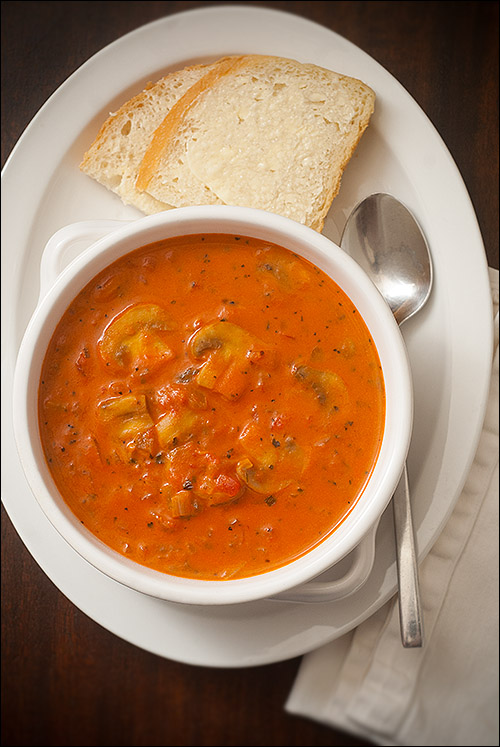
Tomato mushroom bisque with bread and butter. © Ryan Schierling
I moved from Emporia, Kansas to Fort Collins, Colorado in 1991. I was 19, and the little college town was blowing up with micro-breweries crafting incredible beer. If my parents are reading this, I certainly did not partake of alcoholic beverages until the day I turned 21. If you're anyone but my parents reading this, spending the previous year on a University of Kansas dormitory floor of brilliant art majors made creating fake IDs far too simple. Mine was used regularly until the day it was taken away by an overzealous doorman at a Fort Collins bar that shall not be named, and has since shuttered. No hard feelings.

New Belgium Brewing Company had just opened up shop with a dubbel named Abbey and a great little amber called Fat Tire. They only came in 22-ounce bomber bottles, and were unlike anything I'd ever had. O'Dell's Easy Street Wheat and 90 Shilling (still one of my favorite beers of all time) were of the same era, Left Hand Brewing started up in Longmont with their Sawtooth Ale, and soon it seemed you couldn't walk around the block without a new brewpub or home-brew store opening up.

CooperSmith's Pub & Brewing was in Old Town Fort Collins, and a short walk from my first apartment. A few years later, it was a short drive down College Avenue from my second apartment. 

Tuesday, November 11, 2014

All about a cheesy broccoli noodle casserole.

Broccoli noodle casserole with cheddar and Boca chicken. © Ryan Schierling
It's Fall and, naturally, the topic around the proverbial water cooler turns to casseroles. Doesn't it...?

Well, around our house it did. Ryan was busy innovating his riff on a Texas standard, when he looked up from his King Ranch in progress and asked... "So, when are you going to make your broccoli noodle casserole?" Um, you mean the one where I channel my inner 1950s housewife...?

<flashback>

One day, back in the aughts, I have a moment where I decide to get all retro and make a casserole. I mean... how hard can it be? Open a can of Campbell's and I'm half way there. I don't have a particular strategy in mind, just an inclination and the mandatory tin of Cream of Something soup – assemble, bake at 350-degrees, now you're cookin'. 

It's a big casserole, so I share it with my neighbors. It gets raves, which throws me for a bit of a loop – it's very tasty, but come on... no one's supposed to get kudos for an old-fashioned casserole like this, right? Perhaps it's the richness of the sauce or the texture and tooth of the broccoli, though I suspect a bit of noodle casserole nostalgia is at play. Whatever the case, it is certainly classic comfort food and well worth the time it took to make. Recipe carefully documented for future reference.

</flashback>

I have since made this dish again and again – with nary a variation. My inner 1950s housewife can follow a recipe, and has no shame.

Friday, October 24, 2014

Homemade Branston® pickle with English cheddar cheese sandwich.

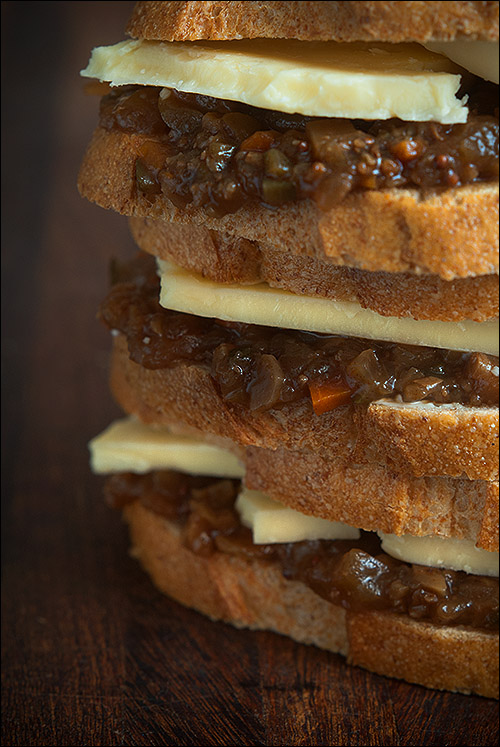
Homemade ploughman's pickle with English cheddar. ©Ryan Schierling
I cannot claim to have invented this sandwich, nor would I. It is a simple cheese sandwich with a legendary dark-brown English chutney-style spread that is bracingly tangy, crunchy, sweet, and a twee bit savory at the same time. If you’re across the pond, it is a sin to eat a cheese sandwich without Branston® pickle.

I am not an Anglophile and I'm not across the pond, but I have been eating pickle and cheese sandwiches for a while now. I came by a jar of Branston® at a shop in Seattle in the late 90s, picked it up out of curiosity – one for me and one as a gift – and have been preaching the gospel of ploughman’s lunch ever since. 

But I never, ever, ever thought to try and make pickle. It’s like making ketchup, or catsup, or whatever. It’s like making butter. It’s like making mayonnaise or mustard. So few hand-make the staples anymore, they just buy them at the grocer. This tart, sweet, "what-the-hell-should-I-do-with-this-mess?" condiment is not for everyone, but the Branston® traditional recipe has been the same for more than 90 years, and pickle fans are legion in the UK. It may be an acquired taste, though I also believe it's a very geographically-defined and refined taste. 

Tuesday, October 21, 2014

Chopped Salad Sandwich.

Chopped salad sandwich, with and without meat. © Ryan Schierling
Oh yes, I’ve heard the jokes… you know the ones, where a sandwich without meat “is just a salad sandwich.” 

Just…? Oh, no.

Admittedly, I’m rather partial to a Cheddar cheese sandwich with picnic mustard and a tall stack of lettuce, so mostly I’ve just rolled my eyes at the whole salad sandwich notion. While Ryan isn’t particularly meat-centric about his sandwiches, he doesn’t generally opt to put lettuce in them either. A cheese sandwich, for him, is historically just that – good ol' American cheese and mayonnaise between two slices of bread. 

Based on our cheese sandwich profiles, we are apparently unfit to helm a food blog of any import. Too lowbrow? So be it, get over it.

On a whim one day when making us lunch, I decided to give the lettuce a little more purpose. We didn’t have a whole lot on hand to work with, except some provolone and a hearty rustic bread. There was middle ground that needed to be found – something beyond bread and cheese, or bread and cheese and lettuce.

Monday, October 20, 2014

Sauerkraut and caramelized onion sandwich.

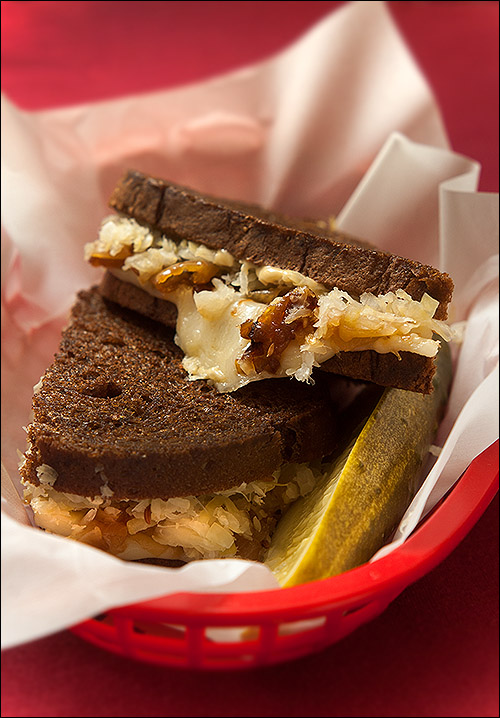
The Wilhelm. © Ryan Schierling
I love a great Reuben. It is one of my favorite sandwiches ever, and I will eat a Reuben anywhere, anytime. The sad thing is, I'm usually disappointed by thin and flaccid, flabby and fatty, tasteless corned beef brisket that's been boiled to the point of inedibility. In my opinion, if there's no respect for the meat, you might as well do away with it altogether. 

This... this is a sauerkraut and caramelized onion sandwich. Think about that for a second. It's cabbage and onions. There’s no corned beef, pastrami or turkey, or kielbasa, or any veggie substitutes like tempeh or seitan, because they're not necessary here. 

The boldest flavors of a Reuben are the sauerkraut, the Russian dressing or mustard, the rye and, if you’re going for a non-Kosher version, the Swiss cheese. Unless you’re eating a $20 Katz’s Delicatessen-style meat-pile, the rindfleisch is usually an additional sub-par, thinly-sliced, sad lunchmeat texture at best, and what little flavor it does have gets lost in the fistfight of aggressive tastes the traditional toppings hold. 

This isn’t a Reuben. It's not a West Coast Reuben, or a Montreal Reuben, and it's definitely not a Rachel

So, really, what is this meatless punch-in-the-mouth we made? I hereby declare this sandwich The Wilhelm. It’s not the prettiest handful you’ll ever make. If fact, it's downright ugly, but it hits all the right notes for fall – toasty warm and rich, savory, tangy, with hints of sweet and spicy. 

The caramelized onions take a while but are easy enough (see Chips, Dips and Dorks) and if you'd like to try your hand at making sauerkraut, the simple recipe is below. Löwensenf Extra Hot mustard, a staple in our "mustard locker," is great with this sandwich. 

Sunday, September 14, 2014

Seriously, we can only eat so much fried okra.

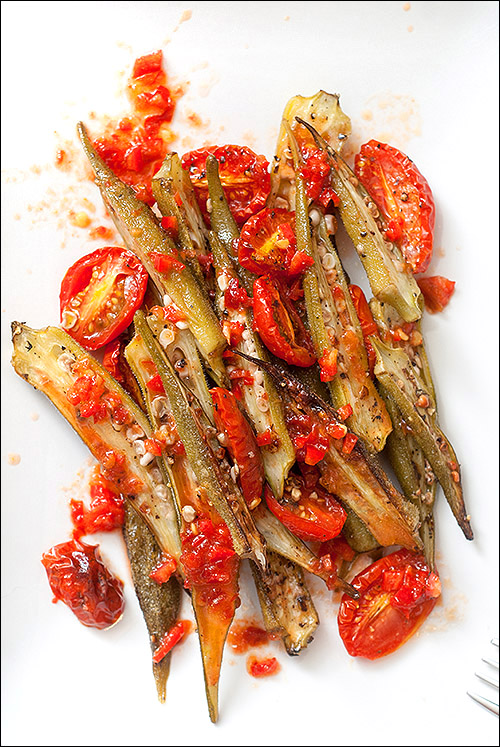
Roasted okra and tomatoes with chili garlic vinaigrette. © Ryan Schierling
My first experience with okra was decidedly unpleasant – an unfortunate "high-brow" circumstance wherein a vegetable galette included its overly-mucilaginous presence.

Then we moved to Texas. If you know anyone with a big garden in these parts, you're certain to find okra offered to you by the cubic bushel in late summer. Okra thrives in the heat and seems to defy the sun-baked earth, and it's been showing up on our doorstep for the last few weeks.

So, how do you say "no" – in good conscience – to the pound of okra that arrives with every late summer CSA delivery? We joined for the local and seasonal offerings, and it just wouldn't be right to turn it away or not make good use of it. 

What exactly are you supposed to do with this stuff? Common wisdom points immediately in the direction of pickling, making gumbo, or battering and frying. But there's only so much pickled okra that's going to get eaten at our house this year, and if I'm going to make a mess of my cooktop with a pot of boiling fat... well, I can't honestly say that okra is the first thing I'd choose to fry up.

In a flash of merciful recollection, Ryan remembered seeing a recipe for roasted okra and cauliflower salad in a cookbook we got last year – Smoke and Pickles by Chef Edward Lee. It has been our salvation over the past few weeks of CSA deliveries. (You can also find it featured in this post by CBS The Talk, where he was a guest last Fall.)

Friday, June 20, 2014

Hangover breakfast, part two.

Caramelized fennel and onion hash. © Ryan Schierling
Sometimes, there’s not a definitive narrative to the things we make.

Sometimes we mumble. 

Sometimes there’s just an overflowing refrigerator and a short-order cook aesthetic – throw some stuff together and put an egg on it. The treatments will vary depending on what we’ve been cooking lately (have you ever eaten taco salad variants five nights in a row?) and what happens to be in the pantry, but shaking things up sometimes requires a reset and breakfast is always where I begin again.

We had pounds of potatoes, tons of onions and two generous fronds of fennel. How am I supposed to be fabulous with fennel?

I don’t enjoy anise-flavored things in the least – Jagermeister and NyQuil (which may as well be the same disgusting thing when you have a cold), absinthe (love the old-world concept and execution, hate the liquor), Black Jack chewing gum (what the…?), star anise (pretty, but pretty repulsive) uhm… black licorice (sue me, it's foul). Some spell it “liquorice” and that would seem to imply I’d love it, seeing that it’s a compound word containing “liquor” and “ice.” Not so. Definitely... not so

But fennel that is slow-cooked down with onions until it’s brown and supremely sweet isn’t something we’ve ever done before. The fennel flavor changes from a bracing, bright anise hit to a far more complex, mellow mouthful that’s so very nice with potatoes. A squeeze of lemon juice and a couple of garden-fresh tomato slices add some acidity, and the egg on top is required whether this is for breakfast or not. Enjoy.

Wednesday, May 21, 2014

Sweet flan? Don't carrot all.

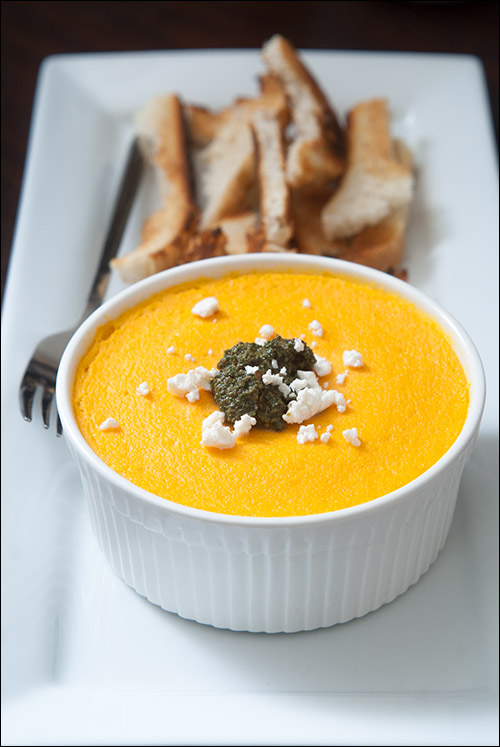
Savory carrot flan with carrot-top walnut pesto and feta. © Ryan Schierling
My forays into flan have been few and far between. I don't care for the caramel-sweet Spanish dessert custard and the crusty English open-pie version isn't my cup of tea. I'd rather have a small, savory custard as an appetizer course, and if blue cheese flan happens to grace a menu, I'll take it as dessert with one last glass of red wine, thank you very much

We've finally gotten with the CSA program, and our bi-weekly delivery of the Austin-area's finest farm veg is a welcome challenge to eat more locally-grown produce, and who doesn't like getting a super-secret-surprise box delivered to their doorstep every once in while? 

Grocery stores offer every fruit and vegetable you can think of – even if it's not in season – when you think you want it... which is always right now. With our CSA box, we're delighted (forced) to use what's currently ready to be harvested, and sometimes it's very nice to be filled with wonder (dread) at how we're going to use our very-perishable bounty. Kidding, kidding. The quantities are small enough that we haven't had too many issues with things getting lost in the crisper (rotter). 

There were some beautiful little carrots in our last delivery, with the most delicate, lacy, bright-green tops I've seen in a while. The easy way out is salad. Boring, big ol' salad. A better option (fate) would be Julie's crowd-pleasing carrots on the side, and this would have been entirely appropriate but I wanted something a little different and a little fancier than the last recipe I offered up, which was Krab enchiladas. Oh, I may occasionally put Slim Jims and gas-station cheese inside a jalapeño and deep fry it, but I know what the hell a bain Marie is. This is penance, perhaps redemption, and I'm using the carrots nose-to-tail. Errr, root to leaf

It's a simple, savory custard, full of right-out-of-the-earth carrots, topped with a pleasantly-grassy (and very complimentary) carrot-top and walnut pesto and some sheep's-milk feta. First course, last course, it doesn't matter. 

Sunday, May 11, 2014

Bonus Enchiladas – Green Chicka Green Green

Green chile enchiladas redux. © Ryan Schierling
This one is inspired by that perennial layered "green chile enchilada" casserole recipe that many of us grew up with. Tasty as it may be, it's probably more heart-attack inducing than the Velveeta in enchiladas Dan Jenkins – what with all the cheese and that obligatory can of Cream of Something soup involved.

Our family recipe (included below in all its quantity unspecific glory, and strictly for educational purposes, of course), was made with Cream of Mushroom soup. But I understand that the non-vegetarians among us would quite often add chicken to this dish and even use Cream of Chicken soup on occasion. So, perhaps a little more protein there, but still not a dish that's going to get any healthy-living bonus points. You see, while there was something of an attempt to eat a "nutritious" meatless diet, our family was also a product of its time – a time when we all fell victim in some form or other to the put-a-can of Campbell's-in-it school of cooking that was all the suburban cultural rage.

These days we like to think we're a little more sophisticated in our preparation of food and sourcing of ingredients. What I remember loving best about this layered casserole was the saltiness of the olives (I've always loved olives) with the flavor of the green chiles. Plus, there was something distinctive about the copious addition of cheddar cheese that also went into that baking dish. Contemplating this childhood favorite in light of our recent "5 days, 5 ways" foray into enchiladas started me thinking about how I might be able to enjoy that flavorful goodness in a lighter, more traditional enchilada form.

Friday, May 2, 2014

Enchiladas Dan Jenkins.

Eat these with an over-easy egg and say your prayers. © Ryan Schierling
When I was a kid, the whole seatbelt thing was something folks were just warming up to. I don't know the reason the moment stands out in my memory so, but one day as we piled in to the back of our family station wagon, I was a little slow to put my seatbelt on. My younger brother took it upon himself to harass me about my lack of safety precautions. Finally, in exasperation, he exclaimed, "Do you want to die?!" 

The feeling I had when he said that is kinda the same one I have when I eat these enchiladas. They are stupid to eat, but there's a liberation in the ridiculousness of it all. Between the gooey, salty, Velveeta, the bright tang of onions on the tooth, and that river of enchilada sauce – it seems like the food equivalent of what the free-lovin' 60's must have been like. Drape an over easy egg over the top and you just did it on acid, man....

Our first introduction to this hard-core Tex-Mex standard was at Dart Bowl in Austin. This recipe is from Texas culinary historian-curator-troublemaker Robb Walsh's Texas Eats: The New Lone Star Heritage Cookbook. There are two sauce options in the book – chili con carne sauce or original chili gravy – one with meat and one without. I rather prefer the smoother, meatless style (looking at you vegetarians who care not a hoot about your arteries this week), but there's a fairly narrow margin of difference between the two.

You'll be all set for a stiff drink and a nap when you're done. And, you know, we kinda had to make up for all those light enchilada recipes we've posted this week some way or another... but you'll only get lame apologies for that until you've tried these.

Recipe not included below because it's not our recipe to offer, and we make it exactly as it was written with no adaptations. Go buy a copy of Texas Eats, turn to pages 112-113 and fold the pages back until the book's spine breaks. It will now always open to this dish. It's worth it. 

Well, at least once a year, or until your cardiologist finds out.

Thursday, May 1, 2014

Enchiladas de la tierra.

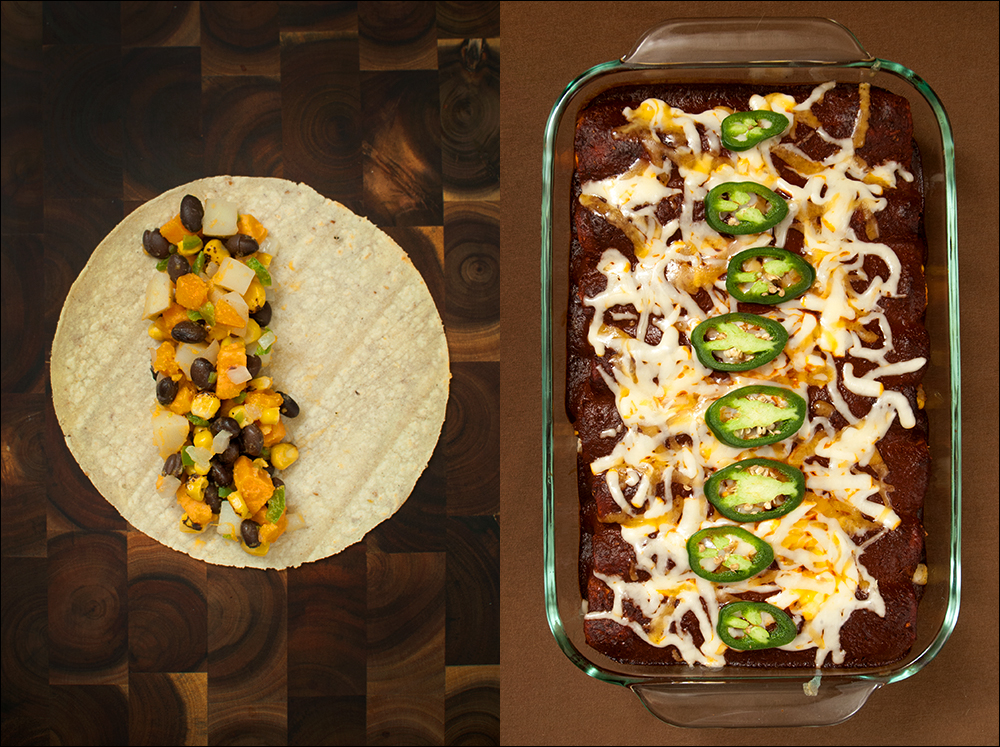
Sweet potato, potato, back bean and roasted corn enchiladas. © Ryan Schierling
Once upon a time, I came across a taco joint in a northwestern town that served a veggie burrito which included sweet potato. It's a rare item to see featured as a vegetable in most Mexican restaurants, and I thought it was downright delightful. The filling for this enchilada recipe was born from that inspiration and my love for simple black bean and corn enchiladas. Nothing fried here, just a hearty mix of colorful goodness with a tasty homemade red chile enchilada sauce.

Can we just have a word here about red enchilada sauces? Somehow I got hung up on this topic at an early age. My mother was raised in Southern California and somewhere along the line developed some very strong opinions about a certain few ingredients. She always insisted that "Las Palmas" brand red enchilada sauce was the real deal – the gold standard in a can. A little label reading in later years proved her point. Most commercial red enchilada sauces are made with a pureed tomato base. Apparently, as far as Mom is concerned, authentic enchilada sauce is made with only red chiles, not tomatoes. As it can still be a little tricky to find the chile-only variety in the average supermarket, I completely understand her brand loyalty. There is definitely an important difference in both flavor and texture, and if you choose to go the canned-sauce route for these enchiladas, I implore you to do a little label reading of your own before making that purchase.

Homemade enchilada sauce is an easy thing to make if you have a good blender and can source the dried chiles. I like the flavor of the New Mexico or California chiles with the Pasilla chiles, as the combination has more of the "enchilada sauce" flavor profile I grew up with. The Arbol chiles give it a friendly touch of heat. However, you can substitute some of the dried chiles to suit your taste. Many traditional recipes recommend using a combination of  guajillo and ancho chiles – which happen to be two of my favorites in other contexts for their particular richness and depth of flavor.

Forgive me, but the proportion of filling to sauce between these recipes are not very well aligned. The enchilada sauce recipe will be just about right (maybe a tad bit extra) for a 7x11 pan of 8 enchiladas. The filling you will definitely find yourself with plenty extra. I suggest either making a double batch of enchilada sauce, or plan on using the extra filling for tacos or burritos in the next couple of days.


Related Posts Plugin for WordPress, Blogger...