Showing posts with label beans. Show all posts

Wednesday, March 2, 2016

The 'New' State of Chilaquiles in Austin, Texas.

100 plates of chilaquiles. © Ryan Schierling
(FGHD editor's note: Originally updated March 2016 for the AFBA City Guide with 100 plates of chilaquiles.)

As a lot of you know, we've been on a epic, epicurean quest – a grand gustatory gamble with breaking the fast deep in the heart of Texas.

We've been scouring Austin for the very best chilaquiles it has to offer. We've torn apart the town, top to bottom, for more than two years sampling both highbrow and humble versions of this traditional Mexican dish. 

There are no shortage of restaurants offering up their take on what shouldn't really be more than crisp fresh-fried tortilla chips (totopos) simmered with a red or green sauce until just slightly softened, crowned with a pair of properly-cooked eggs. With such a simple preparation, you'd think it would be difficult to screw up this classic.

We weren't looking for haute cuisine a la Mexicana, we just wanted an honest, reliable, simple Sunday morning comfort-food breakfast at a joint where everyone might eventually know us (and our broken Spanish).

There were standouts, certainly, but just as often there were store-bought chips, soggy and swimming in sub-par sauces, eggs that were under-cooked, over-cooked or not even offered as an option. There were some surprises, and there were some disappointments. 

There were also some stunningly brilliant breakfasts. 

If a restaurant presented only one sauce option for chilaquiles, Julie and I would typically order the same dish. If a restaurant had both verdes (green) and rojos (red), we'd order one of each. The majority of the time, we'd order eggs over-easy. If we knew the eggs were going to be happy eggs (see $9 chilaquiles), I'd go for sunny-side-up. Beans, potatoes and accoutrements (if available) were taken into consideration, as was the coffee or aguas frescas. The overall experience was key, but really, it all came down to the chilaquiles. 

After eating 100 different plates of chilaquiles, we've done our due diligence, and now, we humbly present to you ten establishments that Julie and I both agreed have the finest chilaquiles in Austin. These are our favorites, the places we return to time and time again. 

These chilaquiles are the best of the best. 

Monday, August 10, 2015

A simple, tiny taco tome.

(L) Our beautiful flea-market machacadora. (R) Pinto beans. © Ryan Schierling
This is a story about a humble taco. It’s a bit of a love story, where homemade corn tortillas are concerned, and where my love for anything made of masa harina was born. These tacos reach back deep into the earliest grasp of my childhood food memories.


My mom grew up in southern California, but as it would happen, the craft of making homemade tortillas was learned as a young working mother in the Pacific Northwest from our neighborhood bread baker and all-around food-geek, Mrs. Cooper (who, impressively, milled her own flour at home!) Using masa harina, water and a sturdy cast-iron tortilla press, we made these delectable little homemade tortillas on a pretty regular basis when I was a kid. It was great fun to roll the masa dough into little balls and then smash it between the waxed paper or plastic on the press. Then there was the trick of peeling it off the plastic (usually a deconstructed large zip-bag) without it breaking into pieces in my young hands, and onto the cast-iron griddle they went. 
It was a team effort and family activity all its own, with a delicious payoff.

The toppings were always just this simple – refried beans, shredded cheddar cheese, iceberg lettuce and (if you felt like it) a little bit of old-school grocery-store taco sauce. Simple and honest. For me, the flavor of beans and cheese on fresh corn tortillas is about as comfort food as it gets. The lettuce adds a cool contrast and a bit of crunch.


There’s plenty of fancy to go around these days. Always a new take to be found on an old recipe or the temptation to take two perfectly good food items and wrangle them into a mind-bending knot and call it "fusion cuisine." But every time I feel like I might be over-complicating my food experience, I think of these tacos. They don’t need “more” to be better. In fact, what makes them so delightful are the plain and clear flavors. A little crema or drizzle of a favorite sauce would be delicious, too, but these tacos truly do not require any of those things to be wonderful.
 In a world of "bolder, spicier, more complex!" these are gentle, simple and straight-forward.

Wednesday, April 22, 2015

Baking a pot of beans.

Baked beans. © Ryan Schierling
Family recipes were the hook that reeled us in to blogging about food. We are nostalgic ones at heart, and were just looking for a way to give all those tenuously-preserved, barely-written-down mealtime staples a place to live on with some degree of veracity.

The funny thing I've learned along the way is that the recipes from my family share several things in common: they are typically minimal in ingredients, the recipes are virtually never deviated from, and even in light of these first two facts, they are universally the most nebulously documented recipes I've ever encountered. The sauces are “to taste." The quantities are sometimes not even estimated because the cook is presumed to “just know." These are the kind of recipes where, if you haven't had the privilege of standing at the cook's side carefully observing the nuances, and tasting along the way when a dish has been prepared, you have to call upon a family member who has been in that place a time or two and taken very good notes.

My family's recipe for baked beans is exactly this kind of recipe. It is a five-ingredient wonder that came by way of my great-great-grandmother (my father's mother's father's mother) who immigrated from England via Canada. I have no way of knowing how much it has, in fact, evolved over the years. Judging by my family's dogged recipe loyalty – not a single iota. But, judging by the inclusion of molasses – there was, almost certainly, a touch of New England (Boston-style) influence somewhere along the way.

Best I can tell, it's been a recipe more akin to an oral tradition than a secret formula. I have been given this recipe three ways, all with the same ingredients. One simply described verbally in the tradition of a “to taste” formula, and two which vary mostly on the amounts of sugar (noting that one didn't even offer the quantities for the beans or tomato juice). So, I've stitched the pieces together and offer this detailed recipe which I present only as a benevolent guideline for successfully making my great-great-grandma Scott's baked beans.

Thursday, May 1, 2014

Enchiladas de la tierra.

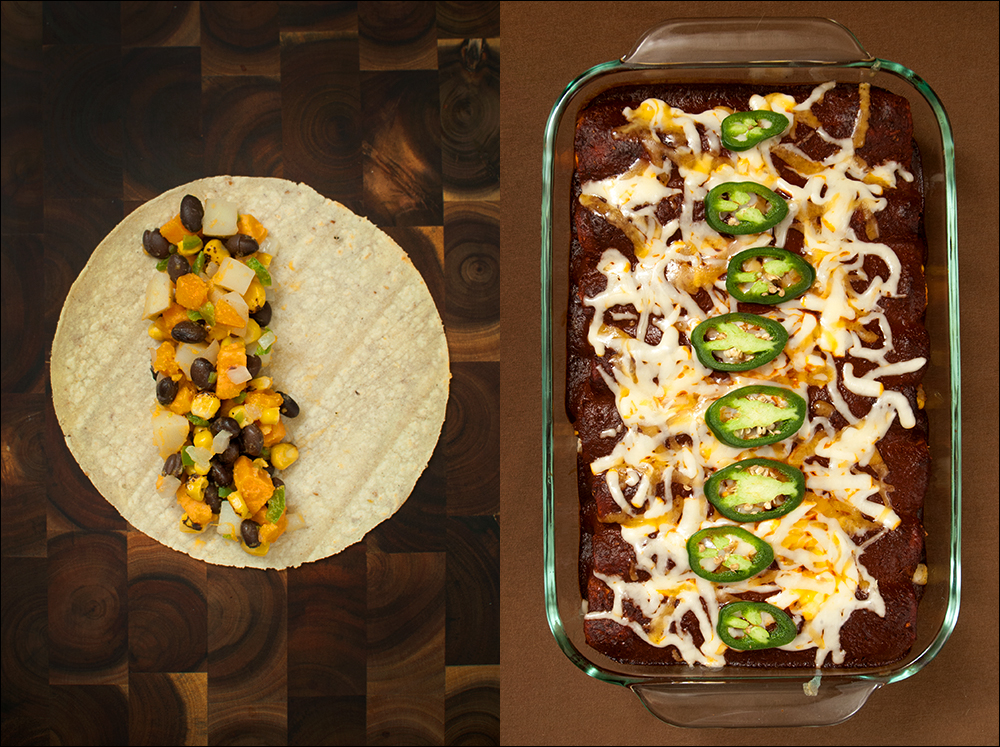
Sweet potato, potato, back bean and roasted corn enchiladas. © Ryan Schierling
Once upon a time, I came across a taco joint in a northwestern town that served a veggie burrito which included sweet potato. It's a rare item to see featured as a vegetable in most Mexican restaurants, and I thought it was downright delightful. The filling for this enchilada recipe was born from that inspiration and my love for simple black bean and corn enchiladas. Nothing fried here, just a hearty mix of colorful goodness with a tasty homemade red chile enchilada sauce.

Can we just have a word here about red enchilada sauces? Somehow I got hung up on this topic at an early age. My mother was raised in Southern California and somewhere along the line developed some very strong opinions about a certain few ingredients. She always insisted that "Las Palmas" brand red enchilada sauce was the real deal – the gold standard in a can. A little label reading in later years proved her point. Most commercial red enchilada sauces are made with a pureed tomato base. Apparently, as far as Mom is concerned, authentic enchilada sauce is made with only red chiles, not tomatoes. As it can still be a little tricky to find the chile-only variety in the average supermarket, I completely understand her brand loyalty. There is definitely an important difference in both flavor and texture, and if you choose to go the canned-sauce route for these enchiladas, I implore you to do a little label reading of your own before making that purchase.

Homemade enchilada sauce is an easy thing to make if you have a good blender and can source the dried chiles. I like the flavor of the New Mexico or California chiles with the Pasilla chiles, as the combination has more of the "enchilada sauce" flavor profile I grew up with. The Arbol chiles give it a friendly touch of heat. However, you can substitute some of the dried chiles to suit your taste. Many traditional recipes recommend using a combination of  guajillo and ancho chiles – which happen to be two of my favorites in other contexts for their particular richness and depth of flavor.

Forgive me, but the proportion of filling to sauce between these recipes are not very well aligned. The enchilada sauce recipe will be just about right (maybe a tad bit extra) for a 7x11 pan of 8 enchiladas. The filling you will definitely find yourself with plenty extra. I suggest either making a double batch of enchilada sauce, or plan on using the extra filling for tacos or burritos in the next couple of days.


Friday, March 29, 2013

Bunny chow de chivo, Tejano-style.

Quarter chivo. Texas-style bunny chow. © Ryan Schierling
I was at the fancy grocery store a while back, and there was a little girl in the bread aisle throwing an unfettered hissy fit. "I don't want to eat the ends of the bread!" she cried at her mother. Mom looked confused. "What?" 

"I DON'T WANT TO EAT THE ENDS OF THE BREAD!!!!" the girl shrieked again. Her mother shook her head, grabbed her daughter's hand and, still somewhat puzzled, explained earnestly "You don't have to eat the ends of the bread."

The little girl crossed her arms indignantly and scowled. "Good. Because only poor people eat the ends of the bread."

I wanted to grab a $40 jar of Bar-Le-Duc red currant jam, hand-seeded with a solitary goose quill, and throw it at her precious little head. Not only do poor people eat the ends of the bread, sometimes they repurpose the empty plastic bread bags to put over their kids' shoes when they're out playing in the snow. I might have some deep-seated childhood issues about that one, but I will still make a sandwich out of the heels of the bread if that's what's left. Waste not, want not. 

As for what poor people do and do not eat, some of those back-of-the-pantry, scraped-together, day-before-payday, simple meals are the best things you will ever put in your mouth. However fancified by restaurants in the last few years, soul food and comfort food all come from the deep roots of poverty, part and parcel. 

Friday, July 6, 2012

Masa is manna. Plantains are love.

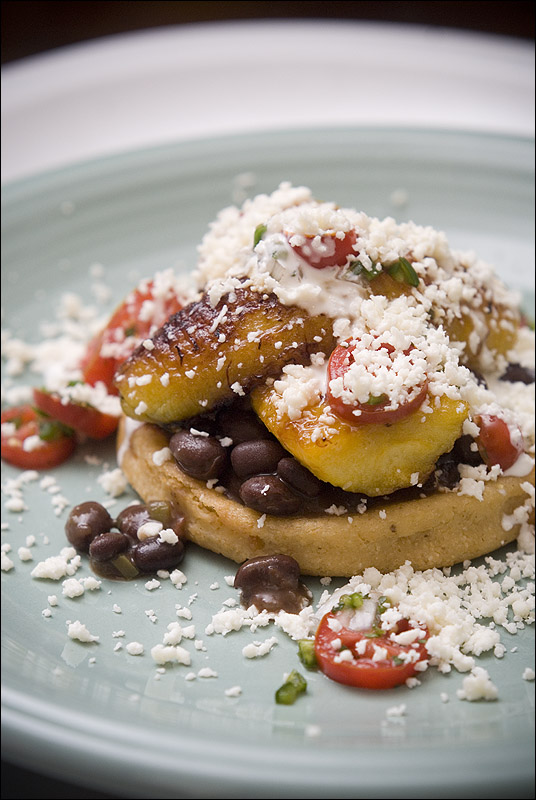
Sopes con platanos. © Ryan Schierling

As far back as memory serves, I've had a food crush of biblical proportions on masa de maize. Unlike plain old cornmeal or fresh-roasted corn, masa is made from corn baptized (or cooked… whatever... semantics) in a solution of slaked lime. I'm pretty sure there must also be some kind of mystical ceremony involved before these divine kernels are ground into this dough-of-the-gods. My personal food mythology even goes so far as to claim that the manna collected by the Israelites as they wandered the desert was actually masa. I'm just that committed.

There are certainly lots of wonderful Mexican items that are created from masa – tamales, tortillas, gorditas. But the one I believe shows the best that masa can be is in sopes, with just enough tender cakiness to highlight the fresh masa flavor and a brief deep-frying which gives them a wonderfully light golden crunch.

The little restaurant that introduced me to proper chilaquiles is the same joint that introduced me to this sope – Señor Moose Café. Reasonable prices, unassuming and casual, this place serves up "Mexican Mexican" food. Comida tipica from many regions of Mexico grace their menu, with an authenticity that does not shy in the least from using ingredients such as chicken livers and/or making their own 25-ingredient mole. The sope with plantains (sope con platanos) on their breakfast-lunch menu was a deeply-appreciated favorite of mine. And, once again, I have been driven to making my own out of a desperate sense of loss and burning desire. When it gets to the point that you're considering booking tickets to either Seattle or the state of Nayarit in Mexico, you know it's time to get cooking.
Related Posts Plugin for WordPress, Blogger...