Showing posts with label 5 days 5 ways. Show all posts

Friday, October 24, 2014

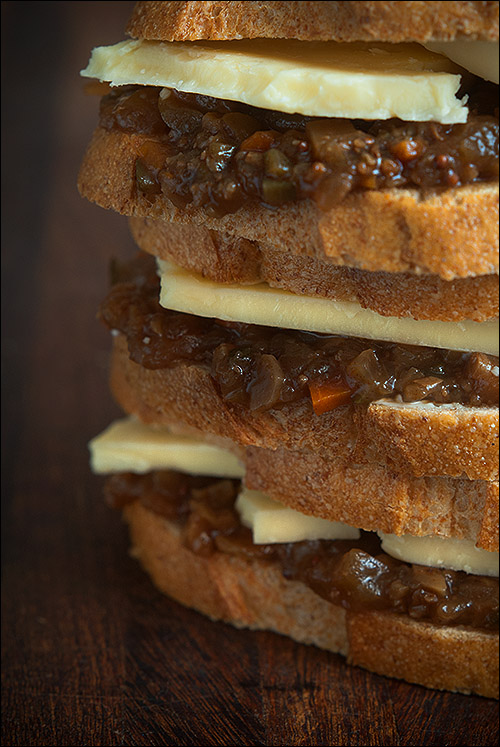
Homemade Branston® pickle with English cheddar cheese sandwich.

Homemade ploughman's pickle with English cheddar. ©Ryan Schierling
I cannot claim to have invented this sandwich, nor would I. It is a simple cheese sandwich with a legendary dark-brown English chutney-style spread that is bracingly tangy, crunchy, sweet, and a twee bit savory at the same time. If you’re across the pond, it is a sin to eat a cheese sandwich without Branston® pickle.

I am not an Anglophile and I'm not across the pond, but I have been eating pickle and cheese sandwiches for a while now. I came by a jar of Branston® at a shop in Seattle in the late 90s, picked it up out of curiosity – one for me and one as a gift – and have been preaching the gospel of ploughman’s lunch ever since. 

But I never, ever, ever thought to try and make pickle. It’s like making ketchup, or catsup, or whatever. It’s like making butter. It’s like making mayonnaise or mustard. So few hand-make the staples anymore, they just buy them at the grocer. This tart, sweet, "what-the-hell-should-I-do-with-this-mess?" condiment is not for everyone, but the Branston® traditional recipe has been the same for more than 90 years, and pickle fans are legion in the UK. It may be an acquired taste, though I also believe it's a very geographically-defined and refined taste. 

Thursday, October 23, 2014

Tuna sandwich with white beans and radish.

Tuna with white beans, radish and capers. © Ryan Schierling
There are days when I crave the tuna salad sandwich from my childhood – tinned, chunk light tuna mixed with mayonnaise and sweet relish, on thin slices of whole wheat bread. It's a simple sandwich to make, and it always tastes exactly the way I remember it. 

Julie has zero frame of reference for tuna salad, because she never had it as a kid, not even once. The first tuna sandwich she was willing to try was my tuna melt with Mexican mint marigold, and this was just in the last few years. There was no cajoling, no "just try it, just one bite, c'mon...it's just tuna, it's not like it's octopus salad..."  She tried it, liked it, and that opened the door just enough for me to wedge in a can of premium yellowfin tuna packed in olive oil. 

Now there are two tonno sandwiches we make regularly at home. This second sandwich is a flavorful, protein-packed tuna salad with cannellini beans, radishes, shallots, capers, parsley and lemon zest. No heavy mayo or sticky-sweet relish, just a refreshing, clean and crunchy tuna salad served on toasted ciabatta rolls. 

Wednesday, October 22, 2014

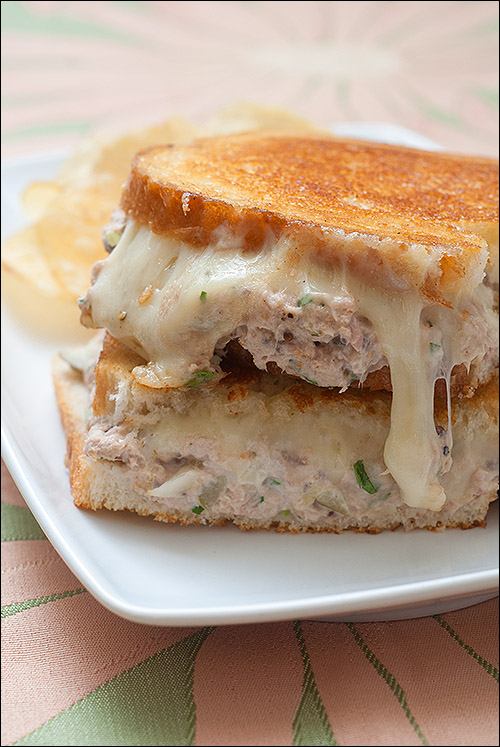
Tuna melt with Mexican mint marigold.

Tuna melt with Mexican mint marigold (or tarragon, if you please). © Ryan Schierling
Tuna, tuna, tuna, tuna... melty cheese, please.

Tuna salad sandwiches. While ubiquitous culturally, they were never a staple in the meat-free household of my childhood. The closest thing to a tuna sandwich in my experience was probably the Nuteena sandwich – but we never had a melty version of that.

Quite frankly, I never found the smell of tuna sandwiches to be appealing. But, then, it could be that my first real contact with the stuff was working in a less-than-fancy food service environment. While I do enjoy trying new things, I have never been one to bother stretching myself for something that doesn't hold the appearance or promise of present or future enjoyment.

By the time Ryan introduced me to the tuna melt, I already had some decent tuna experience under my belt – just nothing of the cheap, tinned variety. I could appreciate the creamy texture of tuna sashimi, and I enjoyed seared tuna as an entree, but chunk light tuna in water was another thing entirely and I was a bit skeptical.

Now, I probably suggest this comforting sandwich more often than he does.

Tuesday, October 21, 2014

Chopped Salad Sandwich.

Chopped salad sandwich, with and without meat. © Ryan Schierling
Oh yes, I’ve heard the jokes… you know the ones, where a sandwich without meat “is just a salad sandwich.” 

Just…? Oh, no.

Admittedly, I’m rather partial to a Cheddar cheese sandwich with picnic mustard and a tall stack of lettuce, so mostly I’ve just rolled my eyes at the whole salad sandwich notion. While Ryan isn’t particularly meat-centric about his sandwiches, he doesn’t generally opt to put lettuce in them either. A cheese sandwich, for him, is historically just that – good ol' American cheese and mayonnaise between two slices of bread. 

Based on our cheese sandwich profiles, we are apparently unfit to helm a food blog of any import. Too lowbrow? So be it, get over it.

On a whim one day when making us lunch, I decided to give the lettuce a little more purpose. We didn’t have a whole lot on hand to work with, except some provolone and a hearty rustic bread. There was middle ground that needed to be found – something beyond bread and cheese, or bread and cheese and lettuce.

Monday, October 20, 2014

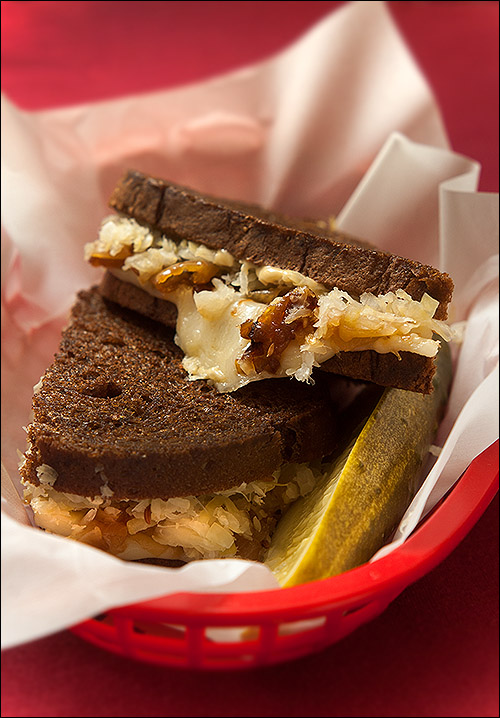
Sauerkraut and caramelized onion sandwich.

The Wilhelm. © Ryan Schierling
I love a great Reuben. It is one of my favorite sandwiches ever, and I will eat a Reuben anywhere, anytime. The sad thing is, I'm usually disappointed by thin and flaccid, flabby and fatty, tasteless corned beef brisket that's been boiled to the point of inedibility. In my opinion, if there's no respect for the meat, you might as well do away with it altogether. 

This... this is a sauerkraut and caramelized onion sandwich. Think about that for a second. It's cabbage and onions. There’s no corned beef, pastrami or turkey, or kielbasa, or any veggie substitutes like tempeh or seitan, because they're not necessary here. 

The boldest flavors of a Reuben are the sauerkraut, the Russian dressing or mustard, the rye and, if you’re going for a non-Kosher version, the Swiss cheese. Unless you’re eating a $20 Katz’s Delicatessen-style meat-pile, the rindfleisch is usually an additional sub-par, thinly-sliced, sad lunchmeat texture at best, and what little flavor it does have gets lost in the fistfight of aggressive tastes the traditional toppings hold. 

This isn’t a Reuben. It's not a West Coast Reuben, or a Montreal Reuben, and it's definitely not a Rachel

So, really, what is this meatless punch-in-the-mouth we made? I hereby declare this sandwich The Wilhelm. It’s not the prettiest handful you’ll ever make. If fact, it's downright ugly, but it hits all the right notes for fall – toasty warm and rich, savory, tangy, with hints of sweet and spicy. 

The caramelized onions take a while but are easy enough (see Chips, Dips and Dorks) and if you'd like to try your hand at making sauerkraut, the simple recipe is below. Löwensenf Extra Hot mustard, a staple in our "mustard locker," is great with this sandwich. 

Sunday, May 11, 2014

Bonus Enchiladas – Green Chicka Green Green

Green chile enchiladas redux. © Ryan Schierling
This one is inspired by that perennial layered "green chile enchilada" casserole recipe that many of us grew up with. Tasty as it may be, it's probably more heart-attack inducing than the Velveeta in enchiladas Dan Jenkins – what with all the cheese and that obligatory can of Cream of Something soup involved.

Our family recipe (included below in all its quantity unspecific glory, and strictly for educational purposes, of course), was made with Cream of Mushroom soup. But I understand that the non-vegetarians among us would quite often add chicken to this dish and even use Cream of Chicken soup on occasion. So, perhaps a little more protein there, but still not a dish that's going to get any healthy-living bonus points. You see, while there was something of an attempt to eat a "nutritious" meatless diet, our family was also a product of its time – a time when we all fell victim in some form or other to the put-a-can of Campbell's-in-it school of cooking that was all the suburban cultural rage.

These days we like to think we're a little more sophisticated in our preparation of food and sourcing of ingredients. What I remember loving best about this layered casserole was the saltiness of the olives (I've always loved olives) with the flavor of the green chiles. Plus, there was something distinctive about the copious addition of cheddar cheese that also went into that baking dish. Contemplating this childhood favorite in light of our recent "5 days, 5 ways" foray into enchiladas started me thinking about how I might be able to enjoy that flavorful goodness in a lighter, more traditional enchilada form.

Friday, May 2, 2014

Enchiladas Dan Jenkins.

Eat these with an over-easy egg and say your prayers. © Ryan Schierling
When I was a kid, the whole seatbelt thing was something folks were just warming up to. I don't know the reason the moment stands out in my memory so, but one day as we piled in to the back of our family station wagon, I was a little slow to put my seatbelt on. My younger brother took it upon himself to harass me about my lack of safety precautions. Finally, in exasperation, he exclaimed, "Do you want to die?!" 

The feeling I had when he said that is kinda the same one I have when I eat these enchiladas. They are stupid to eat, but there's a liberation in the ridiculousness of it all. Between the gooey, salty, Velveeta, the bright tang of onions on the tooth, and that river of enchilada sauce – it seems like the food equivalent of what the free-lovin' 60's must have been like. Drape an over easy egg over the top and you just did it on acid, man....

Our first introduction to this hard-core Tex-Mex standard was at Dart Bowl in Austin. This recipe is from Texas culinary historian-curator-troublemaker Robb Walsh's Texas Eats: The New Lone Star Heritage Cookbook. There are two sauce options in the book – chili con carne sauce or original chili gravy – one with meat and one without. I rather prefer the smoother, meatless style (looking at you vegetarians who care not a hoot about your arteries this week), but there's a fairly narrow margin of difference between the two.

You'll be all set for a stiff drink and a nap when you're done. And, you know, we kinda had to make up for all those light enchilada recipes we've posted this week some way or another... but you'll only get lame apologies for that until you've tried these.

Recipe not included below because it's not our recipe to offer, and we make it exactly as it was written with no adaptations. Go buy a copy of Texas Eats, turn to pages 112-113 and fold the pages back until the book's spine breaks. It will now always open to this dish. It's worth it. 

Well, at least once a year, or until your cardiologist finds out.

Thursday, May 1, 2014

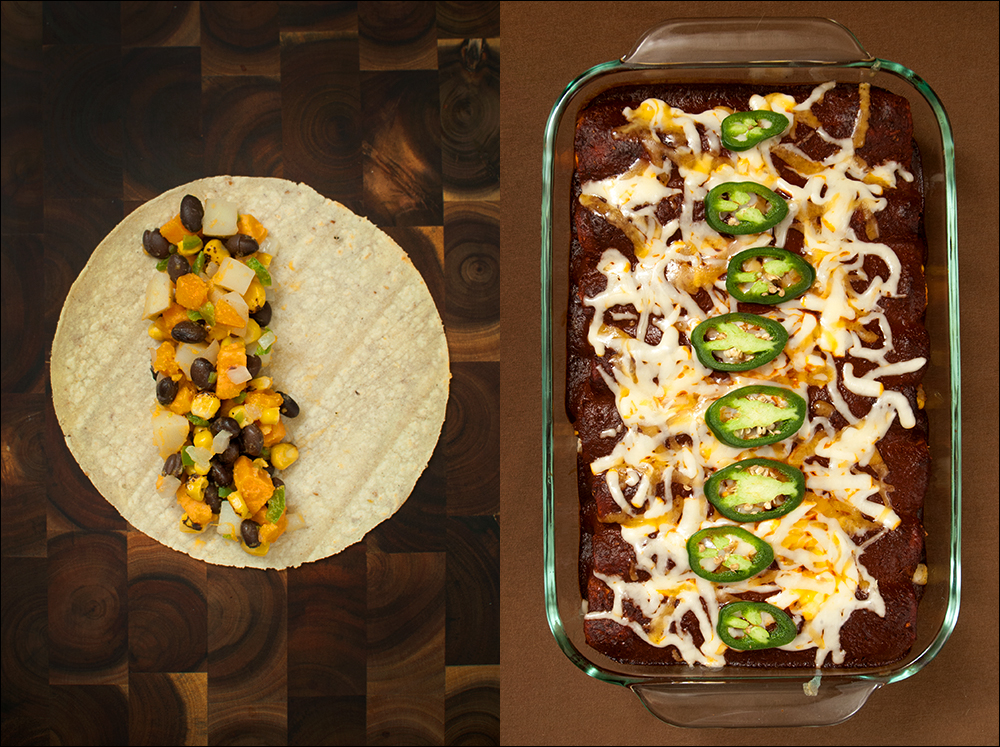
Enchiladas de la tierra.

Sweet potato, potato, back bean and roasted corn enchiladas. © Ryan Schierling
Once upon a time, I came across a taco joint in a northwestern town that served a veggie burrito which included sweet potato. It's a rare item to see featured as a vegetable in most Mexican restaurants, and I thought it was downright delightful. The filling for this enchilada recipe was born from that inspiration and my love for simple black bean and corn enchiladas. Nothing fried here, just a hearty mix of colorful goodness with a tasty homemade red chile enchilada sauce.

Can we just have a word here about red enchilada sauces? Somehow I got hung up on this topic at an early age. My mother was raised in Southern California and somewhere along the line developed some very strong opinions about a certain few ingredients. She always insisted that "Las Palmas" brand red enchilada sauce was the real deal – the gold standard in a can. A little label reading in later years proved her point. Most commercial red enchilada sauces are made with a pureed tomato base. Apparently, as far as Mom is concerned, authentic enchilada sauce is made with only red chiles, not tomatoes. As it can still be a little tricky to find the chile-only variety in the average supermarket, I completely understand her brand loyalty. There is definitely an important difference in both flavor and texture, and if you choose to go the canned-sauce route for these enchiladas, I implore you to do a little label reading of your own before making that purchase.

Homemade enchilada sauce is an easy thing to make if you have a good blender and can source the dried chiles. I like the flavor of the New Mexico or California chiles with the Pasilla chiles, as the combination has more of the "enchilada sauce" flavor profile I grew up with. The Arbol chiles give it a friendly touch of heat. However, you can substitute some of the dried chiles to suit your taste. Many traditional recipes recommend using a combination of  guajillo and ancho chiles – which happen to be two of my favorites in other contexts for their particular richness and depth of flavor.

Forgive me, but the proportion of filling to sauce between these recipes are not very well aligned. The enchilada sauce recipe will be just about right (maybe a tad bit extra) for a 7x11 pan of 8 enchiladas. The filling you will definitely find yourself with plenty extra. I suggest either making a double batch of enchilada sauce, or plan on using the extra filling for tacos or burritos in the next couple of days.


Wednesday, April 30, 2014

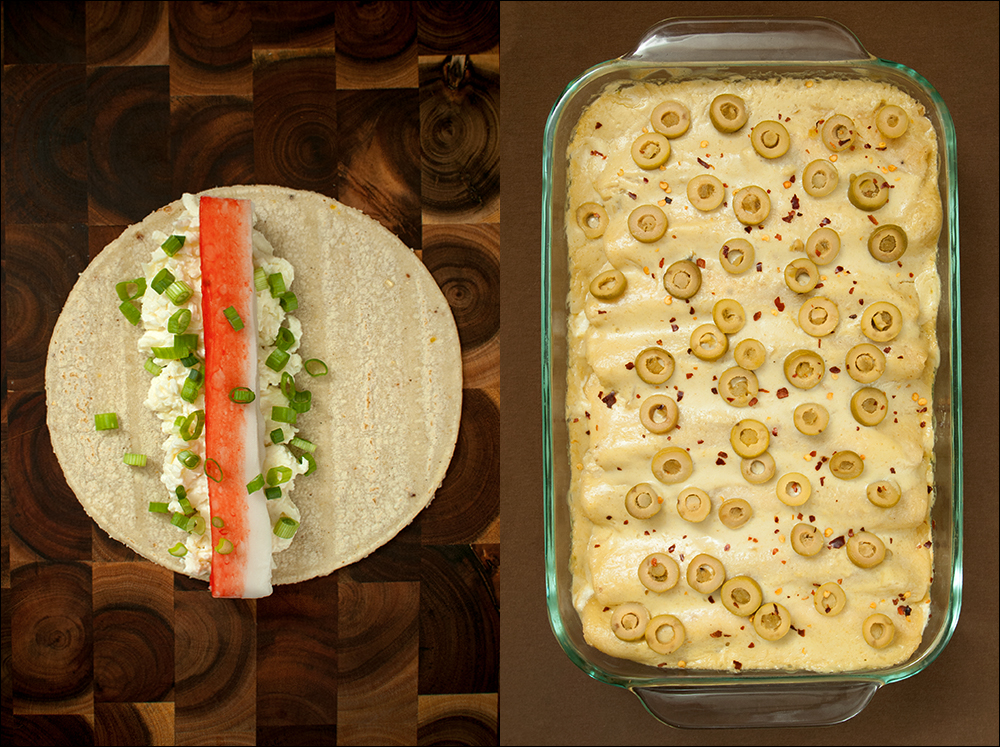
Krab enchiladas.

Krab enchiladas – do not attempt without proper supervision. © Ryan Schierling
I have a few favorite, revered dishes from when I was a kid. This one is kind of a geographical anomaly, as growing up in Kansas was as far away from any coastal waters containing crab could possibly be. Billboards advertised "Beef, it's what's for dinner!" (But if you want crustacean, it's probably going to be spelled with a "K.")

And so it was. Krab (aka Sea Legs or Ocean Sticks) – constructed primarily from Alaska pollock, egg white, crab flavoring and red food coloring – was what we got at the grocer in Emporia, Kansas. Mom made these enchiladas with flour tortillas, jack cheese and a white sauce. Think enchiladas suizas, middle-of-the-midwest-style. 

I don't make them exactly the way mom did. I've tried lump crab meat and cod, and both taste a little fancier than they should for this preparation. This is, in a sense, modern day depression-era cooking – trying to make something elaborate out of an amalgam. The cream cheese tempers the whole dish well, adding a perceived richness that the faux crab doesn't provide on its own. Kind of like pulling up to Red Lobster for senior prom in a limo that you really can't afford. 

So I did switch up the filling up a little and bossed-out the garnish, but had to stay true to the shockingly-red Krab sticks, which are a little like sweet, sweet crabby-flavored string cheese. Don't hate me for loving these. 

Tuesday, April 29, 2014

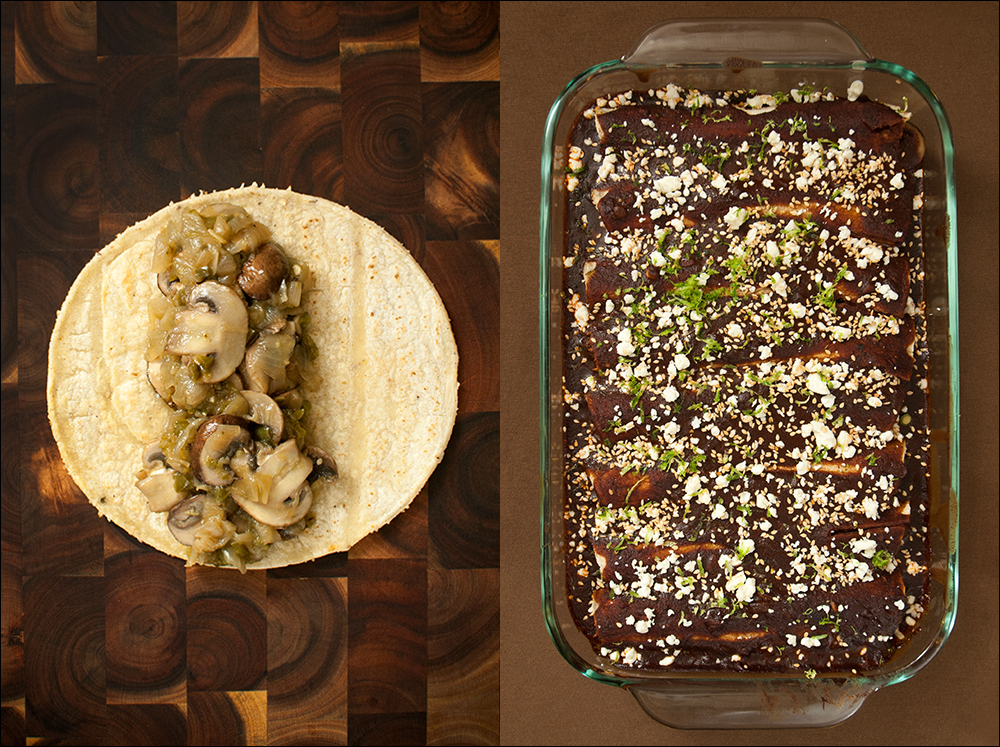
Mole mushroom melee.

Enchiladas with mushroom and caramelized onion. © Ryan Schierling
When most of us consider sautéed mushrooms and caramelized onions, we don't immediately think "Oh, Mexican food!" First inclinations might turn to a pizza topping, a side for steak and potatoes, or a stroganoff staple. 

Not around here.

One of our longtime-favorite enchiladas is this simple en mole recipe. The mushrooms lend a meaty texture and the sweetness of the gently-caramelized onions – with an added kick of heat from some chopped jalapeños – make for a very satisfying and well-balanced filling. A good mole sauce with all its chile pepper bravado, nutty complexity and hint of sweetness, is the perfect compliment. Mole sauce is usually served with chicken, and all too often that chicken is boiled, beaten and barren – dry as the desert. It is rare to find a meatless alternative that is savory enough to stand up to the richness of mole sauce, and this one works rather splendidly.

All this talk of mole – I don't want anyone thinking they have to either reach for a grocery store jar or make one of those 47-ingredient recipes that take three days to prepare. There is a happy medium, and it isn't the least bit difficult. Some version of this recipe has been floating about the inter-webs for years, and for enchiladas, it is perfect. Do be careful with the addition of nut butters, though. While peanut butter is likely in your pantry, and is perfectly acceptable to use, be cautious with the quantity, or it may taste a little too much like peanut sauce. Alternate nut butters such as almond or hazelnut impart a nice nutty flavor without being quite so distinctive. You can also play around with the use of seed butters such as sesame (tahini) or pepitas for a twist on the complexity the nut butters provide. If you're really, truly desperate, you can use those six-month-old Reese's Peanut Butter Cups from your Halloween candy stash. (I can neither confirm nor deny that this has been attempted in our household, by Ryan, on at least one occasion.)

Monday, April 28, 2014

Enchiladas del alma.

Chicken enchiladas with mustard greens and sweet potato mash. © Ryan Schierling
The problem with most enchiladas is that they’re unimaginative. Pick your protein, pick your sauce, cover with yellow cheese – casserole dish it up and stick it in the oven. We don’t even bother ordering enchiladas if we dine out, because most of these "pick two" formulas are terribly boring and a little pedestrian. 

What we’re doing here is offering you some other options. This version of “five days, five ways” is going to be four non-traditional enchiladas and one very traditional Tex-Mex enchilada that no one outside of Texas seems to know about but definitely should. There are no exotic elements or weird sauces, no strange fillings or garnishes, just really solid combinations that are tried and true. 

None of these are strict recipes in a controlled sense, where you take an exact amount of this and add a precise amount of that. These are just ingredients that have worked well enough together that we’ve added them to our regular rotation. We've made them so many times that they are now considered “family” preparations. 

This first recipe came out of Christmas dinner soul-food leftovers. We’d had an incredible roasted chicken, some tangy, cider vinegar-soused mustard greens and a light, fluffy sweet potato mash. The flavors mingled so perfectly together that we decided to roll it all up in a corn tortilla and give it a nice mild green sauce mixed with cream. We've since recreated that lovely Christmas dinner a number of times just to have leftovers for these enchiladas. As the filling was bits and pieces from a previous meal, there are no real quantities for a proper recipe, but I’ll walk you through it.

Wednesday, July 3, 2013

Slaw of wee little cabbages.

Brussels sprout slaw with grapefruit-fig vinaigrette. © Ryan Schierling
Where we have merely dedicated a five-day stretch to the subject, one could potentially spend a lifetime dedicated only to documenting variations of slaw. As much as we appreciate the cruciferous veg, we are not the people to make such an exploration of a specific side dish our exclusive focus. However, we would be remiss if we did not include a variation using Brussels sprouts for this "5 days 5 ways" celebration of slaw.

Brussels sprouts are oft referred to as "wee little cabbages" in our household. This is technically fitting as they are members of the same genetic family – from the Brassica genus, to be exact – and in excellent company with some other very delicious vegetables such as broccoli, cauliflower and, of course, cabbage. When it comes to sensitivity to the more bitter aspect of this family, Brussels sprouts are probably one of the trickier to develop a taste for, but the little bit of work it takes to complement that touch of bitter is well worth it. Where cooking serves to soften this bitterness, a raw salad requires an act of embracing and balancing it. 

Tuesday, July 2, 2013

Pretty in pink.

Sauerkraut slaw with red cabbage. © Ryan Schierling

Sauerkraut is, in American culture, a tough one when it comes to palatability. You either love it, or you hate it. 

I'm not ashamed to admit that my love for sauerkraut knows no bounds. I enjoy the sour taste and squeaky texture so much that I've been known to take a two-fingered pull out of the kraut jar and put that gigantic pinch between my cheek and gum, just to savor the juicy deliciousness. It's like the best cabbage chaw you can imagine. And those Frank's Sauerkraut singles? So portable. Okay, I might have a problem. 

But come on, what's not to like? Historically, sauerkraut goes back – way back – a few thousand years B.C. It's rich in vitamin C, high in fiber and low in calories. It was used to prevent scurvy. It's good for your eyeballs (uhm... taken internally, not as a topical ointment) and has been used as a treatment for stomach ulcers and canker sores. 

Whatever name you have for fermented cabbage – in all its glory – it is celebrated worldwide. The Dutch make mashed potatoes with it. The French, choucroute garnie. Russians use it in soup. Koreans have kimchi. Germans serve it with everything, from what I hear. There is always sauerkraut in our refrigerator. Always.

Monday, July 1, 2013

Ranch-style crudité slaw.

Broccoli, cauliflower and cabbage slaw. ©  Ryan Schierling
For the longest time I thought I hated cole slaw. As it turned out, I just didn't like that typical picnic-style slaw with creamy and weirdly-sweet dressing. You know, the omnipresent variety you find in tubs in the supermarket deli.

The first "cole slaw" that I remember liking made a big impression on me, so much so that I wasn't really sure if it even could be considered a slaw so much as a shredded cabbage salad. Granted that was some [blah-blah-blah-redacted] years ago. The strangest thing is that this entire episode was also a defining moment in my appreciation for ranch dressing. Weird and tangential on the surface, I know, but I will explain.

I grew up in a household where blue cheese and Roquefort were the default, everyday salad dressings of choice. I was never one of those kids who put ketchup on everything or wanted to dip anything deep-fried in ranch dressing. In fact, I didn't really find ranch of much interest except as a suitable dunk for raw broccoli and cauliflower on the crudité platter – until that one day when someone served me shredded cabbage "cole slaw" made with ranch dressing instead of the usual fare. Suddenly a variety I could get behind! It just made sense, really. While I may not gravitate to ranch dressings for my salads, there is something to be said for the way certain vegetables are complemented by the creamy, tangy, herb and garlic flavors at its essence. This is doubly true if you make your ranch-style dressing fresh and from scratch.

Sunday, June 30, 2013

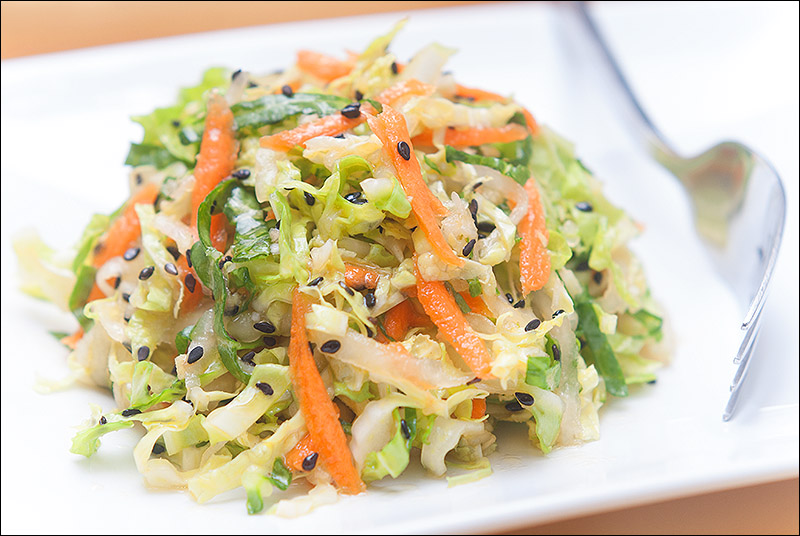
Chinese cabbage slaw with carrots and daikon.

Napa cabbage slaw with ginger garlic dressing. © Ryan Schierling
I didn't eat life-changing barbecue until we moved to Austin. That was four years ago, and that means I put a lot of passable, fair-to-middlin', sometimes downright horrible smoked meat in my craw prior to immigrating to the Great Republic of Texas. In those lean years of blasé barbecue, sides were sometimes a salvation and after so many years of side-dish subsistence, I came to love them more than the main event – the meat. 

Don't hate me, but in those years I really learned to appreciate the subtleties in a coleslaw or potato salad, and I started exploring... experimenting a bit. Napa cabbage is Chinese cabbage. It's not from Napa Valley. Who thought that one up? It's typically used in China, Japan and Korea, so that's how the flavors of this slaw came to be. It's a little tangy, a little sweet, with some nice ginger and garlic background and the toasted sesame oil rounds everything out with a big, rich hug. The carrots give a little bit of natural sweetness, and the daikon radish provides a very mild heat and more crunch.

If you've never worked with Napa cabbage, the outer leaves of the football-sized beast are a little thick, and a bit astringent, but if you peel enough back you'll get to the pale yellow-green, delicate insides. I use one or two of the outer leaves for their bright green color, and I don't mind the added bit of sharpness. The overall flavor is less pronounced than normal cabbage, and it's not nearly as heavy. It makes a very nice, light summer salad with grilled meat like bulgogi or flanken-style short ribs. 

Saturday, June 29, 2013

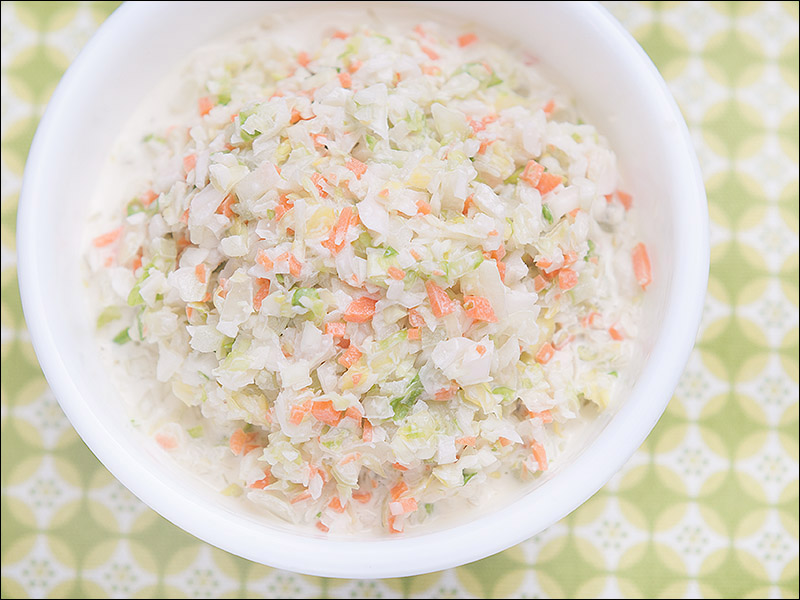
The doctor's new way of making coleslaw.


Garlic salad. © Ryan Schierling
We punish ourselves once a year or so, pushing out five posts in five days, all related to this or that. Last year it was cucumber salads. The year prior, potato salads and a good five days of grilling. 

This summer, we're all about the slaw, so we're going to give you five before the 4th of July. 

There is a gold standard for All-American picnic coleslaw, and it is Kentucky Fried Chicken. As much as I hate to say it, and as much as you might disagree, it is the truth. Name a chain restaurant that has more than 18,000 units and sells as much coleslaw as the Colonel. KFC itself calls it "The World's Best Coleslaw," says that it's "freshly prepared in store" and "sets the coleslaw standard by which all other coleslaws should be measured." My friend Gary worked at Kentucky Fried Chicken in the late 80s, and he tells me that while they made scratch biscuits back then, the chickens were disassembled and breaded on-site and the gravy was homemade – the only thing that was NOT freshly-prepared in store was the coleslaw. It came in bags. It still does, from what I hear. 

Big bags of chopped cabbage, carrots, and onions. The sauce – according to the corporate website – is a mix of sugar, soybean oil, vinegar, salt, eggs, corn starch, mustard flour, xanthan gum, the ever-popular natural and artificial flavor, paprika extractives, paprika, and caramel color. Sugar is the first ingredient, and the last time I sampled it (for research reasons, of course) it was so sweet it could have been some weird cabbage dessert.

I do appreciate it for the role it plays in KFC's menu, which is as a foil to the crunchy, salty chicken. I do have a soft spot for all coleslaw varietals, and I like that the KFC extremely-fine chop of the cabbage, carrot and onion isn't something you get with most coleslaws. If you've ever seen the term "mechanically-separated" on a chicken, pork or beef product, you can only imagine what a Robot Coupe the size of a grain silo with a few million cutting blades would do to truckloads of cabbages, carrots and onions. I'm speculating here, but only in a way that imagines there are no human hands actually involved in the preparation of this product. It's made by coleslaw robots.

I need a coleslaw robot…

Saturday, May 19, 2012

Cucumber salad #5.

Cukes and onions. © Ryan Schierling


We're just going to all agree to call this a "salad." Okay? It's a side, it's a snack, it's stupid simple, and if you don't have a family recipe that is virtually identical, then you should adopt this one at once.

Cucumbers seem to have a natural inclination to be pickled, and on day five of "cucumber salad week" here at FGHD, we're accommodating them. Plus, I get to finally admit that when served raw and plain I'm mostly ambivalent about cukes. They really do have a wonderful flavor, but naked and alone they have a twinge of bland and bitter. However, pair them with vinegar (or lemon juice) and salt they are transformed – voilà! – a thing of elementary elegance.

This post isn't for pickles, but it is a about as close as you can get in 30 minutes or less with a refreshingly pleasant, puckering cucumber slice to show for it. Use the cukes and onions on a salad, or plate a few slices as a side. Around here, though, we've usually managed to pluck all of them out of their icy bath as a crunchy snack before dinner is even served. 

Cucumbers and red onions on the rocks

1 cucumber, peeled in stripes and sliced 1/4" thick
1/2 red onion, sliced thin
1 teaspoon salt
10 ice cubes
1 cup cold water
1/2 cup white vinegar

Put cucumber and onions in a one quart bowl Add ice cubes, then water and white vinegar and salt. Give a quick stir and stick it in the fridge, or just let it sit on the counter, and chill for about 15-30 minutes.

Friday, May 18, 2012

Cucumber salad #4.

Cucumber bruschetta. © Ryan Schierling
When I was a younger man, inexperienced in the ways of life and love and the kitchen, I thought bruschetta was kind of an Italian salsa – a tomato, onion, basil and balsamic-based topping for toasted baguette rounds. I didn't know the garlic-rubbed toasted bread was actually the bruschetta, and it was my first experience with the glory that is balsamic vinegar. There wasn't Mario or Giada or Lidia or Mary Ann on teevee telling me what to do.

Proper terminology or not, I ham-fisted a lot of toasted bread topping with tomato and red onion, garlic and basil, balsamic vinegar and olive oil, and it bolstered my confidence in the kitchen (and in life and love).

That might be a lot to ask of a bruschetta, but I think it's handled it well over the last 20 years, because I've been making adaptations on it ever since. Julie came up with this recipe. We went back and forth a bit, tasting multiple versions and then agreed that I am the crusty, chunky, slightly acerbic, and she is the cool, crunchy sweetness.

Together, somehow, we are a delicate, fresh spoonful on grilled sourdough baguette. Bon appetit

Cucumber bruschetta

1 sourdough baguette, cut into 1/2" rounds, oiled and grilled until toasty
4 cucumbers, peeled, center seeds removed, diced
2 scallions, minced
6-8 large basil leaves, chiffonaded
12-15 red cherry tomatoes, cut in half
cracked black pepper
cucumber bruschetta dressing (below)

Mix cucumber, scallions, dressing and a pinch of salt together. Plate bruschetta, spoon cucumber mix on top. Put half a cherry tomato on top of each slice of bruschetta with cucumbers, top with the chiffonade of basil and freshly cracked pepper.

Cucumber bruschetta dressing

1/3 cup white wine vinegar
1/3 cup cup oil (we used equal parts vegetable and olive oil… it seems to emulsify better)
1 tablespoon honey
1/8 teaspoon ground white pepper
1 small pinch kosher salt
1/8 teaspoon dijon mustard

Mix vinegar, honey, pepper, salt and mustard together in a medium-sized bowl. Whisk in a steady stream of oil until emulsified. 

Thursday, May 17, 2012

Cucumber salad #3.

Cucumber salad... sandwich? © Ryan Schierling

This will be the only time you ever get a salad sandwich out of me. Mark my words.

I'll make tuna salad, egg salad or even a vegetarian deviled-ham salad (no, for really and seriously), but straight-up salad sandwich reminds me too much of a certain worldwide sub-sandwich chain's Veggie Delight, circa 1991. When you're a poor college student, sometimes the bread and vegetables is all you can afford. Extra lettuce, please!

But this is one of those light, refreshing summer meals that needs no meat. Nothing more than some warm, fresh flatbread, a liberal spackling of homemade hummus and a few spoonfuls of this horiatiki-inspired cucumber salad.

Fold it up like a taco, make sure you've got plenty of napkins, and tuck in.

Cucumber salad, Greek-style

2 cucumbers, peeled, center seeds removed, diced
2 medium tomatoes, cored and diced
1/2 of a small red onion, diced
1 small green bell pepper, seeded and diced
juice of 1 lemon
1 tablespoon fresh oregano, minced
4 ounces feta cheese, crumbled
12 pitted kalamata olives, halved
a pinch of kosher salt, to taste

In a medium-sized bowl, mix the cucumber, tomato, red onion and green pepper. Add a pinch of salt, the juice of 1 lemon and give everything a good toss. Add the oregano, olives, half the feta and mix it all up. When you're ready to serve, crumble the remaining feta on top of the salad.

Our hummus

1 19-ounce can cannellini beans, drained and rinsed
1 15-ounce can garbanzo beans, drained and rinsed
1 clove garlic
juice of 2 lemons
1 teaspoon ground cumin
1 tablespoon crushed red pepper flakes
3/4 cup olive oil
2 tablespoons tahini
a good pinch of kosher salt

Using a food processor, chop the garlic. Add the cannellini, garbanzo beans and lemon juice. Pulse until a very thick paste begins to form. Add the tahini, cumin, red pepper flakes and salt and continue to mix. While the hummus is pureeing, add a thin, steady stream of olive oil into the food processor until everything is nice and creamy. Let the food processor run for a couple of more minutes, then spoon hummus into a bowl and refrigerate until you're ready to eat.

Wednesday, May 16, 2012

Cucumber salad #2.

Cucumber and cantaloupe salad with hazelnuts and chevre. © Ryan Schierling
Fresh, earthy, crunchy, creamy. This one is our twist on cucumber-cantaloupe salad.

Don't call it a fruit salad because it will surely disappoint anyone expecting to satisfy a spirited sweet tooth. It gets a good grounding from the rich chèvre, the flavorful crunch of toasted filberts and the provocative hint of rosemary.

This one is easy to prep, but unfortunately it doesn't do well all mixed together in a serving bowl. Those lovely little bits of goat cheese just dissolve away into a creamy mess. Individual portions are prettier. No stirring, just a simple presentation of cucumber and melon with an unexpectedly serious garnish.

Cucumber salad with cantaloupe and chèvre

1 English cucumber, peeled
1/4 cantaloupe
1/4 cup white wine (such as pinot grigio), or the juice of 1 lemon
1/2 cup filbert (hazelnuts) pieces, lightly toasted
2 ounces chèvre
1 tablespoon fresh rosemary leaves, finely minced
Salt and fresh ground black pepper to taste.

Slice and the cucumber and cantaloupe into approximately 1/2" pieces. Gently fold the white wine and/or lemon juice with all the diced cucumber and cantaloupe in a bowl, then let it chill in the fridge for a bit.

When you're ready to serve, stir again lightly with a pinch of salt, then portion it out into smaller serving bowls. Give each a dusting of finely minced rosemary, then top with pieces of chèvre and hazelnuts. If you're feeling it, add a crack of black pepper, too.

Serves 3-4.
Related Posts Plugin for WordPress, Blogger...